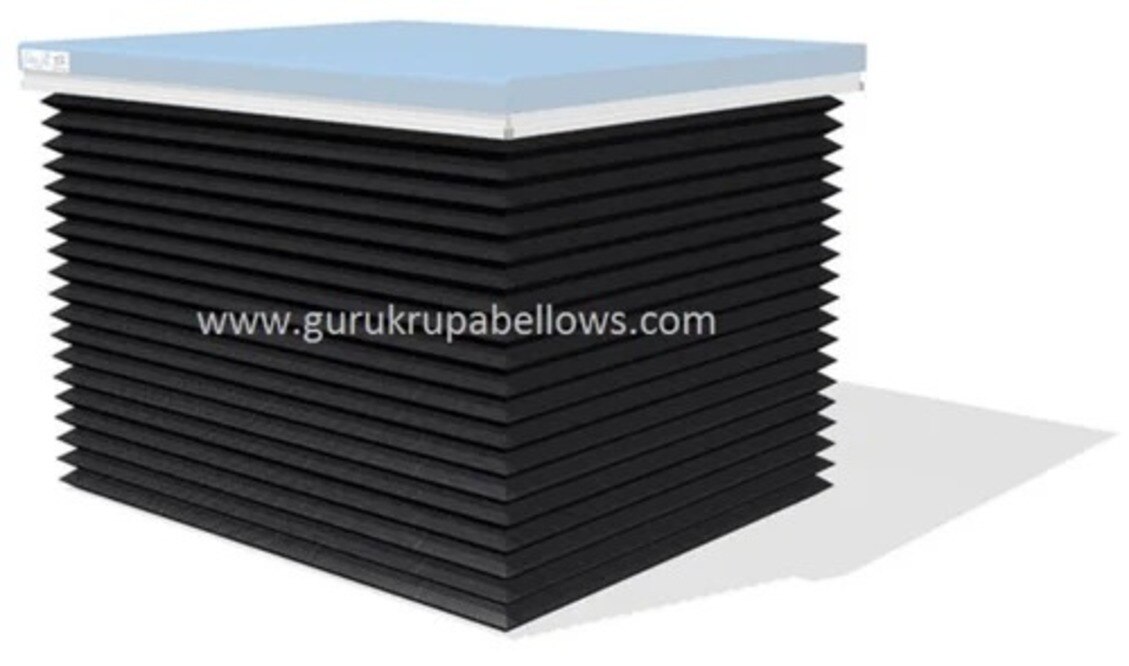
A scissor lift bellow cover earns its place when chips, coolant, dust, heat, weld spatter or repeated cleaning can damage an exposed actuator, screw, sensor, cable or pivot. By matching the cover to the machine’s motion, hazard and maintenance routine, you can identify whether your operation needs one, specify it correctly and reject a design that will interfere with the lift.
Key takeaways
- Protect exposed scissor mechanisms from chips, dust, sparks, heat, and corrosive fluids.
- Choose coated fabric, leather, elastomer, or heat-resistant construction for the actual hazard.
- Measure closed height, open height, width, depth, stroke, mounting space, and clearance.
- Specify cycle speed, temperature, folds, attachment method, and inspection access to the supplier.
Which industrial users have a real need for scissor lift bellows?
Machine-tool builders, automation integrators, maintenance teams, welding shops, material-handling equipment makers and factories operating their own lifts need a bellows cover when the scissor mechanism exposes parts that contamination or contact can damage.
| User | Main exposure | Components or evidence to inspect |
|---|---|---|
| Machine-tool builder | CNC chips, abrasive grinding dust, coolant and oil | Cylinders, lead screws, cables, sensors and pivot zones |
| Automation integrator | Process debris and incidental contact around an integrated lift | Actuators, chains, wiring and pinch-prone moving sections |
| Welding or fabrication shop | Hot spatter, metal dust and sparks | Hydraulic or electric actuators, pivots and nearby cables |
| Material-handling equipment maker | Outdoor dirt, moisture, impact from nearby loads and weather | Cylinders, chains, sensors and exposed scissor joints |
| Maintenance team | Unprotected moving parts found during a hazard inspection | Hydraulic or electric actuators, lead screws, chains, cables, sensors and pivots |
| End-user factory | Seal wear, sensor faults, cleaning downtime or premature replacement | The component linked to repeated contamination or washdown damage |
Do not choose a cover because the lift is large or has high capacity. Choose it when an exposed component meets a contaminant, contact risk or cleaning regime that it cannot tolerate.
Scissor lift bellow covers for factories therefore serve very different duties, from a coolant-filled CNC cell to a dusty warehouse lift. Match the fabric, coating, seams and mounting method to each process.
When do industrial lift bellow cover applications justify the added component?
Add the component when a moving part faces abrasive dust, chips, coolant, oil, moisture, outdoor weather, heat, weld spatter or frequent washdown. Those are the industrial lift bellow cover applications that justify added mass, mounting work and inspection.
1. Identify what needs protection: hydraulic or electric lift cylinders, screw mechanisms, lead screws, proximity sensors, chains, cables and pivot zones. The bellow must move as the pantograph opens and closes without rubbing or restricting travel.
2. Match the material to the actual exposure. Check the fluid, concentration and temperature; mineral-oil resistance does not prove compatibility with alkaline cleaners, synthetic coolant or cutting-fluid additives. Welding, forging and heat-treatment duties need heat-resistant fabric, silicone or aramid construction, sacrificial layers and stand-off distance. Ordinary PVC-coated fabric can harden, melt or puncture.
3. Define the protection limit before installation. A cover reduces direct contamination and incidental contact, but it is not automatically a load-bearing platform, personnel guard or defence against every chemical, flame, pressure washer or ultraviolet exposure.
4. Check the enclosed mechanism for airflow effects. Repeated compression can pump contaminated air through gaps, so sealed end connections, controlled venting or filtration may be necessary without defeating chip protection.
5. Treat scissor lift bellows for equipment as a process-specific choice, not a catalogue accessory. If the exposed part tolerates the contamination and cleaning regime, omit the cover; if contamination causes seal wear, sensor faults or downtime, specify one that survives the duty.
Which cover construction suits the lift’s motion and hazard?
Choose construction by combining the lift’s movement with the hazard, not by selecting the thickest available cover.
| Option | Best fit | Limitation |
|---|---|---|
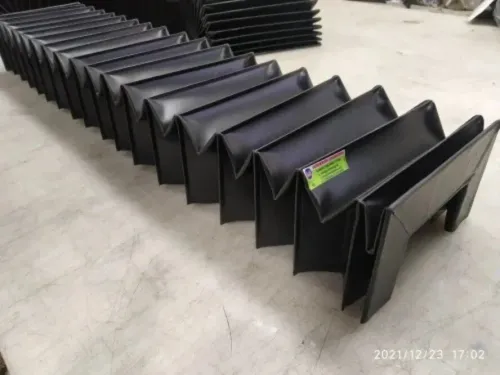
| Sewn or fabric bellows | Flexible, low-mass protection around an actuator with frequent extension and compression; material can match coolant, heat or spatter | Unsupported fabric can abrade or buckle in high-cycle service |
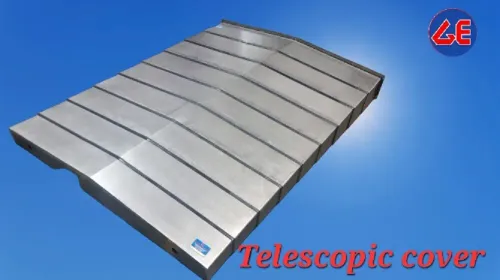
| Telescopic metal cover | Rigid chip deflection and high-temperature resistance | Requires sections and mounts that follow scissor geometry; folding space is larger |
| Round bellows | Cylindrical actuator or screw with practical radial movement and circular attachment | Does not suit broad, crossed-arm coverage |
| Guideway cover | A defined sliding surface | Not a substitute for a freely moving envelope around crossed arms |
Specify the motion profile for scissor lift bellows for equipment, including:
- Compression and extension direction
- Minimum and maximum length, stroke and fold pitch
- Minimum fold radius and lateral movement
- Lift speed, acceleration, stopping shock and cycles per shift
Horizontal or pocket-forming folds need drainage, correct fold orientation, wipers, overlap and clean-out access. Chips and coolant can add weight and prevent collapse. High-cycle lifts may need internal guides, anti-friction strips, wear-resistant fold surfaces or a support frame rather than thicker fabric alone.
Keep every fold clear of scissor arms, guides and the frame, with clearance preserved at full travel. A cover with sufficient stroke can still fail when its compressed pack interferes with the linkage.
What measurements prove that a scissor lift cover will fit?
A lift stroke alone cannot prove fit. Measure the cover envelope, mounting points and motion around the actuator before requesting a quotation.
- Record the fully compressed length, fully extended length and actuator stroke.
- Measure the actuator or cylinder outside diameter, surrounding width and surrounding depth.
- Document mounting-flange dimensions, bolt-hole pattern, mounting-face geometry and attachment orientation.
- Mark available clearance at the lowest and highest lift positions.
- Specify fold direction, required lateral movement and minimum bend radius.
- Locate nearby scissor arms, guides, frames, hot parts and moving cables.
- Supply photographs from several angles and a travel-and-clearance sketch showing both end positions.
- Add lift speed, acceleration, stopping shock and required cycles per shift.
Check the proposed cover through the complete operating cycle, not only while stationary. Look for pinch points, rubbing against scissor arms, twisting, overstretching, fold-to-fold abrasion and a compressed pack that strikes the frame. Confirm that the cover does not impose side loads on the actuator or stop the lift reaching either limit.
Inspect a trial installation at operating speed and during stopping. The cover remains a flexible protection component, so retain separate guarding for crush and shear hazards. If it forms part of the guard arrangement, evaluate access prevention against ISO 14120 and safety distances under ISO 13857.
How should you choose a supplier and maintain the cover?
Choose a scissor lift cover supplier by engineering evidence, not the phrase “industrial grade.” Ask for:
- Material construction, seam method, temperature range, compatible media, allowable speed and minimum bend radius.
- Intended protection function, test method, cycle rating or stated service life.
- Process temperature, coolant or chemical data, chip or spatter type, washdown pressure and frequency, orientation, cycles per shift, photographs, drawings and required replacement interval.
After installation, inspect for cracked or hardened coating, delamination, torn stitching or welded seams, broken support frames, loose mounting strips, fold-to-fold rubbing, trapped chips, coolant leakage and loss of full extension or compression.
Repair or replace the cover when it drags, twists or stops following the motion freely; an intact-looking surface can still impose damaging loads.
For scissor lift bellow covers for industrial users in Chhatrapati Sambhajinagar, compare the supplier on these purchasing factors:
| Supplier evidence | What to verify | Why it matters |
|---|---|---|
| Local measurement support | Site dimensions and travel-clearance checks | Prevents a fit that fails at full stroke |
| Dimensional inspection | Recorded dimensions against the approved drawing | Catches mounting and compression errors |
| Emergency replacement lead time | Written dispatch or delivery commitment | Limits downtime after damage |
| Reproduction capability | Approved drawing or sample can be remade | Preserves a proven fit |
GURUKRUPA BELLOWS PVT LTD belongs in that comparison only when its quotation answers these engineering questions rather than relying on a catalogue label.
Related products
 | Bellow Cover ₹5000 Product Details: Brand GURUKRUPA Color Black-Blue Size Customised With the support of our excellent team workers, we have been delivering the best... View product → |
 | Product Details: Brand GURUKRUPA Color Black-Blue Size Customised With support of our excellent team workers, we have been delivering the best... View product → |
Frequently asked questions
Which industrial users have a real need for scissor lift bellows?
Machine-tool builders, automation integrators, maintenance teams, welding shops, material-handling equipment makers, and factories operating lifts need them when the mechanism is exposed to damaging contamination or contact.
When do industrial lift bellow cover applications justify the added component?
The cover earns its place when chips, dust, welding sparks, hot particles, oil, coolant, corrosive chemicals, or operator contact threaten the lift mechanism, cables, hoses, guideways, or safety.
Which cover construction suits a scissor lift's motion and hazard?
Select the construction from the hazard and movement: coated fabric for general dust and debris, heat-resistant materials for welding exposure, and flexible abrasion-resistant designs for repeated extension and compression.
What measurements prove that a scissor lift cover will fit?
Provide the cover's closed and extended heights, width, depth, stroke, fold size, mounting dimensions, attachment points, operating speed, and the clearance available at every position.
How should you choose a scissor lift cover supplier and maintain the cover?
Choose a supplier that reviews drawings and motion data, confirms materials and attachment details, and provides a fit-tested design. Inspect folds, seams, mounts, and clearance regularly; remove accumulated debris and replace damaged sections.