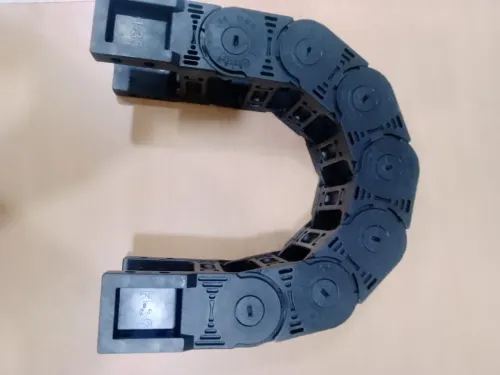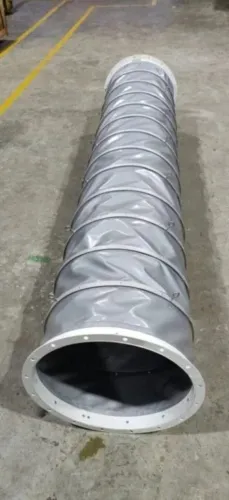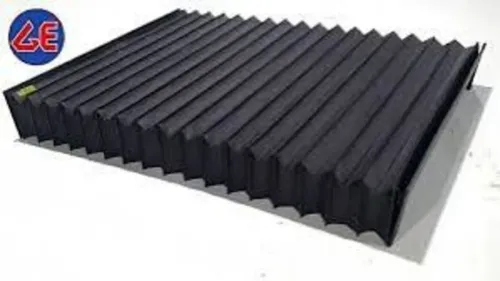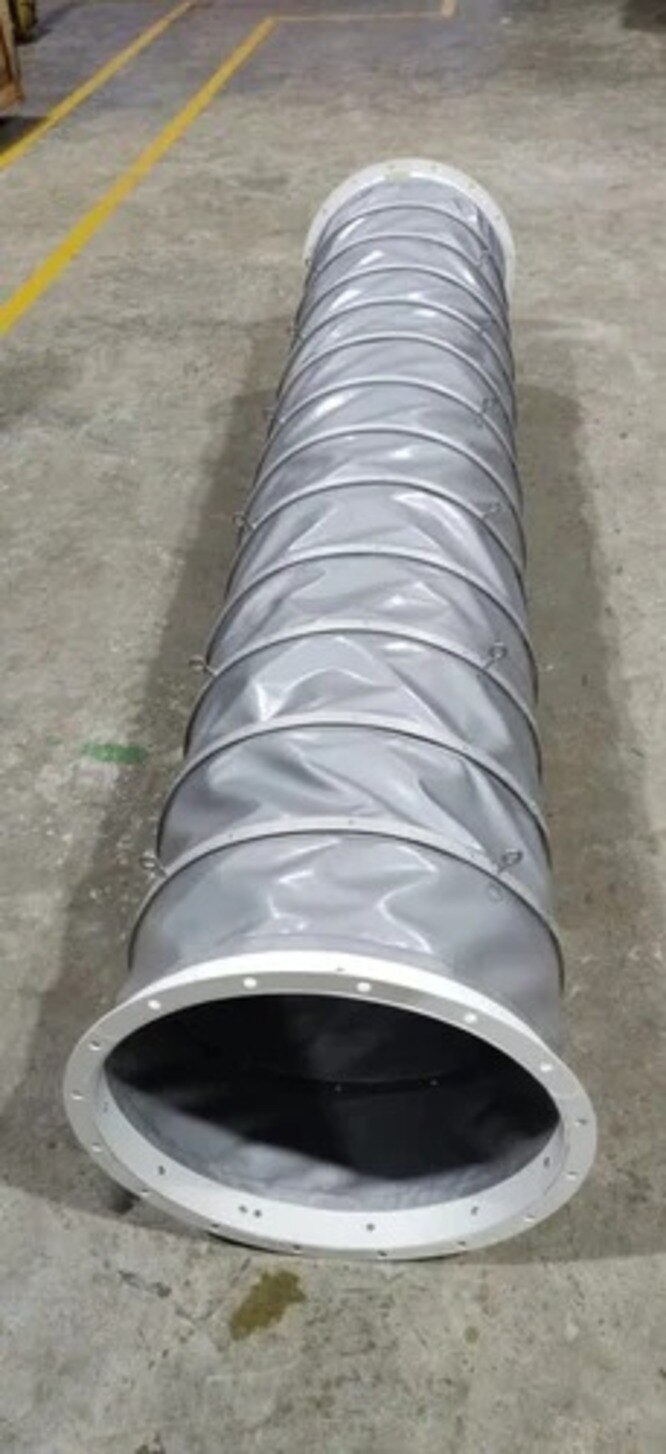
A fly ash loading point needs more than a flexible cover: it must contain fine powder, manage displaced air, tolerate abrasion, and remain aligned with a moving tanker or railcar. By the end, you will be able to map the loading system, specify the required dimensions and materials, and decide whether a bellow arrangement suits your plant’s duty.
Key takeaways
- Use a retractable spout to enclose fly ash transfer into the receiving vehicle.
- Measure outlet height, inlet position, travel, clearance and required loading rate.
- Specify abrasion-resistant, sealed materials suited to fine ash and site hazards.
- Require movement controls, wear inspection points and documented acceptance testing.
What a fly ash loading bellow actually does
A fly ash loading bellow is a retractable telescopic loading spout, not a machine-tool bellows cover. It creates an enclosed path between the plant’s fly ash discharge outlet and the receiving vehicle inlet, so powder falls inside the enclosure rather than dispersing through open air.
The upper end connects to the discharge flange or loading gate beneath a silo, hopper, or transfer line. A suspension frame, winch, or actuator lowers the bellow until its bottom cone seats at the vehicle inlet.
A clamp, flange, or sealing ring holds that connection during filling; the seal must tolerate movement and vibration without leaving a gap.
Fly ash bulk loading bellow covers for cement plants control dust in two ways. Their flexible or segmented sections contain the falling stream, while a vent or dust-return connection routes displaced air and fine particles to the plant’s dust collector.
If the bellow has torn fabric, open folds, worn telescoping sections, or a poorly seated cone, extraction cannot prevent leakage at the loading point.
Position and level controls complete the system. A contact or low-level sensor confirms correct seating, while a high-level signal or loading-time interlock stops the feeder before the vehicle overfills.
These controls protect the bellow from burial and reduce releases, but fly ash loading bellow covers remain one engineering control within the plant’s silica exposure assessment, housekeeping, and respiratory-protection program.
Match the bellow to the loading point and measure the fit
A loading-only bulk loading spot bellow connects a silo outlet to a tanker, truck, or rail-car inlet and is sized for downward product flow, dust return, and controlled retraction. An unloading bellow must suit reverse flow, tanker pressure or vacuum, and the receiving silo connection.
Specify both directions only when the manufacturer confirms the same assembly, seals, dust path, and controls for each duty.
1. Draw the material path. Mark the silo or tanker connection, discharge cone, dust-return duct, clamp or flange, and the lowest vehicle inlet. A machine-tool bellows or flexible expansion joint is not a substitute for a telescopic loading spout.
2. Measure the fixed connection diameter, flange outside diameter, bolt-hole pattern, bolt-hole diameter, gasket face, and available clearance. Record the inlet dimensions on every vehicle type.
3. Measure the vertical distance from the mounting flange to the vehicle inlet at maximum and minimum positions. Add the required stroke, retracted height, lateral offset, truck-position variation, and clearance around the folds.
4. Record loading rate, product temperature at the point, expected cycles per hour or day, retraction speed, and whether the lower end may touch the vehicle. Ask for a cycle test matching this duty; a static temperature rating does not predict wear life.
Cement plant bellow covers fit the loading point only when the suspension stays aligned through the full stroke and the seals remain closed during positioning, filling, retraction, and a misaligned vehicle condition. A supplier drawing should show every measured dimension, connection, stroke, and operating direction.
Specify materials for fine, abrasive and potentially hazardous ash
Do not specify a bellow from the words “fly ash” alone. Obtain the actual safety data sheet and test the blend for particle-size distribution, moisture, crystalline silica, abrasiveness and residual carbon. Fuel, combustion conditions and contamination can change both wear and dust hazards.
| Component | Material direction | Temperature and moisture requirement |
|---|---|---|
| Product-contact cone or liner | Stainless steel 304 or 316, or a documented abrasion-resistant liner | Rate it for the measured continuous and peak ash temperature; specify corrosion resistance if chlorides or damp ash are present |
| Flexible external bellow | Coated polyester for moderate service; aramid, fiberglass or PTFE-coated fabric for higher heat | State continuous and peak temperatures, UV exposure, washdown and condensation; reject fabric that softens, cracks or absorbs moisture |
| Lower skirt and contact zones | Replaceable polyurethane, rubber or textile wear sleeve selected by abrasion testing | Match the sleeve to particle size, loading velocity, misalignment and contact frequency; thicker fabric alone will not protect the fold |
Fine powder escapes through stitching, gaps and worn telescoping sections. Specify dust-tight seams, sealed joints, accessible inspection points and a defined leakage or emission limit for the fly ash equipment bellows and fly ash loading bellow covers.
Treat combustible-dust risk as a separate engineering question. A competent assessment should consider the complete loading arrangement and, where indicated, test Kst, Pmax, minimum ignition energy and minimum explosible concentration. “Anti-static” or “flame-retardant” fabric does not replace bonding, grounding or explosion protection.
Design for movement, controls, wear and acceptance testing
An idle cover proves almost nothing. Cycle the loading spout through its full travel at operating speed, including vehicle misalignment and complete retraction; folds that seal when stationary can open when stretched, twisted, or dragged across the inlet.
Run the acceptance test through these conditions:
- Vehicle positioning and spout seating
- Initial filling, normal filling, and spout retraction
- High-level or overfill signal
- A controlled blocked-outlet simulation
Record dust at each stage, not just at the loading point. Check for visible plumes around the cone, flange, folds, dust-return connection, and tanker inlet; also use the plant’s dust-monitoring method where respirable crystalline silica is present.
In the United States, compare exposure results with OSHA’s 50 micrograms per cubic metre, 8-hour PEL and 25 micrograms per cubic metre action level.
The control scheme must stop the feeder if a low-level or contact sensor shows that the spout is not seated. Add a high-level signal, loading-time interlock, and independent high-high shutdown; these prevent burial of the cone but do not replace dust extraction.
After repeated cycles, inspect product-contact surfaces, abrasion zones, stitching, seals, suspension parts, and the dust-return path. Test the emergency stop and document how long it takes to replace a worn section. These checks separate durable cement plant bellow covers from fly ash equipment bellows that only look suitable.
Turn the findings into a practical purchase decision
Put the purchase order around the loading point, not around a catalogue name. State whether the equipment loads tankers, railcars, silos, or handles unloading, and give the measured retracted and extended lengths, inlet and outlet diameters, flange or clamp pattern, travel, bend limits, vent connection, and available extraction airflow.
Require the supplier specification to include:
- Product-contact material, cleanability, chemical compatibility, continuous temperature, short-duration upset temperature, and resistance to fly ash abrasion.
- External-cover material, UV and weather resistance, dust-tight stitching, seal design, flex-cycle rating, and replacement-part details.
- A defined leakage limit or emission criterion, with the test method, loading rate, extraction pressure, and acceptance result.
- Suspension, winch or actuator capacity, position switches, emergency stop, telescoping guidance, and proof that the cover cannot drag on the tanker inlet.
- Grounding and bonding points, hazardous-area assumptions, and confirmation that anti-static fabric is not being presented as a complete explosion-protection system.
- Inspection intervals, wear limits, commissioning records, and operator instructions.
A quotation from GURUKRUPA BELLOWS PVT LTD becomes useful when it answers those application questions rather than only naming a size.
Choose fly ash bulk loading bellow covers for cement plants when fine powder must stay enclosed through repeated loading or unloading and the bellow connects to both the transfer outlet and dust-return system. Choose a bulk loading spot bellow only when its travel, seals, temperature rating, and extraction arrangement match the measured point.
Do not use it as a substitute for silica exposure assessment, housekeeping, or a dust-collection system.
Related products
 | Fly Ash Bulk Loading Spot Bellow Fly Ash Bulk Loading Spot Bellow ₹10000 Product Details: Minimum Order Quantity 01 Number Brand GURUKRUPA Size ANY We manufacture a wide range of Fly Ash Bulk Loading Spot Bellow in various... View product → |
 | Cement Plant Bulk Loading Unloading Bellows Cement Plant Bulk Loading Unloading Bellows ₹5000 Product Details: Brand GURUKRUPA Size ANY Having rich experience and thorough understanding of the market operations, we are engaged in manufacturing... View product → |
Frequently asked questions
What does a fly ash loading bellow do?
It forms an enclosed, retractable path between the fly ash discharge outlet and the receiving vehicle inlet, reducing open-air powder release.
How do you measure a fly ash loading bellow for a cement plant?
Record the outlet and vehicle inlet dimensions, vertical and lateral travel, parking variation, clearance, loading rate and connection geometry.
What materials should fly ash loading bellow covers use?
Specify sealed, abrasion-resistant construction that suits fine ash, expected movement, temperature, moisture and any identified fire or health hazards.
What should you test before accepting a bulk loading spout?
Test full extension and retraction, alignment, sealing, controls, loading performance, dust containment and access to wear-prone parts.