Fine fly ash can enter truck inlets, valves, sensors, actuators and nearby transfer equipment while also abrading the flexible cover intended to contain it. By the end, you will know how the bellow controls dust, which equipment it protects, what operating data to specify, and how to inspect it before a small wear point becomes a loading failure.
Key takeaways
- Seal both the discharge spout and tanker inlet to contain fly ash at transfer.
- Specify fabric, temperature, abrasion resistance and travel length before ordering.
- Measure flange, opening, compressed length and extended length from the installed assembly.
- Inspect seams, clamps and flexible sections before dust escapes or movement jams.
How the bellow contains fly ash at the loading point
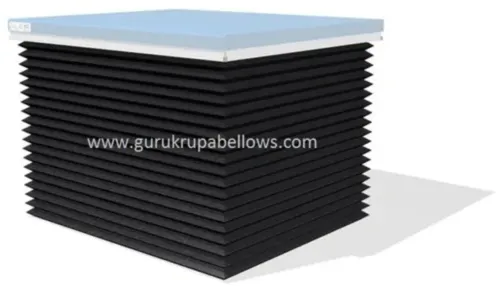
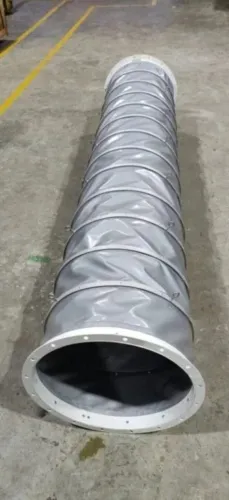
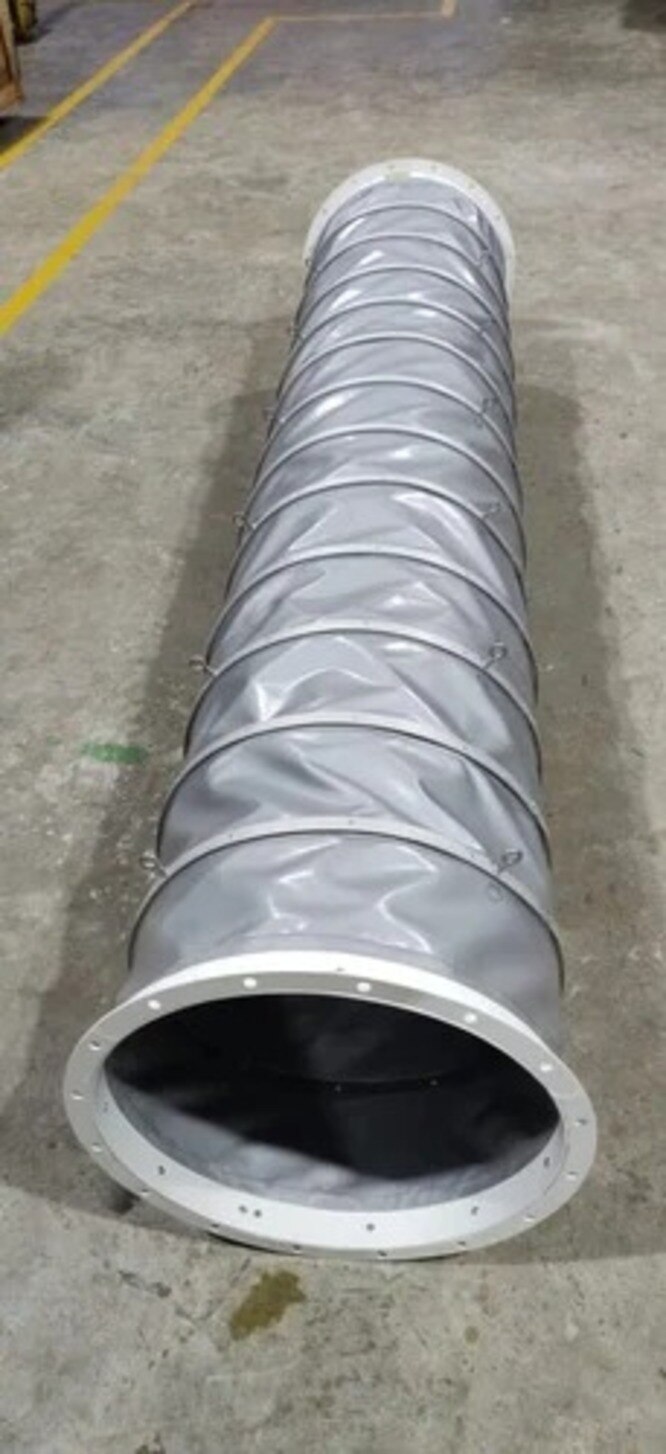
A fly ash bulk loading spot bellow encloses the gap between a silo, hopper or loading spout and the tanker inlet. Its upper inlet clamps to the discharge assembly, while the lower outlet seals around the truck connection or follows it through telescopic travel, preventing ash from escaping at the transfer point.
Flexible folds accommodate height changes without opening the enclosure. Clamps hold the fabric to flanges or collars; a vent outlet connects to a filter or dust-collection line so displaced air leaves through a defined path instead of carrying powder through gaps.
The bellow alone cannot control dust. A blocked filter, undersized vent or absent air path creates pressure inside the cover. Excessive positive pressure then pushes fine ash through seams, clamps and open interfaces. Slight, controlled negative pressure draws leakage inward and keeps particles inside the enclosure.
This protection reduces contamination of:
- The truck inlet and loading connection
- The chute, valves and seals
- Weigh equipment, actuators and sensors
- Nearby transfer frames and surrounding hardware
Fly ash is abrasive, so the folds, clamps and lower outlet remain wear points even when the enclosure works correctly. Moisture adds another risk: caked ash can restrict folds and obstruct the vent.
Properly designed bellow covers for fly ash loading therefore need accessible folds, no horizontal pockets and a vent connection that operators can inspect and clean.
Which transfer components the cover protects—and how movement causes damage
A truck that shifts 50 mm during loading can pull a fixed cover sideways, open a dust gap, or tear its mounting seam. A fly ash bulk loading spot bellow is a flexible enclosure around that moving transfer point; it is not the loading device itself.
| Component | What it does | What the bellow protects |
|---|---|---|
| Spot bellow | Encloses a short point-of-transfer gap | Loading spout, clamps, seals, actuators and sensors |
| Loading spout | Directs ash into the truck inlet | The bellow shields its exterior from abrasive dust |
| Telescopic chute | Extends and retracts to follow fill height | The cover protects telescopic sections and joints |
| Dust-collection connection | Removes displaced air through a vent or filter | It is an air path, not a material-delivery cover |
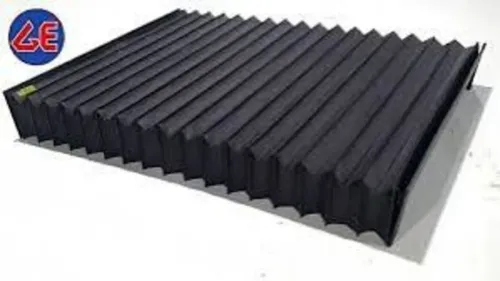
| Machine-guideway bellow | Covers sliding machine ways | It is unrelated to truck loading and should not be specified here |
The outlet transition takes the highest wear because ash changes direction, falls onto the fabric, rubs the truck inlet and collects in folds. Add a replaceable wear skirt, sacrificial liner or short rigid transition there instead of replacing the entire cover.
Support the bellow from its own frame. Do not let it carry a hose, chute or valve; that load side-loads the mounting rings and tears seams. Truck movement, vibration, misalignment and changing fill height require guided suspension, a counterweight or telescopic travel.
Twisting, overextension, tight folds and open gaps then become visible causes of fabric cracking, seam failure and dust escape.
How to choose fabric and operating limits for fly ash service
Choose the cover from measured service conditions, not fabric thickness. A thick fabric fails quickly if its coating cracks during folding or its geometry creates a tight bend radius.
Use this specification checklist for bellow covers for fly ash loading:
- Ash entering temperature, ambient humidity, outdoor UV, monsoon exposure and wash-down practice
- Abrasion severity, flex-fatigue cycles, chemical exposure and required seam reinforcement
- Moisture content, caking tendency, horizontal pockets, drainage and vent-filter access
- Facility SDS or ash analysis, particle data, unburned-carbon content and any respirable crystalline-silica concern
- Dust-hazard assessment before selecting electrical or explosion-protection measures
| Construction | Benefit | Selection point |
|---|---|---|
| Flexible coated woven fabric | Folds without cracking | Prefer flexible coating and open fold geometry over thickness alone |
| Conductive or static-dissipative fabric | Controls charge accumulation | Use only with bonding and grounding for the spout, truck, chute and metalwork |
| Abrasion liner or rigid transition | Takes concentrated outlet wear | Add it where ash strikes the lower outlet or clamps |
Require the supplier to state operating temperature, pressure or suction limits, compressed and extended lengths, permissible travel, bend radius, travel speed and cycle life. Confirm continuity across flexible sections after fabric replacement.
Wet ash can cake inside folds, restrict travel and block the vent path. Avoid horizontal pockets, keep wash-down water out of folds and dust connections, and provide cleaning access without dismantling the cover.
What to measure and specify before ordering a replacement or new cover
Measure the installed envelope, not the old fabric alone. A replacement that matches the nominal diameter can still fail if its folds, travel or mounting pattern is wrong.
1. Record the inlet diameter, outlet diameter, flange thickness, bolt-circle diameter or mounting-hole pattern, and clamp type. Photograph the lower outlet, folded sections, support frame and every nearby obstruction.
2. Measure the collapsed length and extended length between fixed mounting points. Note the travel direction—vertical, horizontal or angled—and the clearance available at full travel, including truck access, chute movement and adjacent valves or sensors.
3. State the duty in writing: positive-pressure conveying, negative-pressure extraction, gravity loading or external contamination protection only. Include conveying pressure or suction if known, because an enclosure designed for extraction is not automatically suitable for pressure service.
4. Require confirmation that the bellow is not a structural tie and will carry no hose, chute or valve load. The design must accommodate truck-height variation, nozzle misalignment and repeated loading cycles without fabric twisting, side-loading or overextension.
For fly ash bulk loading bellow covers in Coimbatore, give GURUKRUPA BELLOWS PVT LTD these measurements alongside outdoor UV exposure, monsoon humidity, wash-down practice and incoming ash temperature. Ask the supplier to show how the proposed folds, drainage, seams and mounting supports address those conditions rather than accepting a generic “any size” specification.
Related products
 | Fly Ash Bulk Loading Spot Bellow Fly Ash Bulk Loading Spot Bellow ₹10000 Product Details: Minimum Order Quantity 01 Number Brand GURUKRUPA Size ANY We manufacture a wide range of Fly Ash Bulk Loading Spot Bellow in various... View product → |
 | Cement Plant Bulk Loading Unloading Bellows Cement Plant Bulk Loading Unloading Bellows ₹5000 Product Details: Brand GURUKRUPA Size ANY Having rich experience and thorough understanding of the market operations, we are engaged in manufacturing... View product → |
How inspection and maintenance prevent a dusty loading failure
1. Set the inspection interval by loading cycles or tonnes handled, then add a calendar check. Inspect high-throughput points daily or every shift; inspect lower-use equipment before each loading campaign and monthly. Abrasive service can create a pinhole long before the next scheduled date.
2. With the bellow extended and isolated, inspect pinholes, cracked coating, frayed seams, flattened or distorted folds, outlet wear, loose clamps and material buildup around the outlet. Check blocked vent filters too: restricted air discharge raises pressure and drives ash through seams, gaps and weak folds.
3. Test grounding jumpers for damage and record electrical continuity before and after fabric replacement. A replacement cover can interrupt the grounding path if bonding hardware is omitted, painted over or clamped onto a nonconductive surface.
Replace the complete cover when abrasion has reached seams, folds or the main body. Protect it earlier with a replaceable wear skirt or sacrificial liner at the outlet; use a short rigid transition where falling ash or truck contact repeatedly attacks one short section. These parts turn a full-cover replacement into a local repair.
Remove caked ash with a soft brush, industrial vacuum or low-pressure air directed into approved collection equipment. Do not hammer folds, use sharp tools or force wash-down water into folds, seams, vent filters or the dust-collection path; moisture can form a plug that restricts travel and airflow.
Store spare fabric dry, shaded from UV, loosely supported without compression, and away from oil, chemicals and standing water. These checks help operators of industrial bellow covers in Coimbatore find abrasion before ash reaches seals, actuators, sensors or the surrounding work area.
Frequently asked questions
How does a fly ash bulk loading spot bellow contain dust?
It encloses the gap between the silo, hopper or loading spout and tanker inlet, with clamped ends that maintain a seal during transfer.
Which equipment does a bellow cover protect during fly ash loading?
It protects the loading spout, tanker connection, nearby guide components, clamps and flexible transfer parts from abrasive ash and dust contamination.
How do you choose fabric for fly ash bellow covers?
Match the fabric to ash abrasion, operating temperature, flex cycles, static-control needs and exposure to moisture or chemicals.
What must you measure before ordering a replacement bellow?
Record flange dimensions, connection diameter, compressed and extended lengths, travel direction, mounting details and available clearance.