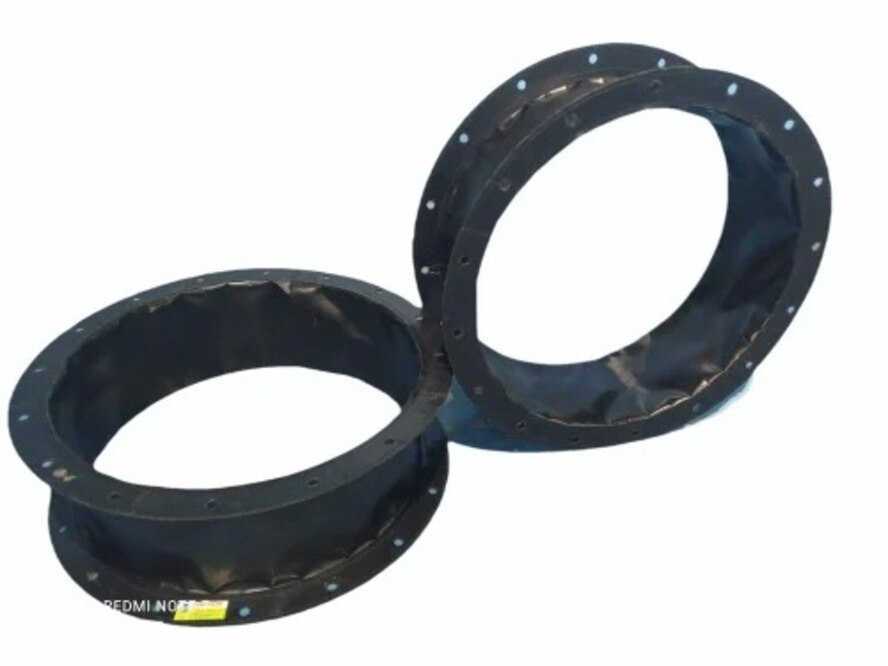
A fabric expansion joint must accommodate the movement, pressure, temperature and media of the equipment it connects; a machine-tool bellows cover follows a different design logic. By the end, you will know which type you need, what dimensions and operating data to provide, and how to evaluate a supplier’s design before installation.
Key takeaways
- Measure axial movement, lateral offset, vibration, and installation gap before ordering.
- Do not substitute fabric joints for machine bellows or metal telescopic covers.
- Specify temperature, pressure, process media, liner, insulation, and reinforcement materials.
- Accept the cover only after checking dimensions, bolt holes, materials, and movement clearance.
What a fabric expansion joint does—and which equipment needs it
A fabric expansion joint protects a duct, exhaust line, or process connection by flexing between connected sections as they expand, shift, or vibrate. It absorbs axial movement, lateral offset, thermal growth, and equipment vibration, reducing loads transferred to fan casings, flanges, refractory linings, and connected machinery.
The flexible connection also limits leakage of hot air, dust, fumes, or process gases.
| Equipment or connection | Movement and exposure | Correct application |
|---|---|---|
| Hot-air duct or furnace exhaust | Thermal expansion, vibration, hot gas, dust | Fabric expansion joint with suitable liner and insulation |
| Fan or blower connection | Startup movement, vibration, pressure fluctuation | Fabric connector rated for the pressure and movement |
| Dust-extraction duct | Abrasive particles and repeated flexing | Fabric joint with wear-resistant inner or outer construction |
| Process piping or gas line | Thermal growth, lateral offset, chemical media | Fabric joint only after media, pressure, temperature, and cycle data are checked |
| Machine guideway or slide | Linear travel, chips, coolant, lubricant | Machine-tool bellows, not a duct expansion joint |
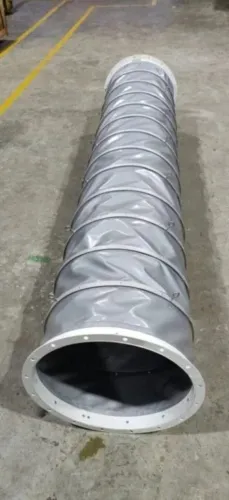
Fabric expansion joint bellow covers are usually laminates, not single fabrics. A woven reinforcement may combine with a coated film, insulation pillow, inner liner, outer wear layer, clamping strip, or formed corner. The seam and coating affect leakage and chemical resistance.
Fabric expansion joint bellows must state pressure class separately from temperature rating. A splash-protection cover is not automatically safe for positive pressure, vacuum, fan-startup loads, or furnace exhaust; specify the nominal opening, face-to-face length, movement, media, temperature, and cycle count.
Fabric expansion joints, machine bellows and metal covers are not interchangeable
Choose by the load and movement: fabric expansion bellows suit ducting, piping and exhaust connections, while machine bellows and metal covers suit moving guideways and machine components.
| Option | What it protects | When it applies |
|---|---|---|
| Flexible fabric expansion joint | Ducts, fans, blowers, furnace exhaust, dust extraction and process piping | Axial movement, lateral offset, vibration and thermal expansion; specify pressure or vacuum separately from temperature |
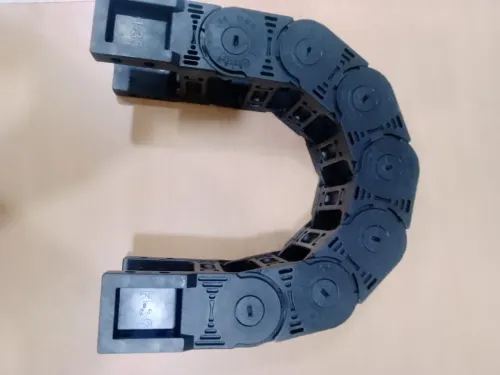
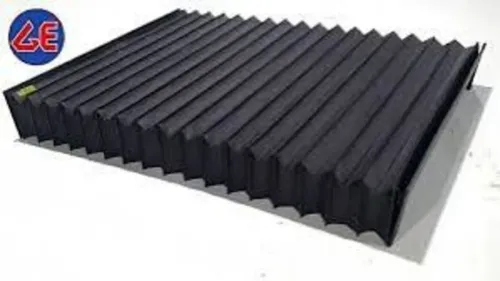
| Machine-tool bellows | Guideways, slides, screws and linear machine components | Repeated travel with chips, coolant, dust and lubricant; select by stroke, cycle rate and compressed height |
| Telescopic steel cover | Guideways and slides exposed to impact or heavy chips | Use when rigid protection must carry abrasion and impact loads |
| Metallic expansion joint | High-temperature piping and exhaust systems | Use when pressure, temperature, cycles or media exceed the fabric assembly’s design limits |
| Rubber bellows | Low-to-moderate temperature piping, pumps and flexible connections | Use when chemical compatibility, pressure and movement match the elastomer |
A duct connector is not a machine guard. A fabric joint may need an inner liner, insulation pillow, retaining hardware and movement controls; a splash-only machine cover can collapse under fan-startup pressure or fail under vacuum. Nominal pipe size alone cannot define the joint.
For a machine cover, keep the surrounding fixed guard and attachment frame responsible for impact and access control. Assess the complete enclosure under ISO 12100, and use ISO 14120 when the cover forms part of a machinery guarding system.
Specify heat, humidity, dust, coolant, oil, wash-down chemicals and outdoor UV exposure rather than writing “suitable for Coimbatore.”
Dimensions and movement data to measure before ordering
Do not order from nominal pipe size or maximum stroke alone. A replacement or custom cover needs the installed geometry, the full travel profile and the loads that occur during operation.
1. Identify the application: duct, fan, blower, exhaust line or process pipe; or machine way, slide, screw or guide. Fabric expansion joint bellows need pressure and thermal movement data, while fabric expansion bellow covers for machine tools need travel, speed and chip or coolant exposure.
2. Record the opening dimensions: nominal opening, internal diameter, external diameter, joint height, width and face-to-face length. Measure both ends, because unequal flanges or offsets will distort a replacement.
3. Photograph and measure each connection. Provide flange dimensions, bolt-hole count, hole diameter, pitch-circle or centre spacing, flange thickness, clamping-strip location and the required sealing surface.
4. State movement in every direction: axial compression and extension, lateral offset, angular rotation and torsional movement. Give closed length, extended length, available folded height, minimum fold radius and the permitted compression ratio.
5. Supply the actual motion profile: travel per cycle, movement speed, acceleration, cycle count per shift and total design cycles. A cover that survives the stroke can still fail when rapid acceleration pulls its folds against a guide.
6. Add operating limits: positive pressure, vacuum, fan-startup load, temperature at the fabric, humidity, dust, oil, coolant, wash-down chemicals and outdoor UV exposure. Separate pressure class from temperature rating.
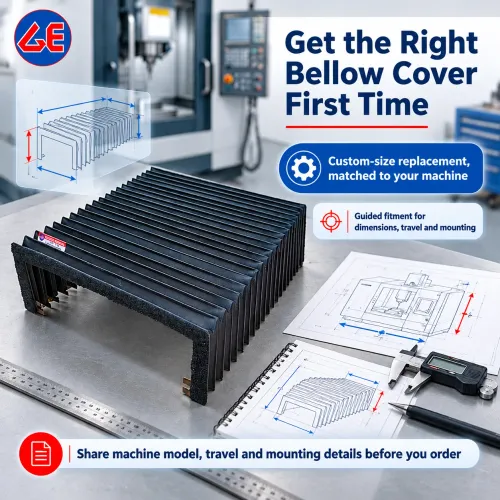
Send a dimensioned sketch and photographs of the installed cover; a supplier can then check clearance, support and movement-control hardware before fabrication.
Temperature, pressure, media and construction: what the specification must prove
A proposed assembly is credible only when its rating matches measured service data, not nominal pipe size. Record the conditions the fabric expansion joint bellows will face:
- Maximum and continuous temperature, including startup, shutdown and radiant heat
- Positive pressure, vacuum level and fan or blower pressure spikes
- Gas, dust, oil, coolant, solvent and cleaning-agent contact
- Axial movement, lateral offset, vibration, flexing frequency and required cycles
- Abrasive particle size, impact direction and wash-down method
Require the supplier to state the complete laminate, not just “high-temperature fabric.” The rating must identify exposure duration, flexing condition, contact medium, seam construction and fastening method. A fabric that survives brief dry-air heat can fail quickly when flexed continuously in hot coolant or oil mist.
Pressure is a separate design question. A splash-protection fabric expansion bellow cover is not automatically suitable for positive pressure, vacuum or blower startup loads. For duct and exhaust service, check whether the assembly includes an inner liner, insulation pillow, retaining hardware and movement-control arrangement.
Construction details often decide leakage and chemical life: woven reinforcement, polymer coating or film, insulation layer, wear layer, clamping strip and formed corners. Ask for material compatibility evidence and a pressure-and-cycle test using representative media and movement.
Do not treat EJMA guidance as a complete textile-bellows standard; confirm that its provisions apply to the proposed laminate and joint assembly. A compact machine cover for ways or slides needs separate proof against chips, coolant, travel and cycle rate.
How to evaluate a supplier and accept the cover in Coimbatore
Accept industrial expansion bellow covers in Coimbatore against a written specification, not the supplier’s phrase “suitable for local conditions.” State the equipment, movement profile, pressure class, temperature range, media and cleaning method before comparing quotations.
- Require a drawing showing face-to-face length, opening dimensions, folded height, flange or clamp details, bolt-hole pattern, seam construction and permitted axial and lateral movement. Add travel speed, acceleration, cycle count and minimum bend radius.
- Record the actual environment: humidity, dust, coolant, oil, chips, wash-down chemicals and outdoor UV exposure. Specify the inner liner, insulation pillow, retaining hardware and movement-control arrangement when the joint serves a fan, duct, exhaust line or pressurised system.
- Ask the supplier for material compatibility evidence, pressure and temperature limits, dimensional inspection results and a sample made with the proposed seams. Suppliers such as GURUKRUPA BELLOWS PVT LTD should be able to discuss the difference between a duct connector and a machine-way cover before quoting.
- During installation, check orientation, clearance at full extension and compression, clamp seating, flange alignment and freedom from rubbing. Inspect corners, folded ends and seams; these fail before an undamaged flat panel.
Run an endurance test using the machine’s real travel profile, coolant or cleaning fluid, chip load, temperature and cycle rate. Stop at the specified cycle count and inspect for pinholes, delamination, cracked coatings, loose fasteners, seam separation and leakage; record photographs, dimensions and any change in folded height.
A duct joint also needs a pressure or vacuum leak check separate from its temperature rating.
Related products
 | Fabric Expantion Bellow ₹1000 Make in Heavy duty Fabric’s View product → |
 | Bellow Cover We are considered a well-known name in the business that manufactures and supplies Bellow Cover. View product → |
Frequently asked questions
What equipment needs a fabric expansion joint?
Ducts, exhaust lines, fans, process connections, and equipment exposed to thermal growth, vibration, or alignment movement need fabric expansion joints.
How do fabric expansion joints differ from machine bellows and metal covers?
Fabric expansion joints suit duct and process connections, while machine bellows protect moving guideways and metal covers handle applications requiring rigid metallic construction.
What measurements are needed before ordering a fabric expansion joint cover?
Record the opening dimensions, face-to-face length, axial movement, lateral offset, angular movement, vibration, bolt-hole pattern, and available installation clearance.
What must a fabric expansion joint specification include?
Specify operating and peak temperature, pressure or vacuum, process media, flow conditions, liner, insulation, reinforcement, outer cover, and fastening details.
How do you inspect a fabric expansion joint in Coimbatore?
Check the delivered dimensions, bolt-hole alignment, fabric layers, seams, liner, reinforcement, fasteners, surface condition, and movement clearance before installation.
Related product
 | Product Details: Brand Gurukrupa Material Nylon Fabric coated with polyurethane Max Temp Resistance 1000 C Offered in the market at the most... View product → |