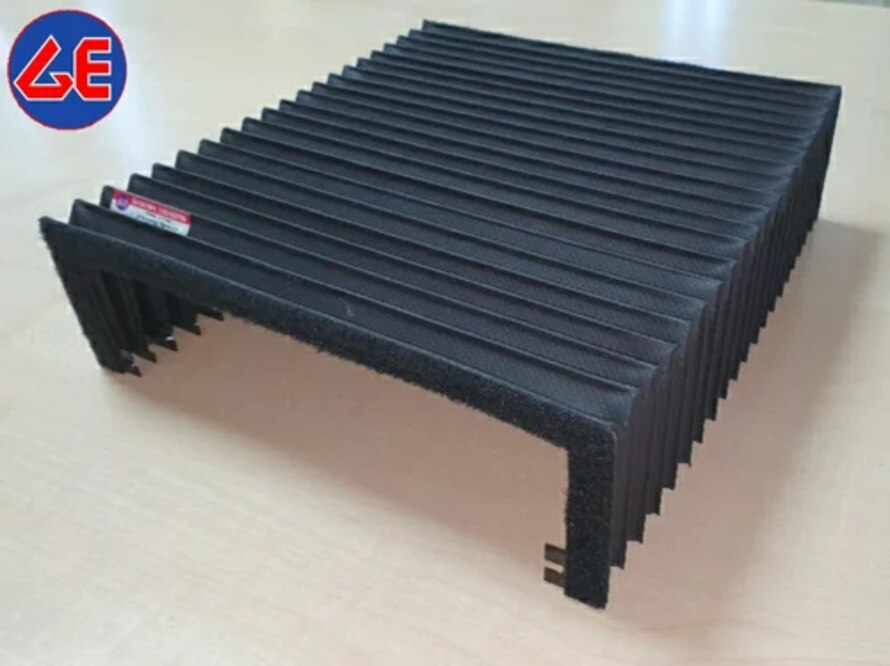
Chips, coolant, abrasive dust and heat can reach a guideway or ball screw while the machine is moving, where ordinary cleaning cannot prevent wear between cycles. You will be able to identify the components that need coverage, specify dimensions and materials, and test whether a selected cover protects the assembly without creating new interference or maintenance problems.
Key takeaways
- Measure compressed length, extended length, width, height and mounting faces.
- Match fabric, coating and temperature range to chips, coolant, dust or heat.
- Use wipers, overlapping folds and sealed mounts to limit contamination paths.
- Test full machine travel, fold compression, rubbing, coolant exposure and chip impact.
How folded bellows protect moving machine parts during travel
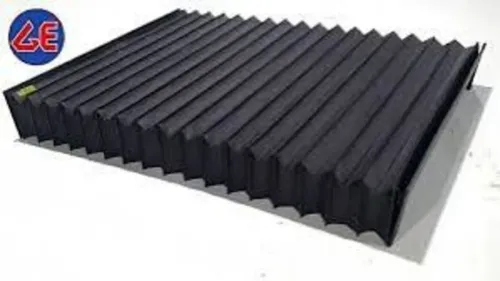
A protective bellow cover shields a moving guideway by turning its length into accordion-like folds. One end mounts to the stationary machine frame, while the other attaches to the travelling slide.
As the slide moves, the folds open on the exposed side and compress into a compact stack on the return stroke, keeping the guideway covered throughout its movement.
Each fold adds or releases a measured section of material, so the cover follows the machine’s stroke instead of dragging across the protected surface. Fold pitch, compressed length and maximum extension determine whether it can close fully without bunching, overstretching or leaving a gap.
A cover that reaches the required travel can still fail if its folded stack collides with the machine.
The material forms a flexible barrier against chips, swarf, abrasive dust and coolant splash. It reduces contamination-related wear, but it does not replace lubrication, way wipers or cleaning. Sharp chips can cut a light fabric cover, while a heavy chip-resistant design can add moving mass and require more clearance.
Mounting and guidance matter during travel. A horizontal cover can sag onto the guideway; a vertical cover can hang and rub as it retracts. Long covers may need guide shoes, support strips or rollers to keep folds aligned.
Do not treat the bellow as a cable carrier unless it has been engineered for cable bend radius, strain relief and routing. A bellow also is not automatically a personnel safety guard.
Which machine components need bellows and how should you measure them?
A guideway, ball screw, hydraulic or pneumatic cylinder, slide, lifting mechanism, or exposed moving assembly needs a bellow when chips, swarf, abrasive dust, coolant, or lubricant loss could damage its working surfaces. Bellows limit contamination; they do not replace wipers, lubrication, cleaning, or a safety guard that prevents access to a dangerous mechanism.
Give the supplier these measurements and operating details:
- Protected length from the fixed end to the furthest moving point
- Required stroke, maximum extension, and available compressed length
- Cover width, height, folded height, and the machine’s clearance envelope
- Mounting-point locations, flange dimensions, hole pattern, and fastening method
- Travel direction, speed, acceleration, and cycle frequency
- Horizontal, vertical, or inverted installation
- Allowable compression, bend radius, lateral movement, and angular movement
- Chips, coolant, dust, heat, cleaning chemicals, and expected impact
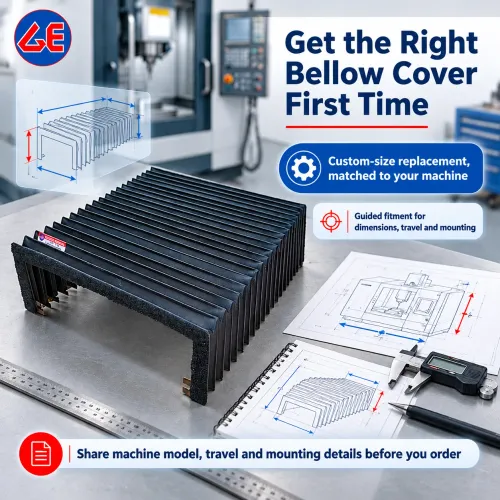
- Photographs or a dimensioned sketch showing obstructions and adjacent components
| Component | Measure | Why it matters |
|---|---|---|
| Linear guideway or slide | Rail length, carriage stroke, rail spacing, and exposed height | Prevents folds from rubbing the rail or carriage |
| Ball screw | Screw length, nut travel, diameter, and surrounding clearance | Sets the cover envelope without restricting the nut |
| Cylinder or lifting mechanism | Rod extension, retracted length, diameter, and mounting axis | Prevents binding at full retraction |
| Wide or long assembly | Unsupported span, guide locations, and folded stack height | Identifies the need for guide shoes, rollers, or support strips |
Measure both fully extended and fully compressed positions. A cover that matches the stroke can still fail if its folded stack collides with the machine, sags onto a guideway, or leaves no clearance for mounting.
How shape, mounting and enclosure design control contamination
A cover that reaches full travel can still leave the guideway exposed if its folds collapse into the wrong space. Match the folded height, fold pitch and cover width to the machine’s clearances, then allow for lateral or angular movement.
The compressed stack must not strike the housing, and the extended cover must overlap the opening throughout the stroke.
Use geometry that suits the contamination path:
- Deep, stable folds for long travel, provided the stack has room to compress.
- Reinforced corners and sufficient fold depth where chips could bridge or puncture a fold.
- A tapered or stepped profile when adjacent machine surfaces change height.
- A supported design for wide or vertical covers, where weight can cause sag and fold collapse.
Mounting determines whether those dimensions remain effective. Bolt the cover to rigid, aligned frames or flanges rather than flexible sheet edges. Add guide shoes, rollers or support strips to long horizontal covers; without support, the bellows can sag onto a rail and create rubbing marks.
Keep fasteners outside the moving fold area, and seal mounting seams so coolant cannot enter behind the cover.
An enclosure should overlap the protected opening on every side, with no corner gap at maximum extension or compression. Use overlapping panels or labyrinth-style joints where straight seams could admit chips. Industrial bellow covers reduce contamination reaching ways and screws, but they do not replace wipers, drainage, lubrication or inspection.
Choosing materials and alternatives for chips, coolant, dust and heat
Match the cover to the contaminant that causes the damage, not to the machine’s brand or location. Fine grinding dust needs tightly constructed, abrasion-resistant coated fabric with protected seams; sharp swarf needs heavy chip-resistant construction, sacrificial slats or a chip deflector.
| Option | Cover or protection method | When it applies |
|---|---|---|
| Fine abrasive dust | Close-folding coated fabric with sealed seams | Grinding, graphite or cast-iron dust can work into folds and abrade the fabric |
| Sharp aluminium or steel chips | Heavy chip-resistant bellows with external slats or a deflector | Cutting produces punctures, cuts and repeated impact |
| Coolant and tramp oil | Coating, thread and adhesive confirmed compatible with the coolant and cleaning chemicals; add drainage | Splash, pooling or oily residue reaches the cover |
| Radiant heat or hot chips | Heat-rated assembled cover with a heat shield or metal protection | Thermal cycling or hot swarf can damage fabric, coating and seams |
A light dust cover is the wrong choice where sharp chips strike it. A heavy chip-resistant design lasts longer but adds folded height and moving mass, so check that it does not overload the travel mechanism.
Temperature ratings must cover the assembled bellows, including fabric, coating, thread, adhesive, frame and supports; request the test temperature and exposure conditions.
A bellow is not automatically a cable carrier. Route power and data cables separately with their specified dynamic bend radius, strain relief and coolant protection. Whether sourcing protective bellows in coimbatore or elsewhere, retain way wipers, lubrication and cleaning: the cover reduces contamination-related wear but cannot replace them.
How to specify, test and maintain a cover before approving it
Approve a cover only after the supplier proves fit, endurance and contamination control on your machine. A drawing is not enough: compare protected length, maximum extension, compressed stack, mounting dimensions, available height and width, fold pitch, allowable compression, and lateral or angular movement.
A buyer comparing protective bellow covers for benefits in coimbatore should request these figures in writing.
| Evidence | Approval signal | Reject if |
|---|---|---|
| Dimensional drawing | Open and closed positions clear every collision point | Compressed folds hit the guideway or machine |
| Cycle test | Real speed, acceleration, coolant, chips and cleaning method used | Supplier provides only a static demonstration |
| Thermal data | Assembled-cover rating includes fabric, coating, thread, adhesive and frame | Only a fabric temperature limit is stated |
| Safety assessment | Separate guarding covers access and stopping hazards | The bellows alone is treated as a personnel guard |
Ask GURUKRUPA BELLOWS PVT LTD for the test conditions and inspection results, not only a catalogue size. After installation, record the baseline extension and listen for changes during full travel.
Inspect the cover at scheduled intervals for:
- Pinholes, cuts, delamination, brittle coating or exposed reinforcement
- Distorted folds, rubbing marks, abnormal noise or incomplete extension
- Loose fasteners, opened seams and blocked drainage
- Chips or coolant reaching the guideway despite normal movement
Replace or repair a cover when damage creates a contamination path; continued travel does not prove continued protection. Keep way lubrication, wipers and cleaning in the maintenance plan.
Related products
 | Bellow Cover ₹1000 We are offering an excellent quality of Protective Bellows for all type Guideways. This design covers three sides of the rail. View product → |
 | Bellow Cover ₹5000 Product Details: Brand GURUKRUPA Color Black-Blue Size Customised With the support of our excellent team workers, we have been delivering the best... View product → |
Frequently asked questions
How do folded bellows protect moving machine parts during travel?
A bellow connects the stationary frame to the travelling slide and expands or compresses with machine travel. Its folded fabric or elastomeric sections cover the guideway while allowing movement.
Which machine components need bellow covers, and how should you measure them?
Use covers on exposed guideways, linear rails, lead screws, ball screws, telescoping slides and other moving assemblies. Measure maximum travel, compressed length, extended length, opening width and height, mounting-face dimensions, fold height and nearby clearance.
How do shape, mounting and enclosure design control contamination?
Select the fold direction and cover profile around the machine’s travel path. Seal or overlap mounting frames, prevent sagging, maintain clearance from moving parts and add wipers or scrapers where chips and coolant could enter.
How do you specify, test and maintain a protective bellow cover?
State travel, operating speed, fold geometry, material, temperature, coolant exposure, mounting method and expected debris. Test the cover through full travel, then inspect folds, seams, mounts, rubbing, hardening, tears and contamination at scheduled intervals.
Related products
 | Round Bellow Covers ₹1000 To match with our reputation in the market, we are here to present an unparalleled assortment of Round Bellow Covers. View product → |
 | Soft Material Bellow Product Details: Brand GURUKRUPA Specifications:- Function of accordion machine shield: water-proof,oil-proof, anti-corrosion, fire-proof... View product → |