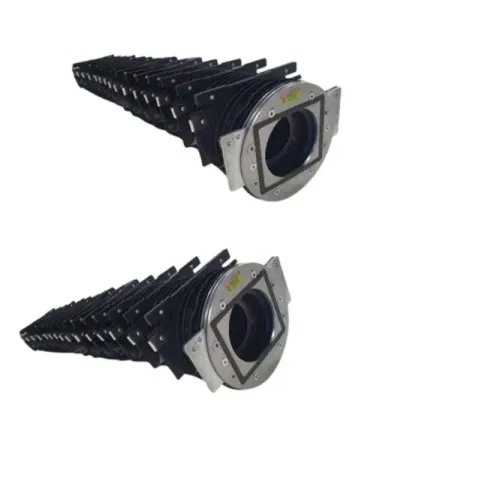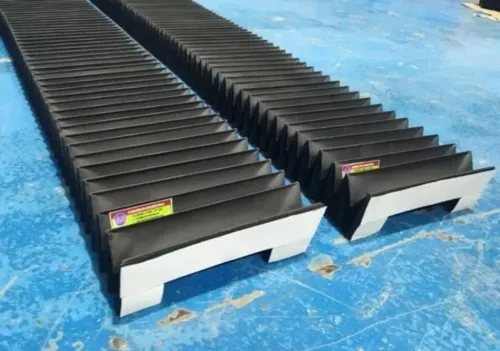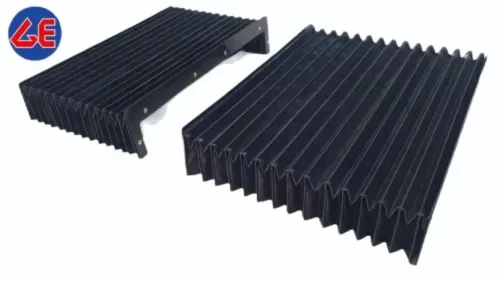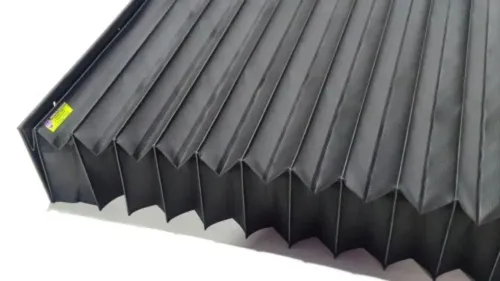

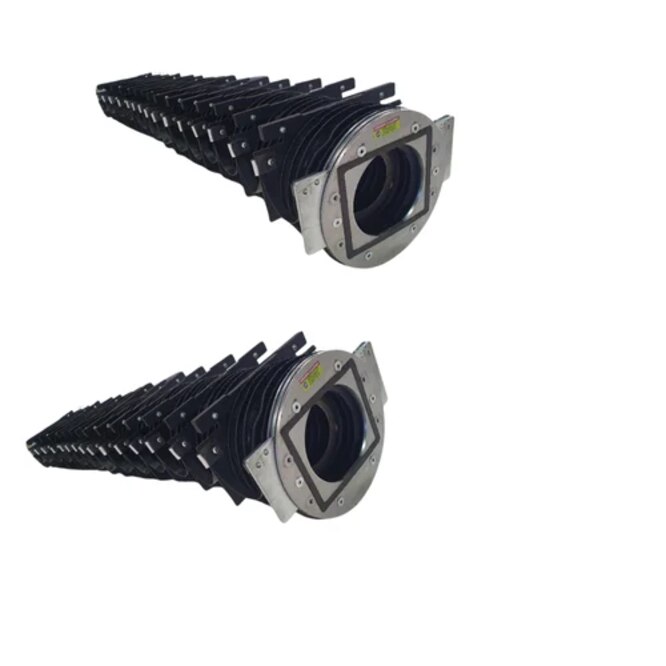
A Trumpf laser bellow cover is a machine-specific protection assembly, not a generic accordion boot: its dimensions, fold geometry, materials, frames, and test method must match the axis it protects. By the end, you will know what information to measure, how manufacturers build the cover, which material and fold choices affect performance, and what evidence to request before approving a replacement.
Key takeaways
- Measure axis travel, speed, acceleration, clearances, and mounting points before ordering.
- Match fold geometry and materials to heat, sparks, debris, and axis motion.
- Test assembled bellows for travel, compression, extension, seams, and mounting accuracy.
- Specify the exact TRUMPF model, protected axis, dimensions, and operating conditions.
What information must be measured before manufacturing begins?
A reliable production drawing starts with the exact TRUMPF machine model and protected axis, not an overall length. Record whether travel is horizontal, vertical, or compound, plus operating speed and acceleration, because a cover that works on a horizontal axis can sag or bind on a vertical one.
1. Photograph both end fittings while installed, then mark fixed reference points on the machine and cover. Record the open length and fully compressed length; usable stroke equals open length minus closed length. Measure cover width, fold height, fold count, fold pitch, flange thickness, hole centres, mounting-hole pattern, flange orientation, and end-frame shape.
2. Measure guideway clearance and laser-head clearance throughout travel. Trace cable and hose routing, then record the minimum bend radius. Note every location where folds rub, sag, twist, strike a bracket, or approach the carriage. These observations reveal interference that a static measurement misses.
3. Send the measurements, photographs, machine model, axis details, operating conditions, and failed-cover construction to the supplier. The drawing must show extension, compression, mounting geometry, clearances, fold geometry, and routing—not merely an outside envelope.
How Trumpf laser bellow covers are made depends on these machine-specific dimensions. A photograph cannot establish fold pitch, compressed height, hole alignment, flange orientation, or bend radius, while an overall length cannot show how the cover behaves through its full stroke. Confirm the drawing before material cutting or frame fabrication begins.
How are the cover, folds, seams and end frames manufactured?
Production begins only after the approved drawing fixes fold count and pitch, open and closed lengths, compressed-fold height, mounting geometry, minimum fold radius, and guideway clearance. Trumpf laser bellow covers manufacturing then follows this sequence:
1. Cut the selected coated fabric and reinforcement panels to the drawing. Mark fold centres, seam allowances, panel orientation, and reinforcement locations before forming perforated or combination folds.
2. Form each fold to the specified pitch and packing density. Check the compressed height and minimum radius so the cover reaches full extension without collapsing into or colliding with the guideway.
3. Join panels by sewing, thermal welding, bonding, or a specified combination. Inspect stitch tension, bond continuity, weld temperature, and sealed edges; excessive heat can embrittle fabric or leave an unbonded seam.
4. Attach sewn or welded end frames, then fit clamped or bonded flanges. Drill mounting holes from the approved pattern, not from an old cover whose holes may already be distorted.
5. Add internal baffles, support frames, stainless-steel slats, or wear strips when sagging, hot particles, or abrasion threatens the folds. Keep every fastener and internal part outside the travel path.
A dimensionally equivalent replacement is not a redesign. Changed brackets, cable routing, axis stroke, or end-frame orientation can make an apparently identical cover bind. Before installation, reject uneven folds, exposed reinforcement, stitch pull-out, pinholes, distorted flanges, overheated welds, and protruding fasteners.
Which materials and fold designs suit a laser machine environment?
Material selection starts with the heat and contamination reaching the cover, not the laser’s rated power. Laser power is not fabric temperature: distance, shielding, beam path, radiant exposure, hot particles, and airflow determine what the cover experiences.
| Material or component | Main advantage | Main trade-off |
|---|---|---|
| Coated polyester or technical fabric | Flexible, light, efficient packing | Abrasive dust can wear the coating and fibres |
| Aramid-reinforced fabric | Better tear strength and elevated-temperature resistance | Higher cost and reduced flexibility |
| Silicone-coated fabric | Heat resistance and release properties | Requires verification against abrasion, oils, and repeated flexing |
| Polyurethane- or PVC-coated fabric | Good general protection and flexible folding | Coating can embrittle, abrade, or delaminate under heat |
| PTFE-based specialist laminate | Strong chemical and heat performance | Higher cost and more difficult fabrication |
| Flame-retardant laminate | Reduces flame-spread risk | A flame rating does not prove spark, spatter, or flex-life suitability |
| Stainless-steel slats or components | Resists hot-particle impact | Adds weight, cost, stiffness, and drive load |
| Wear strips | Protect folds at rubbing points | Adds bulk and cannot correct poor alignment |
A headline temperature rating is not enough. Request a compatibility chart stating continuous and short-duration temperature limits, radiant-heat exposure, flame test method, spark or spatter exposure, coolant and oil compatibility, ultraviolet exposure, dust conditions, and performance after repeated flexing.
A brief hot-particle strike differs from continuous heating: one can cause local burn-through, while the other can embrittle coatings or reduce flexibility.
Fold design changes travel, cooling clearance, packed mass, and failure risk. Dense folds pack efficiently but increase rubbing; deeper folds need more clearance. Add sealing only after verifying the machine’s airflow and cooling requirements, because a tight cover can restrict ventilation or trap heat.
How are Trumpf laser bellows tested after assembly?
Trumpf laser bellows testing begins with a dimensional inspection, because a cover that looks correct can still bind on the machine. Record width, open length, closed length, stroke, fold pitch, compressed height, mounting-hole centres, frame squareness, and clearance around the laser head and guideway.
1. Fit the cover in its installed orientation, not only on a bench. Move the machine axis through the full specified stroke at the intended speed and acceleration. Inspect for sag, torsion, fold interference, abnormal force, rubbing, loss of extension, frame movement, loose fasteners, seam damage, and debris entering protected areas.
2. Repeat the motion for the specified cycle count or duration. A static visual check cannot establish cycle life; repeated travel exposes asymmetric compression, mounting loosening, and progressive seam failure.
3. Reproduce the service heat source during thermal testing. Match the exposure duration, radiant load, and hot-particle contact expected at the laser process, then check for burn-through, embrittlement, delamination, coating loss, and reduced flexibility. A fabric’s headline temperature rating does not replace this test.
4. Complete a risk review under ISO 12100 and assess guard issues under ISO 14120, including exposure of moving axes, entanglement points, blocked emergency stops, and debris reaching optics or the work zone. Neither standard provides a complete Trumpf-specific bellows qualification test.
The supplier record should name the material, seam method, dimensions, cycle count or duration, test speed, thermal conditions, and acceptance criteria. That documentation makes Trumpf laser bellows testing auditable rather than a visual claim.
How should you specify and buy a replacement cover?
Do not approve a replacement from a photograph or overall length alone. Compare the three purchase paths against the machine’s actual geometry and duty:
| Option | What it means | When it applies |
|---|---|---|
| OEM replacement | Original specification, fittings, materials and mounting arrangement | Use when interchangeability and existing brackets matter |
| Dimensionally equivalent aftermarket | Same functional dimensions, with potentially different materials, seams, hardware or warranty | Use after drawing and test evidence confirm compatibility |
| Redesigned assembly | Changed brackets, routing, support or fold arrangement | Use when the existing design causes interference or repeated failure |
Send the supplier:
- Exact TRUMPF model, axis, travel direction, stroke, speed and acceleration
- Photographs of both end fittings, mounting hardware and the model plate
- A dimensional sketch showing open and closed lengths, width, fold height, fold count, pitch, flange orientation and hole centres
- Failed-cover construction, including material stack and seam method
- Temperature, coolant, oil, dust, sparks and other contamination exposure
- Interference points, laser-head clearance, cable or hose routing, and any bracket changes
Require drawing approval before production, a dimensional inspection record, an installed full-stroke travel test, and written acceptance criteria. Check for rubbing, sag, torsion, abnormal force, loose fasteners, seam damage and debris ingress.
Redesign the assembly when axis travel changes, mounting holes become inaccessible, routing changes, abrasion recurs, laser-head clearance is altered, or internal support is needed.
Gurukrupa Bellows Pvt Ltd is one Delhi-based supplier to evaluate against these records, not a substitute for drawing review or testing; search for a trumpf laser bellow covers supplier in delhi with the same evidence requirements.
Related products
 | Trumpf Laser Bellows Product Details: Minimum Order Quantity 1 Number Brand GE Color Black Size any We offer bellows made specifically for your Trumpf® laser machine. View product → |
 | Laser Machine Bellows ₹1000 We are committed to manufacture, export, and supply a qualitative range of Laser Machine Bellows for our esteemed clients. View product → |
Frequently asked questions
What information must be measured before manufacturing a TRUMPF laser bellow cover?
Record the exact machine model, protected axis, travel direction, extended and compressed lengths, width, height, clearances, mounting points, speed, acceleration, and nearby heat or debris sources.
How are TRUMPF laser bellow covers manufactured?
Manufacturing involves cutting the cover material, forming and joining the folds, reinforcing or sealing the seams, and attaching accurately made end frames to the finished assembly.
Which materials and fold designs suit a laser machine environment?
Choose materials and fold construction for the machine’s heat, sparks, dust, oil, chemicals, and motion. The fold pitch and reinforcement must also prevent sagging, rubbing, and interference through the full stroke.
How are TRUMPF laser bellows tested after assembly?
Inspect dimensions, seams, folds, end-frame alignment, and fasteners, then cycle the cover through its full stroke while checking compression, extension, clearance, binding, and damage.
How should you specify and buy a replacement TRUMPF laser bellow cover?
Provide the exact model and axis, a dimensioned drawing or measured sample, operating conditions, mounting details, photographs, and required delivery documents. Confirm the supplier’s inspection and fit-check process before purchase.
Related product
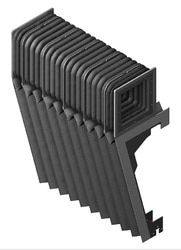 | Laser Cutting Machine Bellows ₹1000 We offer Laser Cutting Machine Bellows made specifically for your laser machine. View product → |