Heavy-duty service is defined by more than machine size: hot chips, abrasive dust, coolant chemistry, axis acceleration, cycle frequency and available installation space determine whether a cover will survive. You will be able to classify your application, compare cover designs, prepare the right measurements and challenge a quotation before selecting a supplier.
Key takeaways
- Choose steel telescopic covers for sharp swarf, hot chips and heavy coolant flow.
- Confirm folded height, stroke, speed, acceleration and mounting clearances before ordering.
- Demand drawings, material details, cycle limits and inspection records from the supplier.
- Reject a cover that restricts travel or lacks protection for its heat and debris load.
When does a machine actually need a heavy-duty telescopic cover?
A machine needs a heavy-duty telescopic cover when its axis faces sharp swarf, hot chips, abrasive dust, substantial coolant flow, cutting-force vibration and frequent rapid cycles. Fine dust or occasional debris usually does not justify the added mass and complexity of steel protection.
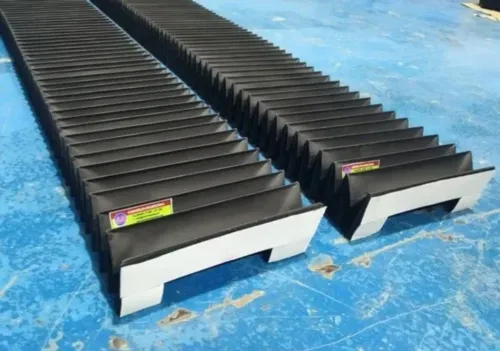
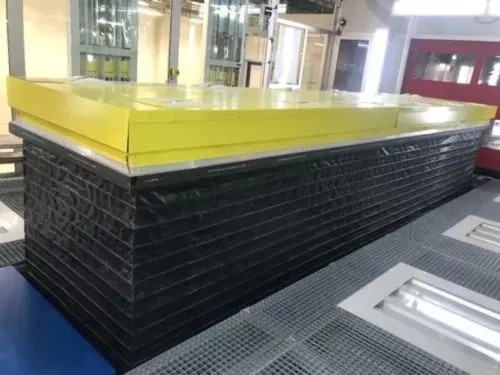
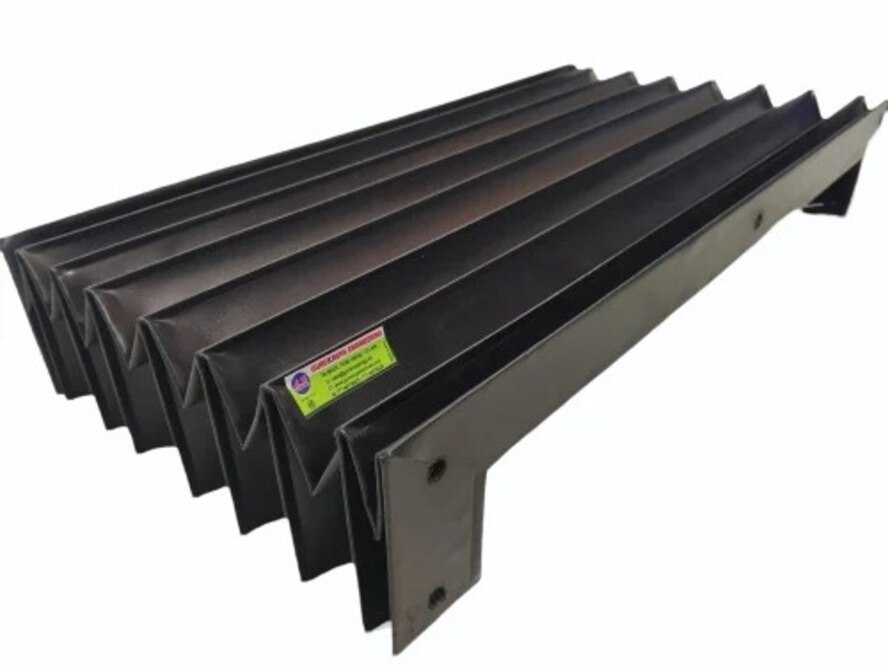
Telescopic bellow covers for heavy duty machinery in Gurgaon suit these conditions because overlapping steel slats resist impact better than coated-fabric or sewn bellows. Define the application through operating conditions, not the label “heavy-duty”:
- Check chip temperature, chip shape, coolant volume, cutting-force vibration, travel speed, acceleration, cycle frequency and daily operating hours.
- Check axis orientation, travel direction, guideway arrangement, chip-discharge path and clearance at full extension and full collapse.
- Treat a steel cover as a strong candidate for heavy chip and coolant exposure only after it is matched to the axis and its complete operating envelope.
Steel protection is not automatically superior. More steel improves impact resistance but increases moving mass, folded length, noise, acceleration load and slat impact during reversal.
Fabric bellows reduce mass and folded length, and suit fine dust or sensitive high-speed axes; roller shutters and apron covers fit particular layouts but do not provide the same sealed, guided movement.
| Option | Main advantage | Main limitation |
|---|---|---|
| Steel telescopic cover | Resists hot chips, sharp swarf and coolant impact | Higher mass, noise and installation clearance |
| Coated-fabric or sewn bellow | Low mass and compact folding | Vulnerable to cuts, hot swarf and severe impact |
| Roller shutter or apron cover | Useful for selected open layouts | Protection and sealing depend strongly on geometry |
Which construction details determine whether the cover will survive?
Ask for a drawing and material schedule, not a “heavy-duty” label. The evidence should state the steel grade, nominal slat or panel thickness, surface coating, formed-section construction, guide and roller arrangement, fastener material, internal reinforcement and drainage path.
Drainage must suit the axis: a horizontal cover needs controlled escape for coolant and chips, while a vertical or inverted cover may need added support.
Request these details before approving the industrial telescopic bellows:
- Wiper material, profile, replaceability and compatibility with abrasive fines, hot chips, coolant and the guideway surface. A torn wiper can admit chips beneath intact slats.
- Coating specification and resistance to the actual coolant, cutting fluid, wash-down water and storage humidity.
- Roller load rating, guide clearance, fastener retention and reinforcement at mounting and reversal points.
- Closed-length stability, slat overlap and protection against panel deformation under impact.
Painted or coated carbon steel is often sufficient in a dry shop with controlled coolant. Choose stainless steel or another corrosion-resistant finish when residue remains on the cover, operators wash it down, humid storage is routine or cutting fluids attack the coating.
Gurgaon’s location does not decide this; fluid chemistry, cleaning method, chip temperature and contamination load do.
| Option | Best use | Main limitation |
|---|---|---|
| Steel telescopic cover | Hot chips, sharp swarf and heavy coolant | Greater mass and impact noise |
| Fabric bellows | Fine dust, low impact and compact folding | Tears and heat damage |
| Roller shutter | Space-saving access protection | Limited chip sealing |
| Apron cover | Broad, simple way protection | Lower sealing and guidance control |
What measurements and clearance checks are needed for a custom cover?
A cover sized from travel alone can bind, strike adjacent parts, or waste usable stroke. Request a drawing for custom telescopic bellow covers that records:
1. Closed length, extended length, usable stroke, cover width and height, mounting-face dimensions, guideway geometry, attachment points, axis orientation and travel direction.
2. The complete stroke envelope, not only both end positions. Trace interference at the retracted end, extended end and intermediate positions with tooling, pallets, tables, chip conveyors, machine doors, lubrication lines, cable carriers, hydraulic hoses, guarding and nearby structures.
3. Space available when fully collapsed, plus clearance for wiper movement, drainage, service access and slat expansion. Mark drain locations and removable panels on the layout.
Vertical, inverted or steep-angle mounting changes support, chip fall and fluid drainage. A horizontal cover can collect coolant or bind when installed vertically, while a restricted collapsed space can force a shorter section design or altered slat arrangement.
Non-standard guideway profiles also need measured support surfaces, gaps and height changes rather than a nominal machine dimension.
A standard cover is the wrong choice when its closed length reduces usable travel, its slats foul an obstruction, or its guides cannot follow the profile. Specify a custom design for long travel, multiple obstructions, unusual mounting faces, steep angles, restricted collapse space, or unusually heavy chip and coolant exposure.
Which operating figures must be confirmed before calling it suitable?
A quotation for telescopic bellow covers for heavy duty machinery in Gurgaon is not engineered until it states the axis envelope and operating limits. Confirm temperature range, coolant and cutting-fluid compatibility, oil exposure, abrasive-dust tolerance, hot-chip conditions, welding-spatter limits and fire restrictions.
Include workshop dust, monsoon humidity, coolant pooling and cleaning water; do not assume an IP rating. IEC 60529 applies only when the complete cover assembly has been tested and documented to a stated rating. A larger cover protects better, but its added mass increases axis load, vibration and slat impact during reversal.
Request these figures in writing:
- Allowable travel speed, acceleration and deceleration
- Cycle frequency and expected operating hours
- Estimated moving mass and axis-load effect
- Permissible misalignment across the guideway
- Noise limits and impact controls, such as rollers, damping or synchronized sections
- Expected service life in hours or cycles
- Maintenance intervals stated in operating hours or cycles
| Orientation | What to confirm | What can go wrong |
|---|---|---|
| Horizontal | Drain paths, wiper contact and chip discharge | Pooling coolant or trapped chips causes corrosion and binding |
| Vertical | Section support, slat design and modified wipers | Gravity increases sag, friction and uneven sealing |
| Inverted | Positive support, drainage and chip-shedding arrangement | Chips and fluid collect on the cover, overloading guides and wipers |
What should you demand from a telescopic bellows supplier in Gurgaon?
A quotation based only on machine model or axis travel is insufficient. Give a telescopic bellows supplier in Gurgaon the machine drawing, axis travel and orientation, closed and extended envelope, mounting details, guideway photographs, chip type, coolant or cutting-fluid data, operating temperature, speed, acceleration, cycle frequency and operating hours.
1. Demand an approval drawing before production. It should show dimensions, mounting faces, service access, drain provisions, slat material and finish, wiper material, estimated mass, allowable speed and acceleration, and maintenance requirements.
2. Confirm that the drawing fits the complete stroke, including collapsed clearance, tooling, guarding, lubrication lines and nearby structures. For custom telescopic bellow covers, require stated limits for horizontal, vertical or inverted installation; drainage and wiper arrangements change with orientation.
3. Record the acceptance checks and rejection conditions. Inspect slats for deformation, wipers for cuts, fasteners and mounting points for looseness, sections for chip accumulation, and the cover for free movement. Never force a jammed cover or aim high-pressure water into the guideway.
Keep the cable carrier separate in the specification. The cover shields guideways; the carrier controls cable and hose bend radius, fill and drag force. Ignoring that distinction can damage cables even when the cover works correctly.
Evaluate GURUKRUPA BELLOWS PVT LTD alongside other suppliers using these documented criteria, not Gurgaon location or a product label. A credible supplier will explain estimated mass, drainage, allowable operating figures and service work in writing.
Related products
 | Telescopic Bellow Cover ₹1000 Product Details: Brand GURUKRUPA Ours is a distinguished name in the business that manufactures and supplies Telescopic Bellow Cover that is vastly... View product → |
 | Telescopic Cover Product Details: Brand GURUKRUPA Being one of the trustworthy names of the industry, we bring forth CNC Telescopic Cover that can be availed at... View product → |
Frequently asked questions
When does a machine need a heavy-duty telescopic cover?
Use one when an axis faces sharp swarf, hot chips, abrasive dust, heavy coolant flow, cutting-force vibration or frequent rapid cycles. Fine dust and occasional debris usually need a lighter solution.
Which construction details affect telescopic cover life?
Check the bellows material, section thickness, wiping and scraping arrangement, guide system, overlap between sections, seals, drainage and mounting method. These details determine resistance to impact, abrasion, heat, coolant and repeated cycling.
What measurements are needed for a custom telescopic bellow cover?
Provide the closed length, maximum extension, stroke, width, height, section count, mounting-hole pattern, guideway dimensions and available side and top clearances. Record nearby tooling, cable carriers and coolant outlets so the cover does not foul them.
Which operating figures must be confirmed before approval?
Confirm travel speed, acceleration, cycle frequency, operating temperature, chip size and temperature, coolant type and flow, abrasive dust exposure, vibration and the required service life. Compare each figure with the supplier's written limits.
What should you request from a telescopic bellows supplier in Gurgaon?
Request a dimensioned approval drawing, material and coating specifications, rated speed and acceleration, folded-height and stroke calculations, mounting details, inspection records, maintenance instructions and replacement-part availability.
Related products
 | Telescopic Cover ₹5000 Product Details: Brand GURUKRUPA Being one of the trustworthy names of the industry, we bring forth CNC Telescopic Cover that can be availed at... View product → |
 | Steel Telescopic Cover Product Details: Brand GURUKRUPA Our company is considered a renowned name in the field that manufactures and supplies Steel Telescopic Cover. View product → |
 | CNC Telescopic Cover Product Details: Brand GURUKRUPA Being one of the trustworthy names of the industry, we bring forth CNC Telescopic Cover that can be availed at... View product → |