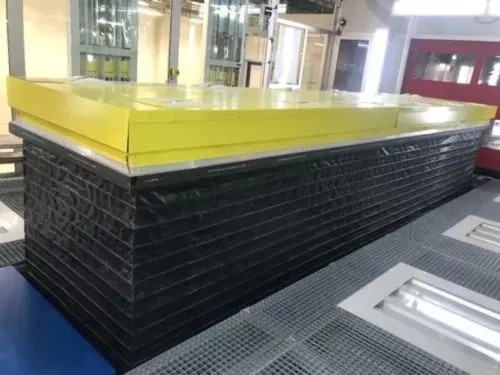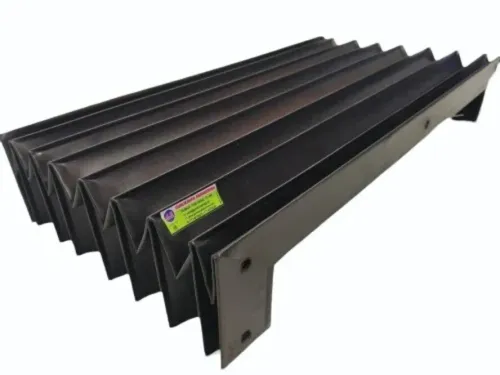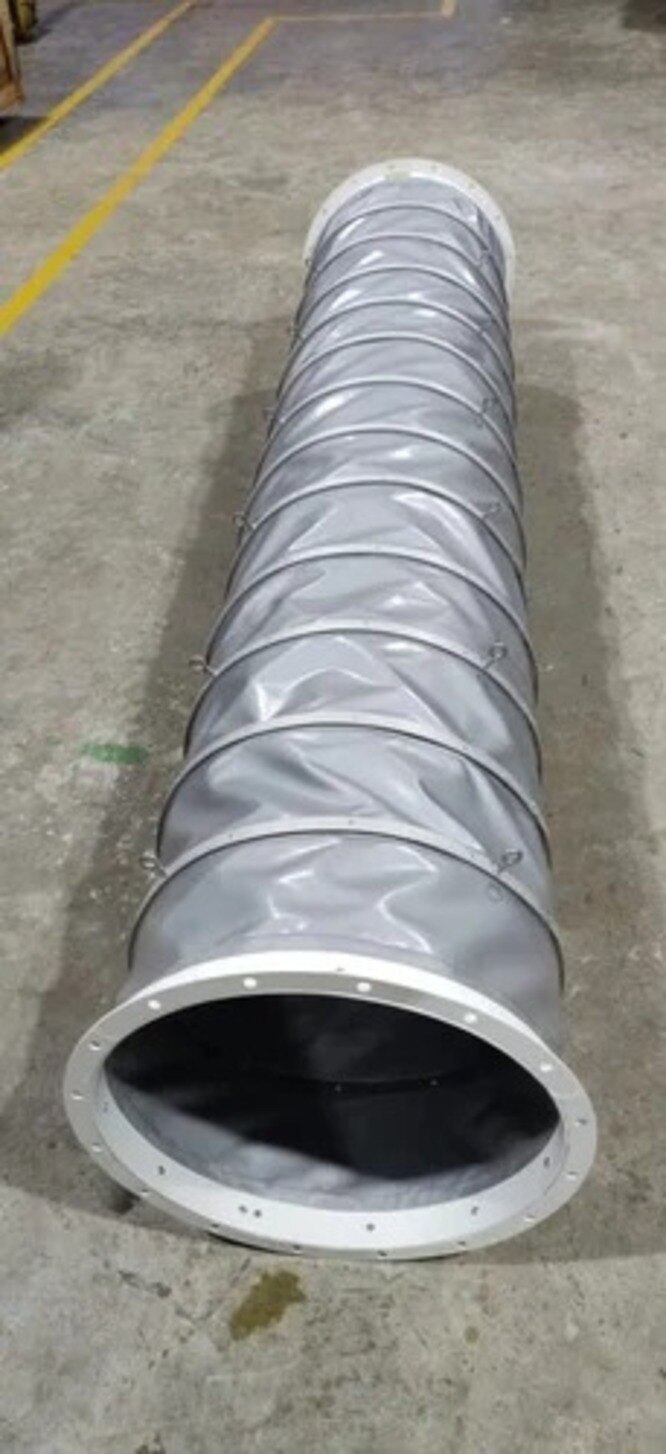
A fly ash loading bellow is not defined by its name alone: it may be a dust-containment sleeve, a flexible cover around a loading spout, or a short replacement section at a transfer point. By the end, you will know which dimensions, service conditions, construction details, extraction data, and acceptance checks to put into a purchase specification.
Key takeaways
- Measure extension, compression, lateral movement and hatch alignment before requesting a quote.
- Specify fly ash temperature, particle size, dust extraction and pressure conditions.
- Compare fabric, flange, inspection, delivery and replacement details—not price alone.
- Check seals, movement, extraction connection and abrasion before accepting installation.
Where does the bellow fit, and what must it do during loading?
Install the bellow between the silo or bulk tanker discharge point and the receiving vehicle inlet. During loading, it extends over the tanker hatch, encloses the material path, and directs displaced dusty air toward the extraction connection instead of releasing fly ash around the hatch.
After filling, it retracts and moves clear so the vehicle can leave.
A “fly ash loading bellow covers” specification can describe several different parts:
| Term | What it means | What to confirm |
|---|---|---|
| Fly ash bulk loading spot bellow | A localized bellows section at the loading point | Whether it is a replacement or part of an assembly |
| Loading spout or telescopic loading chute | The complete guided transfer assembly | Extension mechanism, outlet, controls, and dust extraction |
| Unloading bellow | A flexible connection used when material leaves a tanker or vessel | Direction of flow and connection geometry |
| Flexible connector | A short vibration or movement isolator | Whether it contains the loading dust path |
| Fixed duct | Rigid conveying or extraction pipe | No extension or vehicle-following movement |
The phrase bulk loading bellow covers could mean an outer fabric cover, an internal sleeve, or a short transfer-point bellows section. Your quotation must identify the exact component, tanker-hatch arrangement, mounting rings, and dust path. A spot bellow is not automatically a complete loading system: specify the outlet, extraction route, and clearance needed for retraction.
Which dimensions and movements belong on the purchase drawing?
A nominal spout diameter cannot size fly ash loading bellow covers. Give the supplier a measured drawing or photographs showing the mounting rings, tanker hatch, nearby obstructions, and the complete moving envelope.
Include these dimensions and movements on the purchase drawing:
- Collapsed length and extended length, with minimum and maximum positions clearly marked
- Inlet and outlet diameters, flange or clamp pattern, bolt-circle dimensions, and sealing method
- Tanker-hatch dimensions, clearance above the vehicle, and required telescopic travel
- Lateral offset, rotation, mounting orientation, and intended fold direction
- Fold pitch, documented minimum bend radius, and surfaces that could cause rubbing
- The full moving envelope, including vehicle movement, hatch position, and extraction connection
Show the cover in both collapsed and extended positions. A cover that fits the upper flange but rubs against the tanker, compresses beyond its design length, or cannot follow the required stroke is not a suitable replacement.
Spot bellow wording can hide a scope difference. Confirm which deliverable the quotation describes.
| Localized replacement | Fabric sleeve or short bellows section matched to existing rings | Use when the remaining loading assembly, clamps, extraction path, and interfaces are serviceable |
|---|---|---|
| Complete assembly | Cover plus rings, clamps, cuffs, connections, and specified loading interfaces | Use when the existing arrangement is damaged, unknown, or unsuitable |
| Bulk loading bellow covers | Assembly-specific cover supplied against the complete interface drawing | Use when the quotation must address the entire loading movement and envelope |
A supplier may quote only a localized replacement when you actually need a complete loading assembly. Bulk loading bellow covers cannot be compared fairly with a sleeve-only price.
Which fly ash, temperature, dust, and pressure conditions must the construction withstand?
State the service conditions before choosing fly ash loading bellow covers. Give the supplier fly ash bulk density, flow rate, moisture exposure, buildup or bridging risk, normal temperature, maximum upset temperature, exposure duration, ambient temperature, and contact risks during truck positioning or level-control failure.
Specify the material stack, not “dustproof fabric”:
- Base fabric, coating or laminate, inner liner, wear layer, seam design, reinforcement rings, cuffs, and replaceable wear sections.
- Abrasion protection at fold crests, seams, clamp bands, and rubbing points, where fine ash can wear through before the flat fabric looks damaged.
- Continuous temperature rating and short-excursion temperature rating, with the permitted exposure duration for each.
| Service condition | What it tests | What to confirm |
|---|---|---|
| Continuous heat | Long-term degradation | Material-stack rating at normal ash and ambient temperatures |
| Upset heat | Short exposure damage | Maximum temperature, exposure duration, and seam rating |
| Truck contact | Impact, crushing, or rubbing | Clearance, reinforcement, and replaceable wear areas |
A dust cover is not a pressure-rated conveying line. State whether the cover sees positive conveying pressure, extraction vacuum, pressure pulses, or atmospheric service; require separate burst and collapse checks. For bulk loading bellow covers, document the extraction connection, negative-pressure range, air volume, filter arrangement, collapse resistance, and flow clearance.
If unburnt carbon creates an ignition concern, obtain actual dust data: Kst, maximum explosion pressure, minimum ignition energy, and layer-ignition information. Specify antistatic or conductive construction and require continuity testing for the complete installed assembly.
How should you compare a spot-bellow quotation with a Gurgaon supplier’s offer?
Compare quotations against one defined assembly; otherwise a lower price can hide a missing clamp, ring, or extraction connection.
A buyer seeking a spot bellow supplier in Gurgaon should ask whether the offer covers only the fabric sleeve or the complete interface. Check these items line by line:
| Scope item | Confirm in the quotation | Why it matters |
|---|---|---|
| Fabric construction | Material stack, temperature limits, pressure or vacuum duty, reinforcement, and cuffs | A cover for induced vacuum is not automatically suitable for positive pressure |
| Hardware | Mounting rings, clamps, earthing provisions, and extraction connections | Missing hardware can delay installation or leave a dust leak |
| Geometry | Collapsed and extended dimensions, fold direction, minimum bend radius, and interface pattern | A nominal diameter will not prove that the cover follows its stroke |
| Service package | Inspection method, installation guidance, exclusions, and replaceable wear parts | You need defined acceptance criteria and an identifiable replacement |
The phrase fly ash bulk loading spot bellow is insufficient without a photograph, field measurements, or an assembly drawing showing its location, dust path, clearance, and mounting points. “Spot bellow” can mean a short replacement section rather than the complete loading arrangement.
GURUKRUPA BELLOWS PVT LTD belongs in the same comparison as other suppliers only when it provides the same drawing, material data sheet, service limits, and interface details. Compare lead time and replacement-part identification after confirming that every quote covers the same component and dust-control arrangement.
What should you inspect before accepting and maintaining the installed cover?
Accept fly ash loading bellow covers only after a controlled fit test, not from appearance alone. Use the same procedure for bulk loading bellow covers replaced in the field.
1. Measure the collapsed and extended lengths, outside diameters, fold pitch, and mounting interfaces against the approved drawing. Record field measurements and investigate any mismatch before commissioning.
2. Inspect every seam, cuff, ring, clamp, reinforcement, and attachment point. Reject pinholes, delamination, cracked coating, torn folds, loose clamps, or damaged fasteners.
3. Cycle the cover through its complete stroke while observing the tanker hatch and nearby structure. Reject any rubbing, snagging, fold inversion, or over-compression; these faults can abrade the cover before loading begins.
4. Check leakage with the extraction system operating. Use a smoke test or measured airflow method suited to the installation, and inspect joints before dust escapes externally because fine fly ash can pass through tiny defects.
5. For conductive construction, measure and record continuity across the complete assembly, including rings, clamps, cuffs, and any bonding path. A single earth-wire reading does not prove assembly continuity.
6. Define inspection intervals and reject criteria for permanent set, loss of continuity, and visible wear at contact points. Inspect before each shift or loading cycle when abrasion or hot service demands it.
7. Retain the approved drawing, material identification, temperature and pressure limits, installation orientation, field measurements, acceptance results, inspection records, and replacement-part details.
Frequently asked questions
Where does a fly ash loading bellow cover fit?
Install it between the silo or bulk tanker discharge point and the receiving vehicle inlet. It should enclose the material path over the tanker hatch and connect displaced dusty air to extraction.
Which dimensions belong on a purchase drawing?
Provide the fully extended and compressed lengths, inside and outside diameters, flange dimensions, bolt-hole pattern, hatch position, travel direction, lateral offset and available clearance.
What conditions must a fly ash loading bellow withstand?
State the fly ash temperature, particle abrasiveness, dust concentration, loading rate, air pressure or vacuum, outdoor exposure, cleaning method and required movement cycles.
How should you compare a spot-bellow supplier in Gurgaon?
Compare the proposed construction, fabric and coating, reinforcement, end connections, extraction port, tolerances, inspection documents, installation support, lead time and replacement terms.
What should you inspect before accepting the installed cover?
Check that the bellow reaches the hatch without strain, seals at both ends, moves freely, clears nearby equipment, connects to extraction and shows no loose stitching, cracks or abrasion.