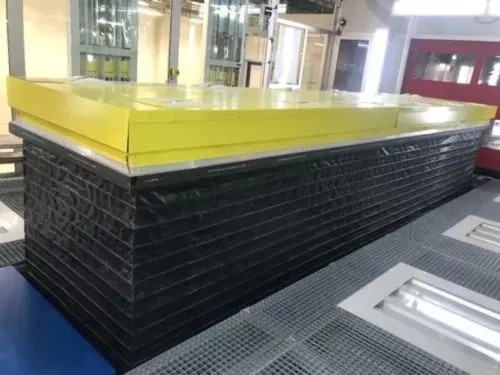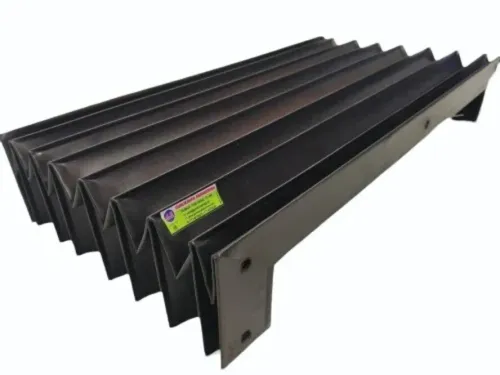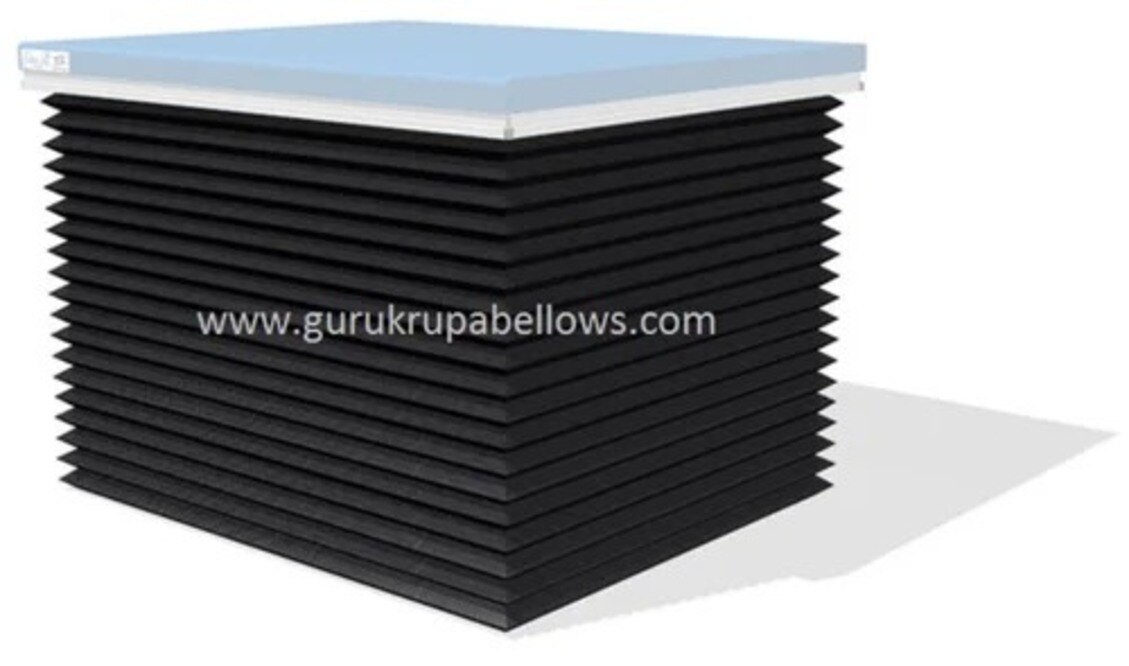
Chips, weld spatter, oil-soaked grit and loose fasteners can enter a scissor lift while the platform raises, lowers or folds, then turn a protective cover into a source of drag and abrasion. You will learn how to identify trapped debris, inspect and clean the cover, separate cover faults from lift faults, and specify a containment design that moves safely through the full stroke.
Key takeaways
- Check pleat valleys, end frames, and flanges for trapped debris.
- Clean bellows without forcing grit deeper into folded sections.
- Separate cover friction from lift alignment and mechanical faults.
- Specify fabric, clearances, travel, and sealing details before ordering.
Where debris enters—and how a trapped fold reveals itself
Debris reaches the folding mechanism as the platform raises, lowers, folds and shifts laterally. Movement draws contamination into gaps around the cover, while vibration carries material toward pleat valleys, end frames and attachment flanges.
Common sources include:
- Machining chips
- Weld spatter
- Dust
- Oil-soaked grit
- Loose fasteners
The first signs of scissor lift bellow cover debris are changes in movement rather than a visible pile. Check for:
- Stiff pleats
- Bulging sections
- Unequal compression
- Scraping sounds
- Restricted platform travel
- Particles expelled from fold edges
Large scrap is easy to spot and remove. Abrasive fines mixed with oil, coolant or moisture are more destructive because they form a paste that works into coated fabric, seams and sliding interfaces. Each cycle then grinds that paste deeper, accelerating scissor lift bellows damage.
Look inside the folded cover, not only across its outer face. Material commonly settles in pleat valleys, around end frames and at attachment flanges. Once compacted, it can stop the bellow from folding fully, create local bulges and increase drag on the next cycle.
A fold that snaps unevenly, rubs against an arm or sheds grit at its edge needs isolation and cleaning before continued operation.
How to contain debris without making the bellow a sump
Choose either a controlled fold that retains debris or a deliberate route to a clean-out area. Do not seal the lowest point by default: sludge trapped there adds weight, causes sagging and abrades fabric during compression.
For scissor lift bellow covers for trapping debris in Gurgaon, a removable access panel, drain path or discharge chute is usually safer than a permanent sludge-filled pocket.
| Option | Debris path | Main risk | Use when |
|---|---|---|---|
| Open edge | Debris falls away | Contamination reaches the mechanism or floor | Chips are large, dry and harmless outside the cover |
| Contained edge | Debris stays in a reinforced fold | Accumulation adds weight and drag | You provide removable clean-out access |
| Sealed low point | Liquid and fines collect together | The cover becomes a heavy sump | Drainage and scheduled emptying are designed in |
- Specify scissor lift bellow covers in Gurgaon from the lift’s closed, extended and intermediate positions. Record compressed height, maximum extension, pleat depth, lateral clearance, attachment locations and the movement envelope of every arm.
- Keep fabric clear of scissor arms and shear points. Reinforce corners, protect overlaps and place attachments so no edge can enter a link gap.
- Add a deliberate low point only when it leads to a drain, chute or removable clean-out. Check that the outlet cannot discharge onto cylinders, guides or electrical equipment.
- Route hoses, cables and cable carriers outside the folding volume. Include them inside only when the bellow drawing provides dedicated clearance.
- Cycle the installed cover slowly through every position before production. Stop if pleats buckle outward, sag onto links, scrape, snag or retain material in an inaccessible pocket.
Inspect and clean the cover before small damage becomes a failure
Inspect the cover before each shift, because scissor lift bellows damage usually starts where movement repeats: a fold line, corner transition, seam, mounting strip or rubbing point.
1. Apply lockout and isolate electrical, hydraulic and pneumatic energy before reaching beneath the platform or opening access panels. Support the platform as specified by the lift manufacturer; never rely on the actuator to hold it raised.
2. Move around the cover and examine every fold, attachment rail, corner, overlap, wiper edge, cylinder clearance and underside. Look for cuts, pinholes, loose stitching, separated seams, cracked coatings, oil swelling, pulled-out fasteners, distorted folds and contact marks from scissor arms, guides or cylinders.
3. Treat a pinhole at a fold or corner as a repair decision, not a cosmetic defect. Repeated tension and compression can extend it into a longitudinal tear, while trapped scissor lift bellow cover debris can abrade fabric and push contamination toward cylinders, guides or other mechanisms.
4. Remove loose material with a vacuum and soft brush. Do not use compressed air to drive grit into seams, bearings, guides or electrical equipment.
5. Use controlled low-pressure washing only when the material and lift design permit it, and prevent water from entering seams or mechanisms. Confirm chemical compatibility before applying any solvent, detergent or degreaser to PVC-coated fabric, rubber or adhesive seams; an incompatible cleaner can swell the cover or release its bonding.
Record defects and keep the lift out of service when a tear, exposed fastener or contact mark could enter a shear point.
Find out whether the cover or the lift is causing movement problems
Start by proving whether the cover or the lift creates the resistance. Follow your site’s isolation and lockout procedure, then inspect the bellow beside the cylinder rod, scissor arms, rollers, hoses, limit switches and structural stops.
Compare the symptom with the likely source:
| Cover clue | Lift or installation clue |
|---|---|
| Incorrect folded length, tight packing or outward buckling | Skewed end frames or unequal attachment heights |
| Excess material bunching at full retraction | Seized guide, obstructed rail or structural stop |
| Insufficient allowance at full extension | Cylinder, roller or arm reaches its limit first |
| Twisted folds or off-centre travel | Mounting is misaligned or forces the wrong fold direction |
| Fastener marks inside the moving envelope | Fastener, hose or cable carrier is occupying the travel path |
| Sagging onto links, rails or the floor | Cover is too loose for the motion profile |
Cycle the isolated mechanism slowly through full travel and several intermediate positions. Check whether a pleat inverts, snags or rubs at one height, then inspect for lost clearance and trapped debris. A cable bundle inside the folding volume can create a hard obstruction even when the bellow dimensions are correct.
After correction, acceptance-test the lift through repeated full-stroke cycles at its intended load. Watch for abnormal force, pleat inversion, snagging, rubbing and clearance loss; repeat with production payload because deflection can change the geometry. Record scissor lift cover movement problems and inspect for scissor lift bellows damage after cycling.
Specify the right debris-containment cover for your lift
Specify the cover from the lift’s closed, extended and intermediate geometry, not from platform length and width. For scissor lift bellow covers in Gurgaon, record compressed height, maximum extension, pleat depth, attachment points, side clearances, arm movement envelope, travel, cycle rate and dwell positions.
- Describe the contamination: chip type and size, dust, weld-spatter exposure, oil or coolant contact, moisture and washdown practice. State cleaning access, drain or clean-out points, and replacement lead time.
- Request the material data, not “industrial fabric”: coating type, base-fabric construction, operating temperature range, oil and coolant resistance, abrasion performance, seam construction, cleaning-chemical compatibility and flame behaviour where relevant.
- Compare drawings showing closed, extended and intermediate folds, attachment heights, clearances and protected overlaps. Reject a design that bunches onto links, sags into the floor, or places fasteners inside the moving envelope.
- Define acceptance testing: cycle the installed cover slowly through full travel, then repeat full-stroke cycles at intended load; inspect intermediate dwell positions for snagging, pleat inversion, abnormal force, contact marks and trapped debris.
For scissor lift bellow covers for trapping debris in Gurgaon, ask GURUKRUPA BELLOWS PVT LTD to review the actual lift geometry rather than nominal dimensions alone. Treat the bellow as an environmental barrier, never structural support or a substitute for guarding. Compare test results, clean-out access and clearances—not colour.
Frequently asked questions
Where does debris enter a scissor lift bellow cover?
Debris enters through gaps around the cover and collects in pleat valleys, end frames, and attachment flanges as the platform moves.
How do you clean a scissor lift bellow cover without damaging it?
Stop and secure the lift, open the cover through its full safe travel, remove loose material, then clean pleats and attachment areas without forcing grit into folds.
How can you tell whether the cover or the lift is causing movement problems?
Inspect for rubbing, uneven compression, distorted pleats, loose fasteners, and misalignment before testing the lift for mechanical or alignment faults.
What should you specify when ordering a debris-containment cover for a scissor lift?
Provide the lift travel, folded and extended dimensions, movement path, mounting points, debris type, temperature exposure, clearance limits, and required sealing level.