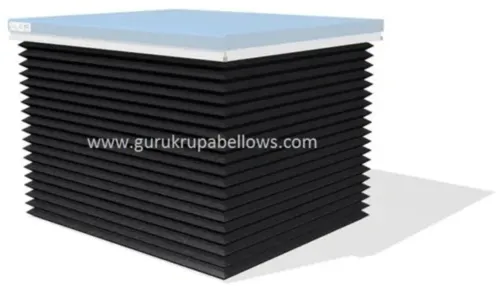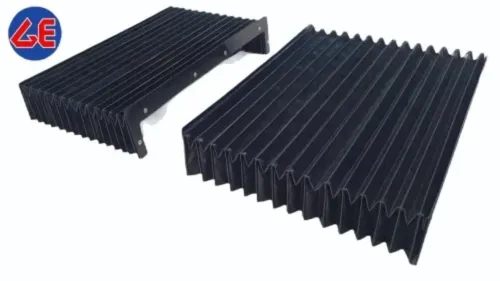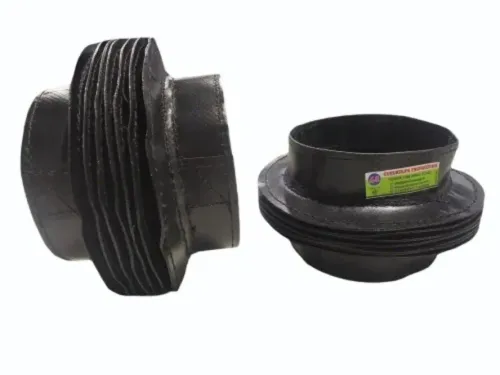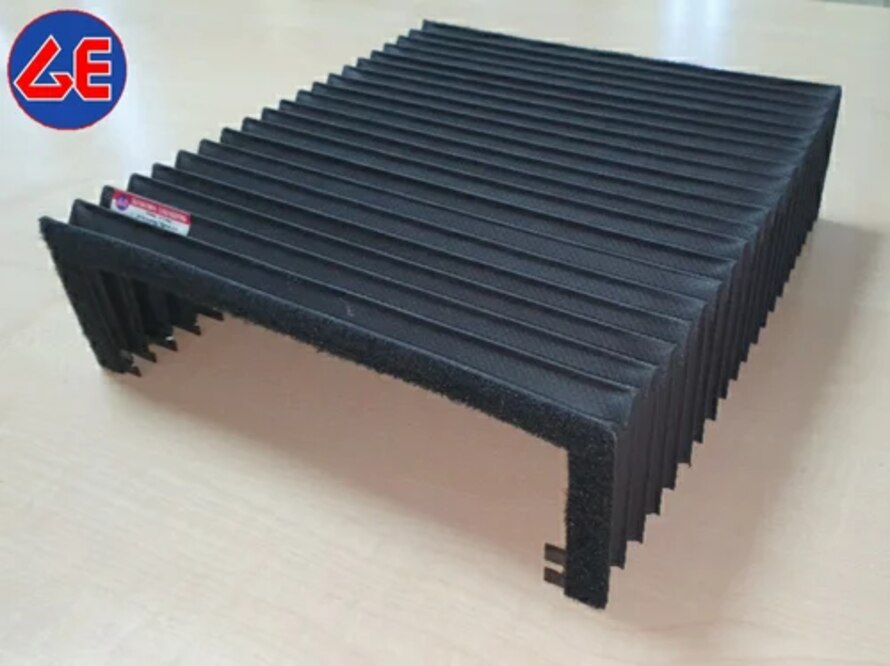
The joining method affects more than appearance: it changes seam sealing, temperature tolerance, flexibility, repairability and how the cover behaves through repeated motion. By comparing the finished construction, operating conditions and installation dimensions, you can select the suitable cover type and prepare an RFQ that avoids premature failure or machine interference.
Key takeaways
- Choose welded seams for compatible coated fabrics and sealed contamination protection.
- Choose sewn bellows when materials, repairs or complex panel construction favour stitching.
- Check temperature, chemicals, fold radius and full-stroke clearance before selecting construction.
- Give suppliers travel, folded length, dimensions, hazards and mounting details.
How thermal bonding and sewing create different seams
Thermally bonded bellow covers fuse compatible thermoplastic-coated fabrics or films with controlled heat, while sewn bellow covers join fabric panels with thread, needle holes and overlapping seam allowances. The welding process may use hot air, a hot wedge, radio frequency or ultrasound; a heat-resistant textile is not automatically weldable.
| Construction detail | Thermally bonded bellow covers | Sewn bellow covers |
|---|---|---|
| Joining method | Melted coating layers form a continuous bonded seam | Thread locks fabric layers through individual stitches |
| Seam surface | Smooth, low-profile and free of needle holes | Raised thread and stitch lines create a thicker overlap zone |
| Physical form | Often lighter and slimmer at the seam, with a cleanable surface | Often thicker and more visibly layered around allowances and reinforcement |
| Flexibility | Bonded zones can stiffen the fold if heat or width is poorly controlled | Stitch density, thread and seam placement determine fold flexibility |
| Leak paths | No needle perforations, but corners, mounting faces and damaged fabric still admit coolant | Stitch holes and worn thread add possible leakage paths |
Neither construction guarantees longer service life. Thermally bonded bellow covers need a weldable laminate and a seam that remains flexible through repeated compression and extension. Sewn bellow covers depend on thread compatibility, stitch geometry and reinforcement; thread abrasion, melting, embrittlement, enlarged needle holes and fatigue can end their service life.
Compare the complete assembly, including fold geometry, guides, frames, wipers and reinforcement. Those details can outweigh the joining method itself.
Compare temperature, contamination and movement limits
The finished cover survives only when its seam, laminate, fold geometry and mounting system match the machine’s temperature, contamination and motion. A thermally bonded bellows is not automatically more durable; the weld layer, reinforcement and fold design set its real limits.
| Construction | Temperature limit | Contamination response | Movement limit |
|---|---|---|---|
| Thermally bonded bellows | Request continuous and peak ratings for the finished laminate and seam; the coating or weld layer often limits service before the base fabric does. | A low-profile, sealed seam resists coolant ingress and is easier to wipe clean. Chips can still cut exposed folds or guides. | Confirm stroke, speed, cycle count, folded height and fold radius. A stiff weld zone can fatigue if it sits in a high-strain fold. |
| Sewn bellows | A suitable high-temperature fabric and thread can exceed the service range of many weld layers. Check thread melting, embrittlement and chemical attack. | Needle holes and overlap zones can admit coolant, fine dust or abrasive slurry. Thread can trap contamination and wear against chips. | Stitch fatigue, hole enlargement and seam abrasion determine life. Reinforcement and seam allowance matter when folds move rapidly or repeatedly. |
Choose thermally bonded bellows when sealed, cleanable seams and coolant exclusion control the risk. Choose sewn construction when the fabric must resist temperatures or chemicals beyond the weld layer’s rating, or when repair and reinforcement flexibility matter.
- Continuous and peak temperature limits with exposure time
- Coolant, oil, chemical and chip descriptions
- Maximum speed, stroke, cycle count and fold compression
- Clearance checks proving that guides, wipers and mounts cannot pinch the cover
Choose the construction for the machine motion and hazard
Choose thermal bonding for fast, clean machine motion where coolant, fine chips or washdown must not enter the folds. Choose sewing when heat, chemicals, repairability or reinforcement exceeds the weld layer’s capability.
The finished assembly matters more than the joining method alone: fold geometry, seam location, mounting frames, guides, wipers and laminate construction can decide service life.
| Option | Best application | Main reason |
|---|---|---|
| Thermally bonded | CNC machining centres with flood coolant and fine chips | Low-profile seams reduce snagging, and a continuous welded joint resists coolant ingress |
| Thermally bonded | High-speed linear axes with frequent short strokes | Smooth folds and lighter construction suit rapid cycling when the laminate remains within its temperature limits |
| Sewn | Grinding, forging or heat-treatment equipment | A suitable fabric and high-temperature thread can outperform a coating or weld layer exposed to sustained heat |
| Sewn | Machines exposed to oils, solvents or aggressive chemicals | Select the thread, fabric and seam allowance for the chemical; do not assume the weld layer is compatible |
| Sewn | Large covers, unusual reinforcements or small-batch maintenance | Technicians can replace stitching or panels without remaking the entire cover |
| Either | Long-stroke telescopic way covers | Guides, mounting frames, fold count and compression clearance often control life more than the seam type |
For thermally bonded bellow covers versus sewn bellows, request the finished laminate’s continuous and peak temperature limits, chemical compatibility and tested cycle count. A sewn cover is not automatically weaker: abrasion can cut thread, enlarge stitch holes or fatigue a seam placed in a high-strain fold.
A bonded cover is not automatically better if heat softens its coating or a reinforcement cannot be welded.
Measure the cover and check clearance through the full stroke
A cover that fits at rest can bind at the ends of travel. Record the protected component’s length, width, height, mounting-face dimensions, required travel, and available folded height before requesting a custom design.
1. Measure the guideway or mechanism in its fully retracted and fully extended positions. Include the maximum envelope of moving parts, not only the rail or screw.
2. Record the cover’s mounting length, extended length, compressed length, fold height, fold width, and proposed fold count. State whether the cover mounts to fixed and moving frames, flanges, angles, or a sliding plate.
3. Check clearance through the full stroke. Move the machine slowly while watching both sides, the top, and the underside for contact with rails, clamps, tooling, cable carriers, hoses, chip conveyors, guards, and nearby panels.
4. Check lateral offset, vertical sag, twisting, folding direction, and clearance at acceleration and deceleration. A cover that clears at mid-stroke can still crease into a guideway at reversal.
5. Add machine photographs and a dimensioned drawing or CAD model to the RFQ. State coolant type, chip size, temperature, expected duty cycle, and whether sewn bellow covers remain under consideration because of fabric or repair requirements.
Ask the supplier to return an installation-clearance drawing showing extended and compressed dimensions, fold count, mounting details, material construction, and seam method. Approve that drawing before manufacture, then verify the proposed dimensions against the machine at both stroke limits.
Turn the comparison into a supplier-ready specification
An RFQ for custom bellow covers in Gurgaon must describe the machine, not just request a “bellows cover.” State the hazard, motion, space envelope and service life target so the supplier designs for the actual duty.
- Dimensioned drawing or CAD model, plus photographs showing the guideway, adjacent tooling and mounting faces
- Required travel, extended length, compressed or folded height, width, profile and clearance at both stroke limits
- Fabric, coating or laminate requirements; continuous and peak temperatures; exposure duration; coolant, oil, chemical, chip and heat conditions
- Movement speed, acceleration, cycle count per shift, operating hours and target service life
- Mounting method, frame material, fastener pattern, guides, wipers, reinforcement and any fixed or moving obstructions
- Whether you are evaluating thermally bonded bellow covers versus sewn bellows, including repair, cleaning and replacement priorities
Ask GURUKRUPA BELLOWS PVT LTD, or any competing supplier, to return a drawing before manufacture. Approve it only after checking:
- Proposed fold count, fold pitch, extended dimension and compressed dimension
- Fabric construction, coating, thread or weld layer, seam locations and reinforcement
- Mounting-frame details, guide arrangements and installation-clearance envelope
- Continuous and peak temperature limits for the finished seam or laminate, not just the base fabric
- Test conditions, sample photographs and acceptance criteria for leakage, interference and full-stroke movement
Record the approved revision number on the purchase order. A verbal dimensional change can produce a cover that fits at rest but jams during travel.
Related product
 | Thermally Bonded Bellows ₹1000 Product Details: Brand GURUKRUPA Color BLACK & OTHER Size ALL On offer from us is available Thermally Bonded Bellows for the clients. View product → |
Frequently asked questions
How do thermal bonding and sewing create different bellow seams?
Thermal bonding fuses compatible thermoplastic-coated fabrics or films using heat or energy. Sewing joins panels with thread, needle holes and overlapping seam allowances.
Which bellow construction handles contamination better?
A thermally bonded seam can provide a more continuous barrier when the materials and welding process are compatible. Sewn seams require attention to needle holes, thread and seam overlaps.
How should you choose between thermally bonded and sewn bellows?
Match the construction to the machine’s stroke, fold movement, temperature, chemicals, debris, heat and fire hazards, plus the fabric’s repair and maintenance needs.
What measurements should you provide for custom bellow covers?
Provide the cover’s extended and compressed lengths, width, height, mounting points, fold dimensions, movement direction and clearance throughout the full stroke.