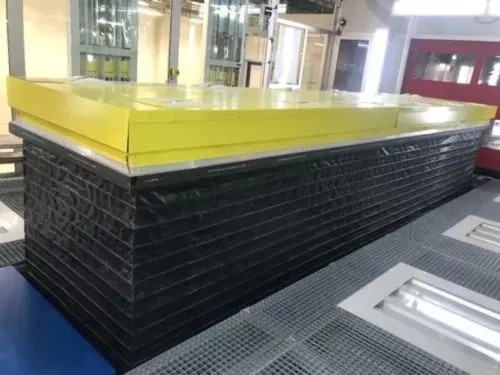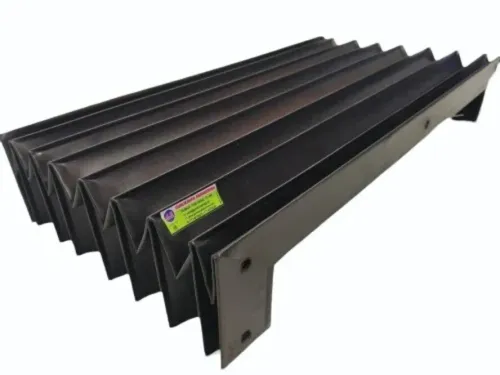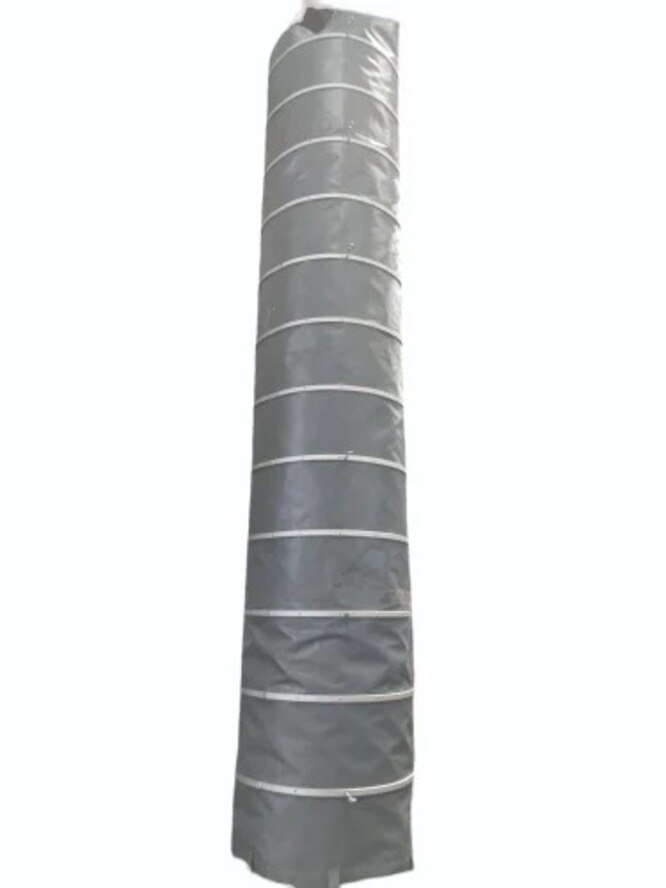
A spot bellow cover shields one exposed, moving machine area rather than enclosing an entire axis or machine bed. By identifying the protected component, its movement, its hazards and its available clearance, you can decide whether a spot cover fits your Gurgaon installation and specify one without relying on an ambiguous product name.
Key takeaways
- Use spot bellows to shield localised moving parts from dust, chips, heat, and coolant.
- Choose full-length covers when the entire guideway or machine bed needs protection.
- Measure travel, folded length, expanded length, mounting dimensions, and clearance.
- Match fabric, coating, seams, and reinforcement to the machine’s specific hazard.
What a Spot Bellow Cover Protects
A spot bellow cover protects one localised moving point rather than an entire machine bed. This compact flexible enclosure fits around an actuator rod, spindle section, guideway, cylinder, ball screw, sensor assembly or short slide, then expands and folds as the component moves.
Its folds block chips, coolant, abrasive dust and lubricant from reaching the mechanism.
“Spot” is not a universal engineering classification, so do not order from the name alone. Specify the component and its travel when requesting spot bellow covers for industrial machinery in Gurgaon:
- Identify whether the cover protects a hydraulic cylinder, pneumatic cylinder, linear guide, exposed shaft, spindle nose area or compact CNC mechanism.
- State whether movement involves straight compression and extension, sliding along a guide, bending around an offset joint, or combined axial and angular motion.
- Give the travel, collapsed length, extended length, fold height and available clearance around brackets, hoses and adjacent machine parts.
A cover designed only for straight travel can crease, twist or pull away when the protected part changes angle. These details also distinguish spot bellow cover applications from full-way or rigid telescopic protection: the cover must match the motion envelope of one vulnerable point, not merely fit its resting dimensions.
Where Gurgaon Factories Use Spot Bellows
Gurgaon factories use spot bellows where contamination threatens one localised moving component, but a full machine-tool way cover would consume valuable space or add unnecessary weight.
Common spot bellow cover applications include actuator rods on press and assembly equipment, exposed spindle sections on machining centres, linear slides on inspection systems, hydraulic and pneumatic cylinders, compact ball-screw sections, sensor heads and short guideway areas.
Choose the cover through this sequence:
1. Identify the protected part and its movement: compression, extension, sliding, bending or combined axial and angular travel. Industrial protective bellows designed for straight travel can crease, twist or detach when a joint changes angle.
2. Measure the available envelope. Fold pitch and fold height control compression and extension. A cover with enough stroke can still bottom out against a bracket when collapsed; excessive fold height can obstruct tooling, a coolant nozzle or a swarf conveyor.
3. Check the operating forces before selecting construction. Confirm minimum bend radius, maximum speed, acceleration and lateral movement. These details determine whether the folds move freely or develop stress and premature wear.
4. Keep protection separate from operator safety. A spot bellow does not replace guarding around a chuck, cutting tool or nip point. Use a cable carrier for cables and hoses unless the bellow has been specifically designed to support them.
When a Spot Bellow Is the Wrong Cover
Choose another cover when contamination or motion extends beyond one localised point. A spot bellow is the wrong choice for a long guideway, column or machine bed; a full-way bellows cover handles long travel, while a rigid telescopic enclosure provides structural resistance, defined panels and a hard barrier.
| Option | Best suited to | Why it is not interchangeable with a spot bellow |
|---|---|---|
| Full-way bellows cover | Long guideways, columns and machine beds | Covers extended travel across a broad machine section |
| Rigid telescopic enclosure | Impact, structural resistance or hard guarding | Uses rigid nested panels rather than flexible folds |
| Cylindrical, round or accordion cover | Rotating or axial shafts | Matches shaft geometry and movement |
| Telescopic cover | Nested straight sections | Extends through guided, overlapping sections |
Do not expose a flexible spot cover directly to heavy hot chips, welding sparks, flame or concentrated heat without an engineered heat shield. Sharp swarf calls for sacrificial slats, flaps, brush protection or stainless-steel lamellae; otherwise punctures and seam damage can reach the mechanism.
Reject the cover when:
- Operators need access from several sides.
- Unsupported hoses or cables would hang from it.
- Its folds obstruct tooling or maintenance access.
- The hazard requires guarding rather than contamination control.
Ask for a separate chip shield, guarding system or cable-management solution when the process demands it. Industrial protective bellows and spot bellows in Gurgaon should protect machine components, not carry loads or replace operator guarding.
What to Measure for a Custom Gurgaon Cover
A useful custom-cover request starts with the machine’s actual motion envelope, not the phrase custom bellow covers in Gurgaon. Give the fabricator:
- Machine make and model, protected axis or component, travel, maximum speed and photographs of every available clearance.
- Compressed length, extended length, stroke, fold height, width and height, plus outside and inside diameters where the cover is round.
- Mounting dimensions, attachment points, minimum bend radius, and the position of nearby brackets.
- Clearance to guideways, cable carriers, hoses, tooling, coolant lines and swarf conveyors throughout the complete stroke.
- Any lateral or angular movement, because an axial-only cover can twist, rub or pull away when the component changes direction.
Gurukrupa Bellows Pvt Ltd can assess a request more accurately when these dimensions describe the installed machine rather than a product label.
After installation, cycle the machine manually or at low speed from end to end. Inspect both travel limits and the middle of the stroke for pinch points, rubbing, twisting, sagging, seam tension and interference. A cover with adequate stroke can still bottom out when its compressed length is too short.
Check axis load or resistance during the test. A bellow can look intact while rubbing against a bracket or guideway, increasing drive wear and reducing positioning accuracy. Record photographs of any contact point and correct the installation before running production speed.
Related product
 | Spot Bellows Product Details: Minimum Order Quantity 1 Number Brand GURUKRUPA Color Black-Blue Size Customised The Gurukrupa Engineering offers Spot Bellows which... View product → |
How to Match the Cover to the Machine Hazard
Match the cover to the actual hazard, not to a label such as “oil resistant.” The right construction depends on the fluid, heat, impact, abrasion and movement the machine creates.
1. Give the supplier the coolant formulation, alkaline cleaner, tramp oil, additives, chemical cleaners and wash-down method. Include operating temperature, ultraviolet exposure and outdoor humidity; high-pressure washing can attack seams and joints.
2. Describe the contamination physically: chip size, sharpness and impact energy, plus airborne dust and coolant mist. Heavy hot chips can puncture fabric, so specify sacrificial flaps, brush protection, stainless-steel lamellae or a separate chip shield where needed.
3. Compare the construction against the exposure. Coated polyester supports flexible general protection; PVC-coated fabric, polyurethane-coated fabric, aramid-reinforced fabric and heat-resistant textile laminates offer different balances of chemical resistance, abrasion resistance, flexibility and heat tolerance. No single fabric suits every machine.
4. Request written compatibility confirmation for the exact cutting fluid and cleaners. The confirmation must cover the coating, stitching, adhesive joints and elastomeric wipers, not just the base fabric.
5. Inspect spot bellows in Gurgaon for cracked or delaminated coating, pulled stitching, detached mounting frames, punctures, lost fold shape, coolant ingress and unusual movement resistance. Seasonal humidity, dust and wash-down routines matter more than the location name.
Repair or replace the cover when damage changes fold geometry or allows contamination to reach the protected part. These checks apply to industrial protective bellows before failure affects axis accuracy or drive life.
Frequently asked questions
What does a spot bellow cover protect?
It protects one localised moving point, such as an actuator rod, spindle section, guideway, cylinder, ball screw, sensor assembly, or short slide.
Where are spot bellows used in Gurgaon factories?
Factories use them around exposed machine-tool components, linear slides, cylinders, actuators, sensors, and other short moving sections that face dust, chips, coolant, heat, or abrasion.
When is a spot bellow the wrong cover?
It is the wrong choice when the entire machine bed, long guideway, multiple connected components, or a large opening needs protection. A full-length telescopic, apron, or enclosed cover fits those conditions better.
What should you measure for a custom bellow cover?
Measure the component’s travel, folded length, expanded length, cross-section, mounting dimensions, fixing-hole positions, operating clearance, and the space available during movement.