Choosing a flexible connection by appearance or a single temperature figure can produce leaks, premature wear, or an unsafe pressure failure. By comparing movement, pressure, temperature, chemical exposure, installation space, and maintenance requirements, you can identify the right construction and write a specification suppliers can actually quote.
Key takeaways
- Identify whether you need a duct expansion joint or machine bellow cover.
- Specify movement, pressure and temperature before comparing prices.
- Match liners, insulation and hardware to the gas stream.
- Request documented material and performance comparisons from Hyderabad suppliers.
First identify the component: duct expansion joint or machine bellow cover?
A fabric expansion joint connects duct sections; a machine bellow cover shields moving machine parts. They may both use fabric layers, but they serve different loads and fail in different ways.
| Component | Primary function | Selection criteria |
|---|---|---|
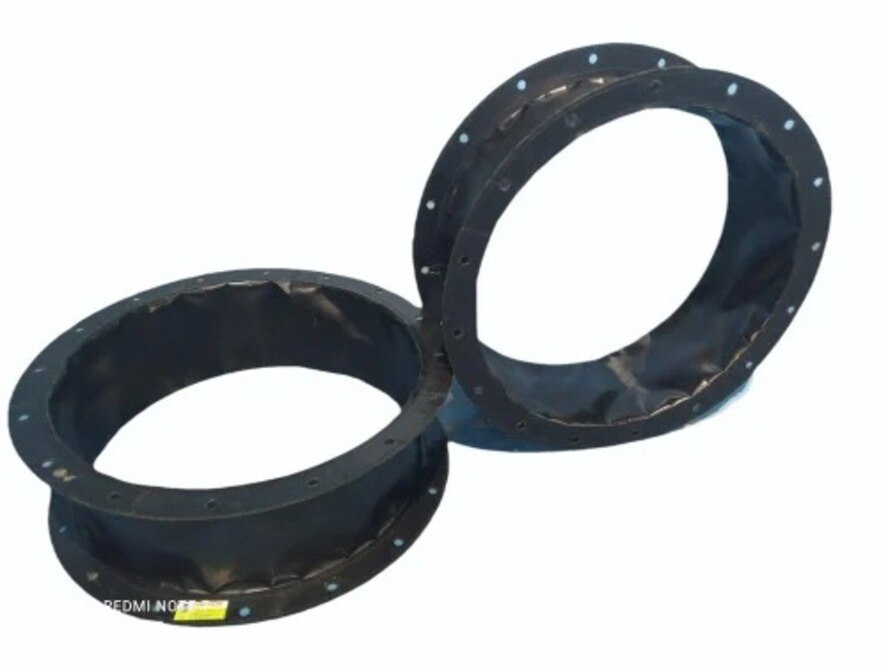
| Fabric expansion joint or fabric expansion bellows | Maintain a gas seal while absorbing duct thermal growth, vibration, axial movement, lateral offset and limited angular misalignment | Duct size, pressure or vacuum, gas and fabric temperatures, gas composition, particulate abrasion, leakage target and movement cycles |
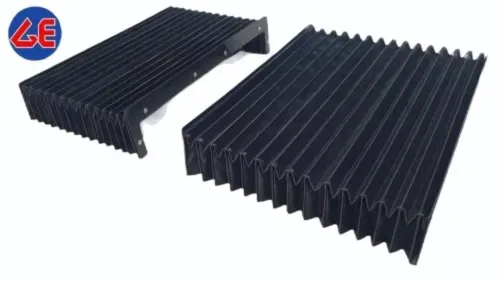
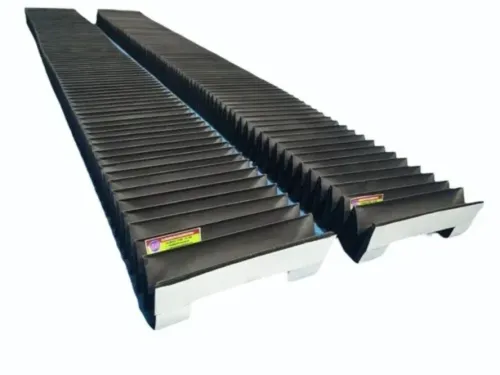
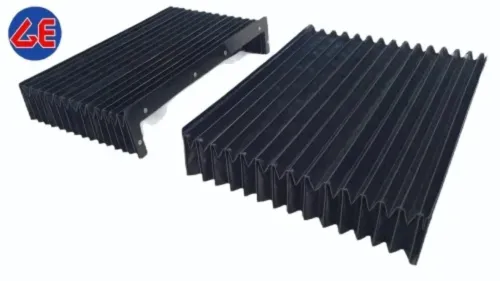
| Flexible bellow covers | Keep chips, coolant, oil, dust and heat away from guideways, screws, cables or other moving machine components | Travel length, folded height, extension speed, chip impact, coolant or oil exposure, wipers, mounting and required maintenance access |
This distinction changes the entire comparison. A duct joint is a low-pressure flue- or process-gas connector, not a general-purpose pressure-piping bellows. A machine cover is a protective enclosure, not a pressure seal designed to contain a gas stream.
Do not substitute flexible bellow covers for a duct expansion joint because both are called fabric bellows. Compare the duct joint with rubber, metallic or PTFE expansion connections using pressure, temperature, movement and leakage requirements. Compare the machine cover with telescopic steel covers, rolling covers or other guideway protection by travel, contamination and service access.
A metallic pipe bellows also requires pressure stability and fatigue-life calculations, commonly referenced against EJMA guidance; that is a different design basis.
How fabric, rubber, metallic, PTFE and rigid connections differ
Choose the connection by its dominant duty: a fabric expansion joint suits hot, low-pressure duct movement; rubber suits vibration; metallic bellows suit higher pressure and temperature; PTFE suits corrosive media; rigid connections suit stability where movement is negligible.
| Connection | Movement, pressure and temperature | Vibration, chemicals and service |
|---|---|---|
| Fabric | Large axial and lateral movement; low pressure or vacuum duty; hot-gas temperatures depend on layers | Good vibration isolation; liner selection controls chemicals; inspect fabric, seals and hardware |
| Rubber | Moderate movement and excellent flexibility; limited by elastomer temperature and pressure rating | Best for pumps, noise and vibration; ozone, aging, abrasion and chemicals shorten service life |
| Metallic | Axial and lateral movement with higher pressure and temperature capability | Resists heat and many chemicals; transmits more vibration and needs accurate alignment to prevent fatigue |
| PTFE-lined | Useful movement at moderate pressure; check creep, cold flow, vacuum and cycle count | Strong chemical resistance; low stiffness demands support and careful leakage inspection |
| Rigid | No useful movement; highest structural stability and pressure confidence when properly designed | Lowest flexibility; needs anchors, guides and space for a separate expansion arrangement |
A fabric connection usually needs more installation length than a metallic bellows, while rubber and PTFE options can fit tighter spaces. Do not confuse flexible bellow covers with duct connectors: covers protect moving machine parts from chips, coolant and dust, whereas duct joints seal thermal movement.
For leakage control, specify the allowable leak rate, flange arrangement and inspection access. Choose a fabric design when replacement access is practical and abrasion or heat will consume layers; choose metallic construction when long cycle life and compact installation outweigh vibration isolation.
Specify movement, pressure and temperature before requesting a price
Provide the operating envelope before asking for a price: duct size, face-to-face length, gas composition, velocity, pressure, vacuum, temperature and movement. Fabric expansion bellows are low-pressure duct connections, not interchangeable with pressure-piping bellows.
| Operating item | Figures to provide | Why it matters |
|---|---|---|
| Axial movement | Compression and extension in millimetres | Sets the joint’s required working length |
| Lateral offset | Millimetres in each direction | Determines convolution geometry and liner clearance |
| Angular movement | Degrees, with the rotation axis identified | Prevents edge loading and uneven sealing |
| Torsion | Degrees of twist or torque in newton-metres | Fabric expansion joint designs do not automatically tolerate twisting |
| Vibration | Frequency in hertz, amplitude in millimetres, and duration | Separates continuous vibration from occasional shock |
| Thermal growth | Duct length, installation temperature, operating temperature and movement per cycle | Converts temperature change into actual displacement |
| Pressure and vacuum | Normal and design pressure in pascals, plus maximum negative pressure | Vacuum can collapse unsupported fabric or draw the liner into the gas path |
| Cycling | Start-stop cycles per day and total design cycles | Determines fatigue, flexing and inspection requirements |
State normal, upset and start-up temperatures separately. Give gas-side, fabric or liner, insulation, and external cold-face temperatures; one advertised maximum is meaningless without its location. Also specify pressure pulses, particulate loading, required leakage level, attachment details and any internal support.
A quote that says only “industrial bellow covers in Hyderabad” omits the figures needed to judge suitability.
Match the liner, fabric, insulation and hardware to the gas stream
A fabric expansion joint needs a layered construction matched to gas temperature, chemistry, velocity and solids—not an outer-fabric rating alone. Specify gas-side, liner, insulation and cold-face temperatures separately; a flexible bellow cover for machinery follows different duties from a duct joint.
- Choose PTFE for aggressive acids, solvents and low-friction surfaces; verify its temperature limit and protect it from abrasion.
- Choose silicone for high-temperature, weather-resistant outer covers when oil and sharp particles are not dominant.
- Choose neoprene for moderate heat, outdoor exposure and oil resistance; choose EPDM for hot water, steam and weathering, but not hydrocarbon service.
- Choose aramid where tensile strength and tear resistance matter. Choose glass fibre for high-temperature reinforcement, and polyurethane where abrasion resistance matters at lower temperatures.
- Add a gas-sealing liner when the outer fabric is porous, chemically vulnerable or exposed to leakage requirements.
- Add an insulation pillow when gas heat could damage the belt, or when the cold face must remain within its temperature limit.
- Add a flow guide when high-velocity gas, vacuum or fly ash could strike the folds; use a wear strip where particles abrade a defined contact zone.
- Use a retaining ring to clamp the belt continuously. Use a backup bar when flange loading, pressure pulses or vacuum could pull the fabric from its attachment.
- Fit a weather shield outdoors to block rain, ultraviolet exposure and falling debris without trapping water against the joint.
State gas composition, dust loading, velocity, normal and upset temperatures, pressure or vacuum, movement cycles and leakage target before comparing flexible bellow covers.
Use a documented comparison when sourcing in Hyderabad
Use the same data sheet for every bidder; otherwise “industrial bellow covers in Hyderabad” becomes a location label rather than a technical comparison.
Record whether you need a duct expansion joint or a machine-tool cover, because a guideway cover is selected for travel, chips and coolant, while a duct joint is selected for pressure, gas and thermal movement.
- Duct or opening size, face-to-face length, operating and design pressure, vacuum or suction
- Gas composition, gas velocity, particulate loading, normal and upset temperatures
- Gas-side, liner, insulation and external cold-face temperatures separately
- Axial movement in millimetres, lateral offset, angular movement in degrees, torsion, vibration and expected cycle count
- Required leakage level, liner and fabric construction, insulation pillow, flow guide, wear strip, retaining ring, backup bar and weather shield
- Flange drilling, bolt material, attachment method and delivery documents
2. Inspect each supplied joint against the drawing. Check dimensions, neutral length, bolt holes, folds, stitching or bonding, liner continuity, hardware, material certificates and visible cuts or delamination. Ask the supplier to state the test method and result for leakage; do not accept a single advertised “maximum temperature” without its measurement location.
3. Put the installation sequence in writing: support the duct independently, set the joint at neutral length, align both flanges, and prevent twisting, forced offset, over-compression or over-extension. Record cold and hot clearances, bolt tightening, final photographs and sign-off.
For fabric expansion joint bellow covers for comparison in Hyderabad, compare this completed record with rubber, metallic and PTFE alternatives—not merely local availability. GURUKRUPA BELLOWS PVT LTD can be included in the same document-based evaluation.
Related products
 | Fabric Expantion Bellow ₹1000 Make in Heavy duty Fabric’s View product → |
 | Bellow Cover We are considered a well-known name in the business that manufactures and supplies Bellow Cover. View product → |
Frequently asked questions
Is a fabric expansion joint the same as a machine bellow cover?
No. A fabric expansion joint connects duct sections and absorbs thermal or mechanical movement. A machine bellow cover shields moving guideways, cables or machine components from contamination and wear.
How do fabric, rubber, metallic and PTFE connections differ?
Fabric joints suit duct movement and thermal isolation, rubber connections handle flexible vibration service, metallic bellows tolerate higher temperatures and pressures, and PTFE helps resist aggressive chemicals. Rigid connections do not absorb movement.
What information should you provide before requesting a price?
Provide axial, lateral and angular movement; operating and design pressure; continuous and peak temperature; duct dimensions; gas composition; installation space; and expected cycle frequency.
Which materials should match the gas stream?
Select the liner, fabric, insulation and hardware against gas temperature, moisture, chemicals, abrasion, dust concentration and corrosion risk. Confirm compatibility with the supplier’s written material specification.
How can you compare industrial bellow covers in Hyderabad?
Use a written comparison listing movement capacity, pressure, temperature, materials, dimensions, hardware, inspection documents, installation scope and warranty terms for each supplier.
Related products
 | Thermally Bonded Bellows ₹1000 Product Details: Brand GURUKRUPA Color BLACK & OTHER Size ALL On offer from us is available Thermally Bonded Bellows for the clients. View product → |
 | Bellow Cover The range of CNC Bellow Cover is manufactured on our premises, under the guidance of our expert professionals. View product → |