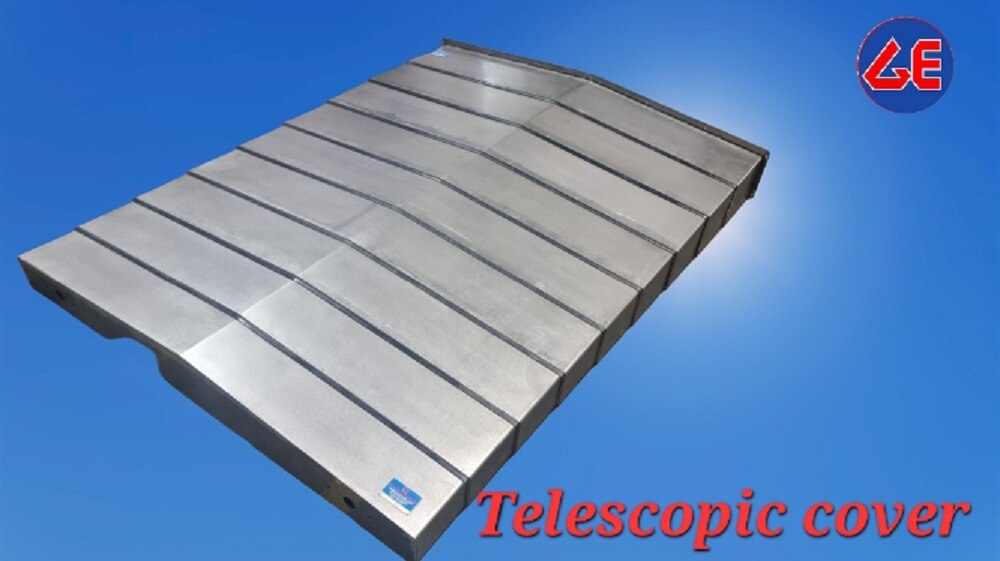
An open gap, scraping noise, or jerky box movement means the cover may have lost alignment or travel synchronization, not merely suffered surface damage. By the end, you will be able to identify the failure, inspect it safely, decide between repair and replacement, and specify a cover that matches your machine’s actual duty.
Key takeaways
- Stop the machine before forcing a jammed telescopic cover.
- Treat an exposed guideway as evidence of a mechanical protection failure.
- Repair bent boxes only after checking travel, seals, wipers, and alignment.
- Specify stroke, closed length, box count, materials, and chip conditions for replacement.
What an Exposed Guideway Tells You About the Failure
A dent is cosmetic only when every box still travels squarely, closes fully, and keeps chips and coolant away from the guideway. If the cover leaves a guideway or ballscrew visible, treat the CNC machine cover problems as a mechanical fault, not a surface defect.
| Symptom | What it indicates | Why it matters |
|---|---|---|
| Scraping, rattling, or jerky extension | Bent box, displaced roller, damaged sliding shoe, or blocked track | Side loading can buckle a section or pull it out of its guide |
| Uneven box movement or a persistent gap | Lost travel synchronisation or an out-of-square mounting | The cover will expose machine parts during movement |
| Coolant or oil inside the telescoping assembly | Torn, curled, hardened, or overloaded wipers; blocked drain channels | Contamination accelerates roller, track, and guideway wear |
| Exposed guideway after closing | Distorted sections, elongated mounting holes, or incorrect alignment | Wiper replacement alone cannot restore coverage |
| Cracked welds, corner fatigue, or loose fasteners | Structural CNC telescopic cover damage | A repaired dent can hide a box that is losing its shape |
Chip packing between sections can force uneven telescoping and produce progressive scraping. Hardened coolant residue, collision damage, excessive speed, poor levelling, worn rollers, and inadequate lubrication create the same warning pattern.
Look beyond the outer skin: compressed wipers, damaged drain channels, and fatigue cracks around attachment points explain why a cover remains open after dent removal. Do not return the machine to production until the cover closes without binding and the guideway stays fully protected.
The Inspection Sequence: Stop the Machine Before You Force the Cover
A scraping, jammed, leaking, or partly open cover is a stop-and-isolate event, not a problem to overcome with extra feed force. Stop the machine, isolate electrical and hydraulic energy, and wait for hot chips and coolant to drain before placing your hands near the sections.
1. Record the failure position. Note whether the boxes move unevenly, rattle, leave a gap when closed, expose a guideway or screw, or rub against the machine structure. Photograph the gap and any coolant trail before cleaning.
2. Remove loose chips and hardened coolant from between sections, tracks, and drain channels. Chip packing can hold a section open, create side loading, and pull a box out of its guide.
3. Check alignment through the full stroke by moving the cover slowly by hand after isolation. Both sides should travel together without binding, sudden jerks, or abnormal noise. Do not continue if a section buckles or catches.
4. Inspect the mechanical guidance. Look for bent boxes, displaced or worn rollers, damaged sliding shoes, blocked tracks, loose rivets, fasteners, elongated mounting holes, distorted flanges, and cracked welds around corners or attachment points.
5. Examine wipers and scrapers for compression, tearing, hardened edges, and loss of contact. Check every closed-position gap and drain path; a failed wiper explains leakage, not a bent section or lost overlap.
6. Check the exposed machine parts for chips, scoring, coolant, and corrosion before restarting. CNC machine cover problems that leave a reachable hazard, shed fragments, or direct coolant toward electrical equipment require repair before production. Cosmetic dent removal does not eliminate hidden CNC telescopic cover damage.
When CNC Telescopic Cover Repair Is Safe—and When It Is Not
CNC telescopic cover repair is safe when the box sections remain square, travel smoothly through the full stroke, and retain equal overlap on both sides. Replaceable faults include compressed wipers, brushes, guide rollers, sliding shoes, loose fasteners, blocked drain channels, and an individual section with a light, localised dent.
Remove chips and hardened coolant before judging the mechanism.
| Option | Repair or replacement decision | Evidence to check |
|---|---|---|
| Wipers, brushes, rollers, sliding shoes | Replace the affected part | Sections move evenly after fitting, with continuous contact and no scraping |
| Fasteners, rivets, drain channels | Repair or replace locally | Mounting holes remain round, flanges remain flat, and drainage works |
| One lightly dented section | Repair or replace that section | The section closes fully without side loading or loss of overlap |
| Several twisted sections or bent guides | Replace the complete box assembly | Jerky travel, unequal side movement, buckling, or a section pulled from its guide |
| Mounting bracket or support structure | Replace or realign the structure | Elongated holes, cracked welds, fatigue cracks at corners, or a cover installed out of square |
| Corroded or repeatedly failing cover | Replace the complete cover | Material has thinned, guide geometry is permanently distorted, or the design cannot handle the machine cycle |
CNC telescopic cover damage demands full replacement when cosmetic dent removal leaves gaps, exposed guideways, abnormal noise, or rubbing against the machine. Do not fit new wipers over bent boxes, worn mounting points, or displaced rollers; the cover will fail again and can damage the guideway.
Obtain section drawings and replacement-part availability before approving a partial repair.
Cleaning, Maintenance, and the Cost of Running with Exposed Parts
Restore movement without forcing the boxes. Isolate machine power, remove packed chips, and soften hardened coolant residue with a cleaner approved for the cover material. Do not blast debris into the guideway with compressed air.
Check whether the track, roller, or sliding shoe is binding before applying lubricant; the wrong lubricant can turn abrasive dust into grinding paste.
Use this inspection schedule:
- At every shift, inspect closed-position gaps, exposed guideways, loose fasteners, and fresh coolant or oil leakage.
- Once a week, clean the tracks and check smooth travel through the complete stroke at low jog speed.
- After a collision, abnormal noise, or sudden scraping, stop production and inspect the cover before the next cycle.
- At the interval specified by the cover maker, measure roller wear, wiper compression, section overlap, and mounting alignment.
If movement remains jerky after cleaning, do not compensate by increasing force or machine speed. CNC telescopic cover repair must correct a bent section, worn roller, displaced shoe, elongated mounting hole, or out-of-square mounting; replacing a wiper alone will not restore synchronization. These are common CNC machine cover problems that quickly become guideway damage.
After repair, run the cover slowly across its full travel and confirm both sides move together, every section closes completely, and no flange rubs the machine structure. Remove any remaining burrs or chips, verify drain channels discharge away from the guideway, and record the inspection result.
Stop immediately if a gap reappears: exposed screws and guideways can turn a small cover fault into corrosion, scoring, and unplanned machine downtime.
How to Specify a Replacement Cover and Find Support in Kolhapur
Send a dimensional and duty schedule before asking for a CNC telescopic cover for problems in Kolhapur. A nominal stroke or photograph alone cannot prevent a replacement from repeating the same failure.
1. Record closed and extended lengths, total section count, cover height and width, travel direction, orientation, and mounting-hole pattern. Measure each section and mounting face after removal; a bent box can hide lost overlap.
2. State the machine duty: axis speed and acceleration, operating hours, acceptable service life, and whether the cover serves a vertical, horizontal, or inclined axis. Add the contaminant—dry chips, abrasive cast-iron dust, flood coolant, high-pressure coolant, minimum-quantity lubrication, or humid air—and describe the cleaning method and pressure.
3. Photograph the cover fully closed and extended, both sides, mounting brackets, wipers, drain channels, rollers, gaps, dents, cracks, and exposed guideway. Include a ruler, machine nameplate, and close-up of any elongated hole or damaged weld.
4. Compare quotations against section material and thickness, wiper profile, guide elements, roller design, drain arrangement, tolerances, replacement-part availability, drawings, and repair instructions. Confirm who will verify alignment and fit after installation.
For local support, ask whether GURUKRUPA BELLOWS PVT LTD can supply section parts, wipers, drawings, and installation guidance rather than treating “custom size” as enough information.
A CNC telescopic cover repair is economical for isolated wipers, rollers, fasteners, or lightly damaged sections; replace the assembly when boxes are twisted, corrosion has thinned them, or the design mismatches the machine cycle.
Related products
 | CNC Telescopic Cover Product Details: Brand GURUKRUPA Being one of the trustworthy names of the industry, we bring forth CNC Telescopic Cover that can be availed at... View product → |
 | Telescopic Cover ₹5000 Product Details: Brand GURUKRUPA Being one of the trustworthy names of the industry, we bring forth CNC Telescopic Cover that can be availed at... View product → |
Frequently asked questions
What does an exposed guideway indicate on a CNC machine?
It indicates that the telescopic cover is not closing or sealing correctly, allowing chips and coolant to reach the guideway.
What should you do before inspecting a damaged CNC telescopic cover?
Stop the machine, isolate its power, prevent axis movement, and inspect the cover without forcing its boxes by hand.
When is CNC telescopic cover repair safe?
Repair is suitable when damage is limited to accessible seals, wipers, fasteners, or a minor deformation that does not affect alignment or travel.
When should you replace a CNC telescopic cover instead of repairing it?
Replace it when boxes bind, overlap incorrectly, remain open, have cracked welds, or cannot protect the guideway through the full stroke.
Related products
 | Telescopic Cover Product Details: Brand GURUKRUPA Being one of the trustworthy names of the industry, we bring forth CNC Telescopic Cover that can be availed at... View product → |
 | Steel Telescopic Cover Product Details: Brand GURUKRUPA Our company is considered a renowned name in the field that manufactures and supplies Steel Telescopic Cover. View product → |
 | Industrial Telescopic Covers Our company is known as one of the eminent names of the industry to manufacture and supply Industrial Telescopic Covers. View product → |
 | SS Telescopic Cover Product Details: Brand GURUKRUPA We are among the celebrated names of the business to bring forth SS Telescopic Cover in standardized packaging. View product → |