A fabric cover must follow the machine’s motion without rubbing, sagging, tearing, or restricting the guideway beneath it. By the end, you will know how fold geometry absorbs movement, how to specify the required dimensions, and when fabric is a poorer choice than a metal or laminated design.
Key takeaways
- Match fold geometry to required travel and compressed package length.
- Measure travel, opening size, mounting space and misalignment before fitting.
- Select fabric, coatings, stitching and reinforcements for the operating environment.
- Use expansion bellows when components need flexible protection during repeated movement.
How folded fabric follows the machine’s movement
A folded fabric cover accommodates movement by opening and closing its accordion folds as the protected component travels. The sections compress and extend along the main axis, flex sideways, and bend through limited angular misalignment between a fixed frame and a moving machine element.
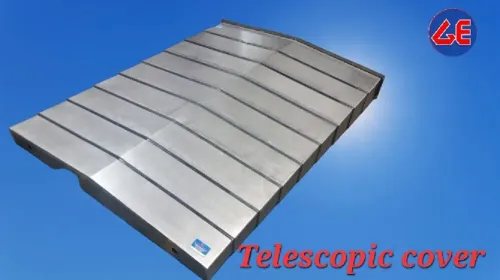
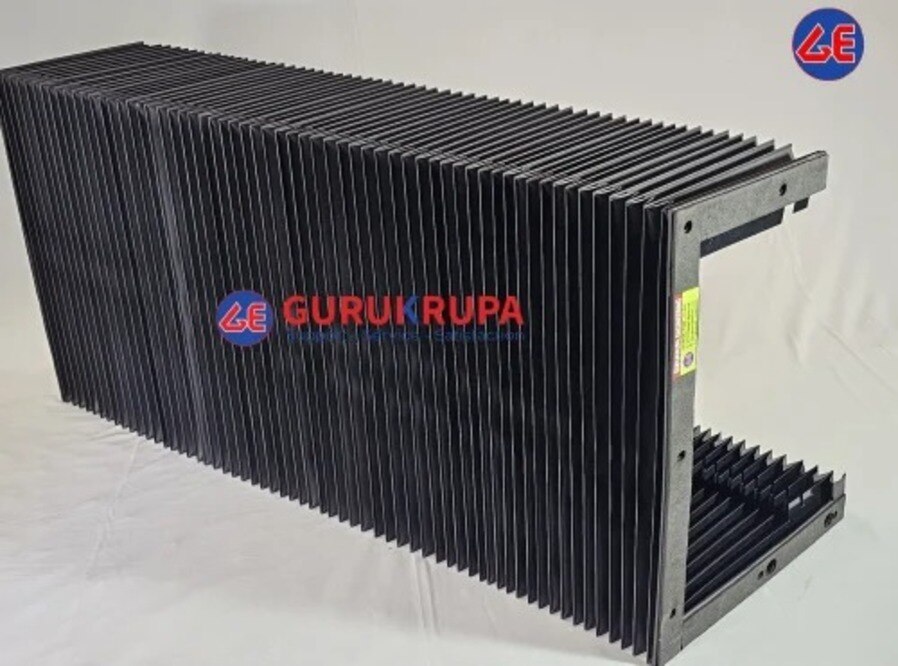
That is how fabric bellow covers for handle equipment movement preserve protection without guiding or carrying the machine load.
- Linear movement: The folds open during extension and collapse during retraction, creating a repeatable cover stroke.
- Lateral movement: Flexible fabric shifts across the width or height to follow offset between mounting points, provided the folds do not rub or buckle.
- Angular movement: The cover bends unevenly when the moving end changes angle, but excessive skew twists the folds and concentrates stress at the attachment.
- Vibration: The fabric absorbs small, rapid oscillations through repeated flexing; secure frames, guides, hoops, or slats prevent flapping and contact with the machine.
Combined movement needs more than a straight-stroke check. Inspect the cover through the complete motion envelope, including maximum compression, extension, offset, angle, and vibration. Long horizontal fabric bellow covers need support, or sag can cause uneven folding, interference, or entrapment between moving parts.
How fold geometry determines travel and package length
Usable movement range is the difference between a cover’s extended length and compressed length, after subtracting required clearances and movement limits. Nominal machine stroke alone is not enough: a cover can bottom out before the slide reaches its end or overstretch at full extension.
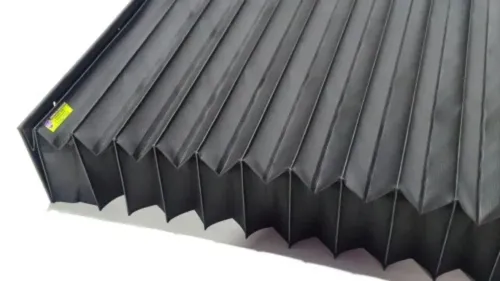
- Fold height sets the depth of each accordion section. Greater height usually provides more expansion per fold, but increases the compressed package and the space needed beside the machine.
- Fold pitch is the distance between adjacent fold peaks. A tighter pitch can shorten the package, but it increases crease flexing, particle retention, rubbing risk, and minimum bend requirements.
- Fold count determines how many expansion sections share the stroke. More folds can provide greater total travel without making each fold excessively deep.
- Compressed length is the cover’s shortest installed length. Check it against the slide, tooling, cable carrier, and adjacent covers; compression beyond this point damages folds and frames.
- Extended length is the maximum designed length. It must exceed the open machine length while preserving attachment overlap and preventing tension at full stroke.
For a moving cover, calculate required length from fixed and moving mounting points at both extremes, then add lateral, angular, and vibration clearances. Fabric bellow covers need repeated full-stroke testing because fold tracking and contact problems rarely appear during static inspection.
What to measure before fitting a moving cover
Measure fabric bellow covers at the machine’s actual mounting points, not from a drawing alone. Record the fixed and moving attachment locations, nominal stroke, maximum lateral offset, vertical drop, angular misalignment, and the full motion envelope at every extreme position.
- Measure the opening width and height, mounting-face orientation, available compressed length, and required extended length. Include brackets, flanges, fasteners, and any overlap needed for sealing.
- Check clearance around the slide, tooling, workpiece, cable carrier, hoses, adjacent covers, and guards. The compressed package must not collide with any of them.
- Record speed, acceleration, cycle frequency, vibration, temperature, coolant, chips, sparks, and chemical exposure. These conditions determine fabric and seam requirements.
- Identify whether the cover runs horizontally or spans a long distance. Add slats, hoops, guide strips, or external support where gravity could make it sag into the moving zone.
- Measure cable and hose bend radius separately. A cover does not replace an energy chain, strain relief, or cable carrier.
| Measurement | Check at | Why it matters |
|---|---|---|
| Nominal stroke | Both travel directions | Confirms the cover’s usable movement allowance |
| Lateral and angular offset | Each machine extreme | Prevents twisted, uneven folding |
| Compressed package | Fully retracted position | Exposes interference with tools and carriers |
| Extended length and sag | Fully extended position | Reveals overstretching and unsupported span |
| Combined motion envelope | Complete cycle | Finds rubbing that end-point checks miss |
How material and construction choices affect service life
A coated fabric survives only when its coating, reinforcement, seams, and supports match the actual hazard profile. A coolant-resistant cover can still fail under hot swarf, cutting abrasion, sparks, or ultraviolet exposure.
| Hazard | Construction choice | Failure avoided |
|---|---|---|
| Dry chips and abrasive dust | Tough polyurethane- or PVC-coated fabric with abrasion-resistant reinforcement | Chip penetration and fold-to-fold wear |
| Coolant, oil, and chemicals | Verify compatibility with the exact fluid, concentration, temperature, and washdown agent | Swelling, cracking, and coolant wicking |
| Heat and sparks | Heat-rated coated fabric, with a spark-resistant outer layer or protective shield where needed | Burn-through and embrittlement |
| Outdoor exposure | UV-resistant coating, sealed edges, and corrosion-resistant frames | Sun degradation and water entry |
Choose sewn bellows when complex shapes or field repair matter; needle holes and seams then need sealing against leakage. Welded or bonded joints provide better enclosure continuity, but confirm coating compatibility and the approved repair method before ordering.
Use end frames, guide strips, support rings, or slats to keep folds aligned without making the fabric carry machine loads. Keep clamps and fasteners outside the active flexing zone, align both mounting frames, and prevent casting contact. Otherwise, overstretching, compressed folds, frame distortion, and horizontal chip accumulation will shorten the life of fabric bellow covers.
When a fabric expansion bellow cover is the right design
Choose a fabric expansion bellow cover when the job is to shield moving machine parts, not to carry pressure, guide motion, or absorb duct loads. It follows the equipment’s movement while the slide, linkage, or frame carries the mechanical load.
| Option | What it does | When it applies |
|---|---|---|
| Machine-protection cover | Encloses guideways, screws, cables, or mechanisms against chips, dust, coolant, and abrasion | Moving industrial equipment |
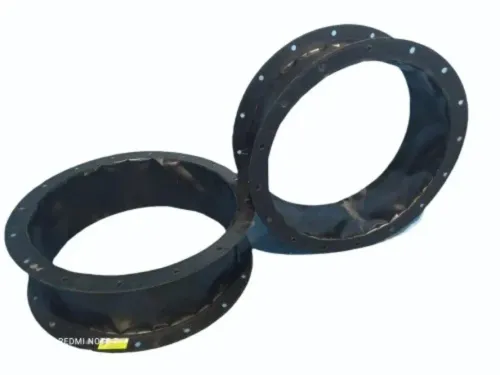
| Flexible connector | Joins misaligned piping or equipment while limiting transmitted vibration | Pipework connections |
| Duct expansion joint | Accommodates thermal growth, pressure, leakage, and connection loads | Ventilation and process ducts |
| Guideway bellows | Protects a defined machine guideway, often with a shaped mounting arrangement | Slides and linear axes |
| Metal bellows | Provides a sealed, pressure-capable flexing element with high dimensional stability | Vacuum, fluid, or high-temperature service |
Before ordering, give the supplier the complete operating envelope:
- Travel in every axis, speed, acceleration, cycle frequency, and orientation
- Open and closed lengths, mounting points, width, height, and minimum clearances
- Temperature, fluids, chip or dust type, cleaning method, and required service life
- Support needs for long or horizontal spans, including hoops, slats, or guide strips
- Seam method, leakage expectations, repair plan, and the full motion-envelope drawing
“Custom fabric bellows in Kolhapur” is only a sourcing phrase. GURUKRUPA BELLOWS PVT LTD still needs these figures to distinguish a machine cover from a pressure-rated expansion joint and quote a usable design.
Related products
 | Fabric Expantion Bellow ₹1000 Make in Heavy duty Fabric’s View product → |
 | Bellow Cover We are considered a well-known name in the business that manufactures and supplies Bellow Cover. View product → |
Frequently asked questions
How do fabric bellow covers accommodate machine movement?
Their accordion folds open and close along the travel axis while flexing sideways and bending through limited angular misalignment.
How does fold geometry affect a fabric bellow cover?
Fold depth, pitch and the number of folds determine available travel, compression ratio and the cover’s stored package length.
What measurements are needed before fitting a moving cover?
Measure maximum travel, opening dimensions, compressed and extended lengths, mounting points, clearance and expected angular or sideways movement.
Which construction choices affect service life?
Base fabric, coating, temperature and chemical resistance, stitching, reinforcement and protection against abrasion determine how long the cover performs.
When is a fabric expansion bellow cover the right design?
Choose it when a flexible enclosure must protect moving guideways, cables, hoses or machine parts while allowing repeated extension and compression.
Related product
 | Soft Material Bellow Product Details: Brand GURUKRUPA Specifications:- Function of accordion machine shield: water-proof,oil-proof, anti-corrosion, fire-proof... View product → |