A soft bellow cover is an engineered moving barrier, not simply a piece of fabric placed over an exposed axis. You will learn which machine parts it protects, how CNC and CMM requirements differ, which dimensions to measure, and which material and test details to request before approving a design.
Key takeaways
- Specify folds, support strips, liners, frames, and mounting flanges.
- Protect guideways, slides, cables, hoses, scales, and exposed machine components.
- Choose soft bellows when flexibility and complex travel matter more than rigid shielding.
- Measure travel, compressed length, height, width, clearance, and mounting points.
What a soft material bellow cover contains and how it moves
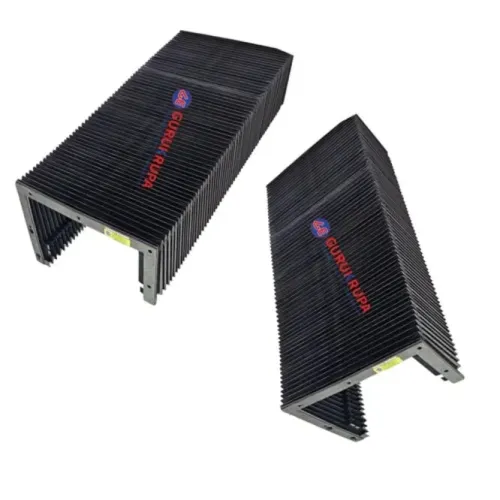
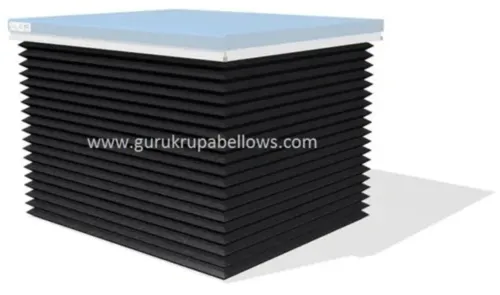
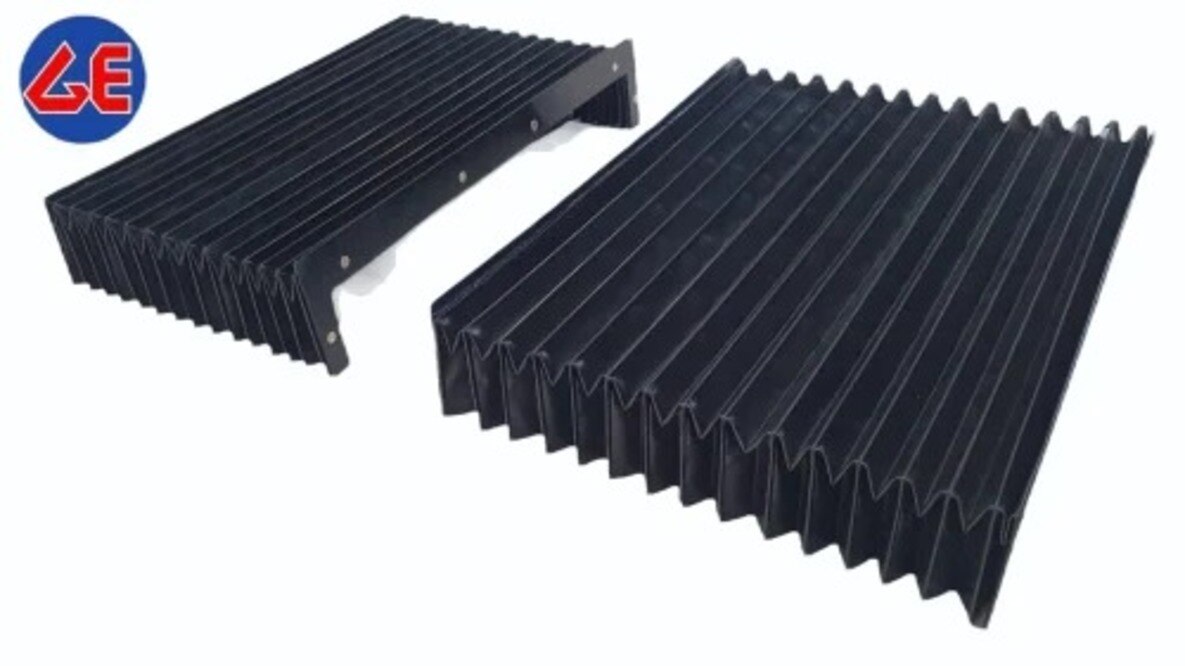
A soft material bellow cover is an engineered assembly: a coated-fabric or elastomer body joined with sewn or welded seams, accordion folds, end frames, and mounting flanges. Internal support strips prevent collapse; liners reduce abrasion or fluid retention, while optional wipers close the moving interface.
| Term | What it means | Why it matters |
|---|---|---|
| Extended length | Cover length at full travel | Must span the complete stroke |
| Compressed length | Folded package at the opposite end | Must fit the available end clearance |
| Fold pitch | Distance between adjacent folds | Sets extension, package size, and fold count |
| Available clearance | Space around the moving cover | Prevents collisions with castings, carriers, or tooling |
As the CNC slide, bridge, or carriage moves into the open position, the folds extend; at the opposite end, they compress into a defined package. Size the cover for the full stroke without forcing folds below their minimum radius, or the fabric, seams, and support strips will crease, rub, and fail prematurely.
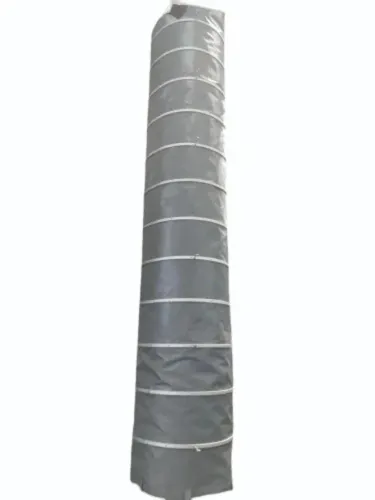
Horizontal installations may need anti-sag support, support strips, or specialised fold geometry so the cover does not drag on a guideway. Vertical installations require checks on extended cover weight, attachment loads, and compression behaviour.
A Soft Material Bellow Cover, catalogue product ID 6598c1bd, closes a moving gap and limits contamination; it is not automatically an operator safety guard. Machine guarding must address access to hazardous motion separately.
Which CNC and CMM components these covers protect
CNC covers shield guideways, linear rails, ballscrews, lead screws, linear scales, encoder systems, moving slides, cables, and hoses from chips, coolant splash, oil, dust, and abrasive fines. A machining-centre cover needs tougher abrasion and splash resistance than a cover on a small enclosed axis because high-volume cutting produces sharper debris and more fluid exposure.
| Machine | Components protected | Main protection priority |
|---|---|---|
| CNC | Guideways, rails, screws, scales, encoders, slides, cables, hoses | Resist chips, coolant, oil, dust, and abrasive fines |
| CMM | Guideways, scales, encoders, bridge or carriage travel, drive and cable routes | Preserve clean movement, low drag, and measurement access |
For CMM equipment, bellow covers for CMM machines limit dust and accidental contamination around precision motion systems. They must shed few particles, remove easily for inspection, and leave unobstructed access to the granite table, probe, and calibration artefacts. A fold that rubs the bridge, carriage, scale, probe, or granite can introduce drag or measurement error.
Bellow covers for cnc machines in pune should be specified against the actual duty, not the machine name alone. A sharp or heavy chip creates impact loading that soft fabric may not withstand; use telescopic steel covers, a chip shield, or a separate enclosure when that exposure exists.
A cover blocks contamination, not operator access to hazardous motion. It must never replace machine guarding or a properly designed enclosure.
Soft bellows versus steel, roll-up, wiper, and three-sided covers
Soft fabric bellows suit complex movement and leave a compact folded package when the axis retracts. Rigid telescopic steel covers resist heavy chips and impact better, but their added mass demands suitable guides, supports, and attachment points.
| Option | What it does | When it applies |
|---|---|---|
| Soft material bellow covers | Accordion folds expand and compress with the axis | Complex paths, limited folded space, coolant splash, dust, and moderate abrasion |
| Telescopic steel covers | Interlocking metal sections shield against impact | Heavy or sharp chips, high-impact machining, and severe debris |
| Roll-up covers | Wind onto a drum during travel | Long, relatively straight movement with room for the drum |
| Way wipers | Seal the moving interface with a strip | Supplementary sealing; not a full enclosure for an exposed guideway |
| Three-sided covers | Shield the top and sides while leaving the underside or access side open | Drainage and maintenance access matter, but all-round protection is unnecessary |
Choose the construction against the exposure, not merely the machine name. Check soluble-oil coolant, cutting oil, grinding dust, hot chips, sparks, cleaning chemicals, and ultraviolet light against the actual fabric, coating, seams, and elastomer. PVC fabric alone is not a complete material specification.
For a buyer comparing bellow covers for CNC machines in Pune, ask whether the cover needs a steel shield, chip guard, or separate enclosure. A way wiper cannot replace that protection, and a three-sided cover does not protect the open underside. A bellow also limits contamination; it is not automatically an operator safety guard.
How to measure the installation envelope before ordering
An overall open length is not enough for a quotation. A cover with the correct stroke can still hit a guard, cable carrier, tool, or enclosure when its compressed package is too tall or long.
1. Record the required extended length, compressed length, total axis travel, fold pitch, open height, folded height, cover width, and clearance available at both ends. Include minimum and maximum height, not only the nominal open dimension.
2. Measure each mounting interface: flange length and width, bolt-hole pattern, hole diameter, reference datums, and attachment type. State whether the connection is fixed, floating, bolted, clamped, or fitted to a frame.
3. Mark travel direction and mounting orientation on a sketch. Add the bend radius and the positions of cable carriers, hoses, tooling, probes, guards, access doors, and nearby machine castings.
4. Check the complete motion envelope through the full stroke. Confirm that folds will not restrict travel, collide with a tool or probe, rub against a carrier, sag onto a guideway, or impose excessive return force on a CMM bridge or carriage.
5. Request a dimensioned drawing showing the compressed package, folded height, mounting datums, and end clearances. A nominal size alone is not usable for soft material bellow covers for CNC CMM in Pune.
6. Ask for allowable speed, acceleration, cycle frequency, minimum fold radius, and cleaning access. Identify the CNC machining centre, small CNC axis, bridge CMM, or other coordinate machine because equal stroke lengths do not guarantee equal envelope or mounting requirements.
What to verify in the material, test data, and supplier drawing
Treat “heavy duty” as a starting point, not evidence. Request the construction and limits in writing before comparing prices, because a cover that fits the stroke can still crack, delaminate, or trap coolant.
- Named base fabric, coating or elastomer, seam method, liner or support construction
- Temperature range, fire classification, and chemical-resistance chart
- Ingress test method or rating where relevant
- Minimum fold radius, expected operating speed, acceleration, and cycle-life test conditions
- Dimensioned mounting drawing showing compressed length, end attachments, clearances, and fold package
- Replacement details for fabric sections, liners, or the complete cover
Match each claim to the actual exposure.
| Exposure | Evidence to request | Failure to detect |
|---|---|---|
| Soluble-oil coolant | Coolant name, concentration, immersion or spray test | Swelling, cracking, delamination |
| Cutting oil | Oil type and chemical-compatibility result | Softened coating or seam failure |
| Abrasive dust and chips | Abrasion test, chip size and temperature limits | Pinholes and underside wear |
| Cleaning agent | Named chemical and resistance result | Brittle folds or adhesive attack |
| Sparks or hot chips | Fire classification and temperature test conditions | Burn-through or ignition |
| UV exposure | UV ageing method and duration | Faded, embrittled fabric |
Treat “waterproof,” “oil-proof,” “anti-corrosion,” and “fire-proof” as incomplete without test conditions. During maintenance, inspect fold roots, seams, end attachments, underside abrasion, compressed folds, trapped chips, and fluid pockets.
For soft material bellow covers for CNC CMM in Pune, ask GURUKRUPA BELLOWS PVT LTD for the application-specific datasheet and mounting drawing. Compare them with the machine envelope and contamination duty, including bellow covers for CMM machines; catalogue references include CNC Bellow Cover, product ID 6598c194, and Soft Material Bellow Cover, product ID 6598c1bd.
Related products
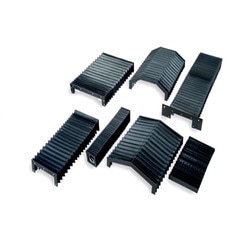 | CNC Bellow Cover Product Details: Brand GURUKRUPA Color BLACK Size ANY We are considered a well-known name in the business that manufactures and supplies CNC Bellow... View product → |
 | Soft Material Bellow Product Details: Brand GURUKRUPA Specifications:- Function of accordion machine shield: water-proof,oil-proof, anti-corrosion, fire-proof... View product → |
Frequently asked questions
What does a soft material bellow cover contain?
It contains a coated-fabric or elastomer body, accordion folds, sewn or welded seams, end frames, mounting flanges, and optional support strips, liners, or wipers.
Which CNC and CMM components do soft bellows protect?
They protect guideways, linear slides, ball screws, cables, hoses, scales, probing hardware, and other moving components from chips, dust, coolant, and abrasion.
How do soft bellows compare with steel, roll-up, wiper, and three-sided covers?
Soft bellows suit flexible, multi-axis movement and irregular shapes; steel covers resist heavy impact, roll-up covers suit long straight travel, wipers seal contact edges, and three-sided covers shield open guideways.
What measurements must you provide before ordering a bellow cover?
Provide maximum travel, compressed length, extended length, folded height, width, mounting-face dimensions, clearance, attachment points, and nearby interference locations.
What should you verify in the material and supplier drawing?
Check the material construction, temperature and chemical resistance, seam method, support-strip design, test data, mounting details, folded dimensions, and travel limits.