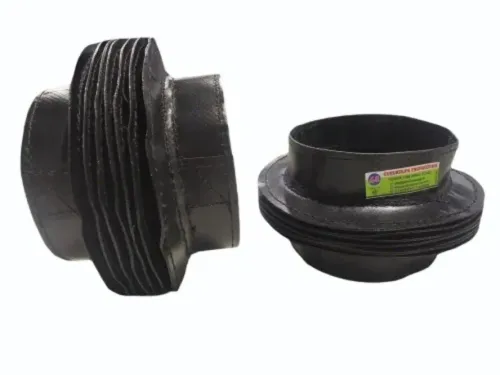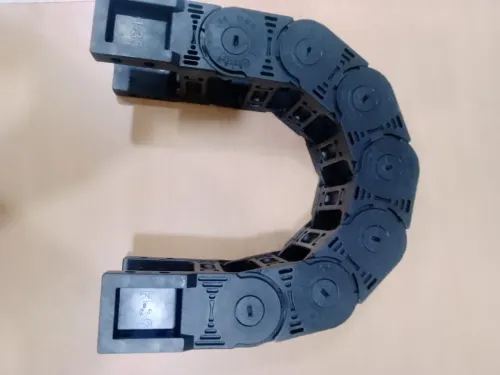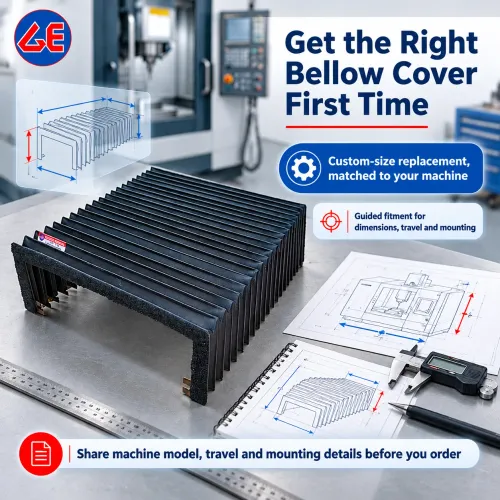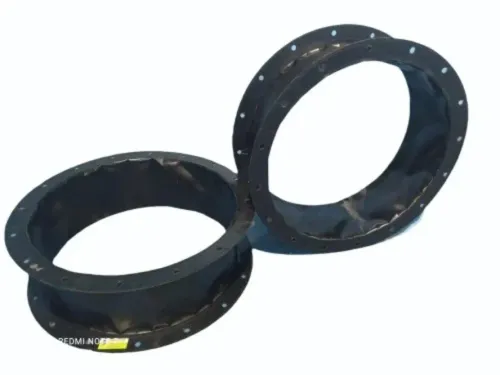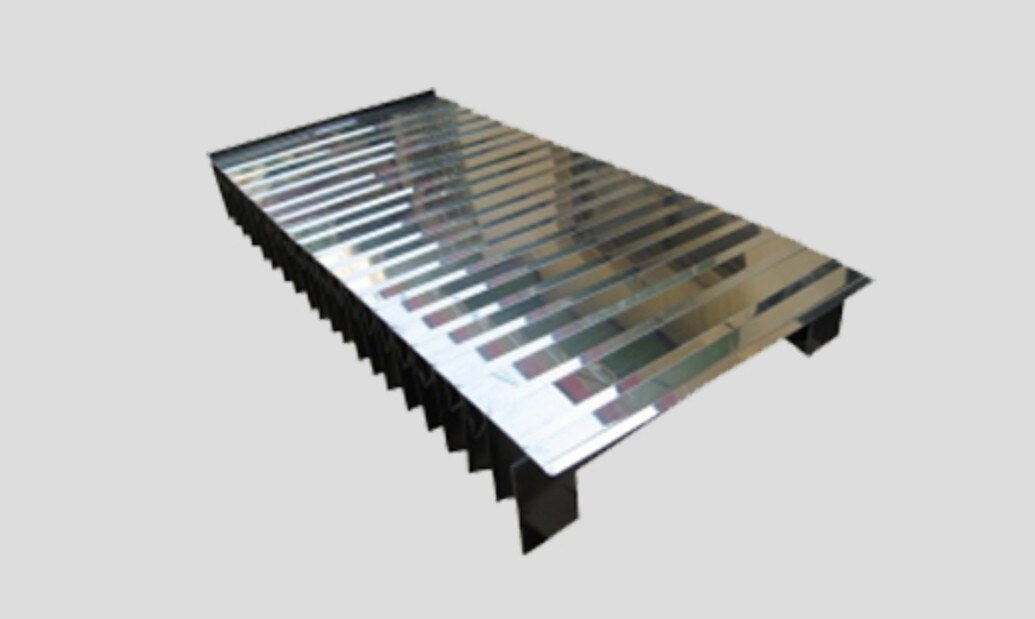
A distributor cannot choose an SS lamella cover from guideway width and travel alone. The right specification must match the machine’s chips, coolant, speed, available installation space and replacement requirements, so buyers can compare technically sound quotations instead of selecting the lowest price.
Key takeaways
- Measure travel, compressed length, extended length, width and mounting clearances.
- Choose metal flaps when chips, heat or sharp debris exceed fabric-cover limits.
- Compare slat material, substrate, seals, access panels and replacement-part support.
- Test cleaning access and movement before judging total ownership cost.
How overlapping stainless-steel lamellae protect a moving guideway
An SS lamella bellow cover is a flexible bellows assembly, not a simple sheet-metal guard: overlapping stainless-steel slats form the chip-facing shield while fabric, elastomer or composite beneath supplies folding movement.
As the axis travels, the lamellae slide over one another or roll around the fold, keeping the metal flaps from obstructing the carriage or guideway. The fixed end attaches to the stationary machine frame; the moving end follows the carriage.
Continuous overlap through the full stroke prevents exposed gaps where chips or coolant could reach the covered way.
Clearance is engineered in both positions. Leave space between the cover and guideway, carriage, cables, guards and nearby components so the pack cannot rub, pinch or buckle at full extension or compression.
Front wipers sweep debris from the slats, end closures finish the openings and limit ingress, and lateral restraints keep the assembly aligned instead of allowing side drift. Stainless slats resist impact and puncture; they do not provide the folding action.
- Ask the quotation to show extended length, compressed pack length, cover width, mounting faces, minimum folding radius and clearance in extended and compressed positions.
- Check the drawing for overlap through the complete stroke, fixed and moving attachments, wiper position, end closures, lateral restraints and drainage path.
- Reject a width-and-travel-only quotation: it cannot prove that a metal flap bellow will clear the machine throughout its movement.
When metal flap machine protection is worth the added mass
Sharp hot chips, abrasive cast-iron dust, welding spatter, coolant splash and nearby cutting tools justify metal flap machine protection. Frequent cycling and high traverse speed strengthen the case, but require supplier validation because added mass increases inertial load and vibration.
| Option | Main advantage | Best fit | Main penalty |
|---|---|---|---|
| Lightweight fabric or accordion | Low mass and flexible folding | Clean machines, light chips, limited axis load | Puncture and heat damage |
| Ordinary flexible bellows | Simple protection on irregular paths | Dust, oil and moderate debris | Weaker resistance to sharp chips |
| Metal flap bellows | Stronger chip and puncture shielding | Hot, abrasive, wet or tool-exposed zones | Mass, noise and fold-space demand |
| Rigid telescopic steel cover | Very robust fixed geometry | Straight, spacious guideways | Poor fit for compact or irregular paths |
Choose a flexible metal design over a rigid telescopic cover when the guideway bends around obstructions, has limited installation space or needs a small folding radius. Choose fabric or an accordion cover when low moving-axis load, quiet operation and small packed thickness matter more than impact resistance.
More slat overlap improves shielding against splash and chip paths, but increases mass, friction and compressed thickness. Even well-overlapped slats can dent, wear at joints or admit chips through gaps. Check fold-space demand, clearance, allowable speed and acceleration before recommending the design; otherwise its protection can become a source of axis overload and premature wear.
What to measure before ordering a new or replacement cover
A quotation based only on guideway width and travel is incomplete. Measure the machine through its entire stroke before requesting SS lamella bellow covers.
1. Record the fixed and moving mounting faces, guideway width and length, full axis travel, available height and width, folded-pack and extended lengths, minimum bend radius, screw-hole locations, mounting orientation, and the paths of cables, hoses and adjacent guards.
2. Check clearance at both end positions and during the complete stroke. Include the compressed-pack clearance, carriage movement, nearby components and drainage space; a horizontal or inclined cover can trap chips and coolant if the folded pack has no drainage path.
3. Describe the operating load: chip size and material, traverse speed, acceleration, cycle frequency, coolant type and concentration, oil exposure, cleaning chemicals and operating temperature. Include wash-down direction and salt or chloride exposure where relevant.
4. Ask the supplier to place flap thickness, stainless-steel grade, overlap, total moving mass, allowable speed and acceleration, wiper material, edge sealing and fastener materials on the drawing or quotation. Request the minimum radius and both folded and extended dimensions there too.
A complete dimensional drawing lets you reject interference before manufacture and compare quotations on usable geometry, not a nominal width. Check whether the proposed overlap, wipers and end closures protect against your chip path without restricting the axis.
How to compare a flexible metal bellows supplier with a rigid-cover maker
A credible comparison starts with disclosure: require 304, 304L, 316 or 316L by name, not “SS.” For a metal flap bellow in Mumbai, provide coolant chemistry and concentration, wash-down chemicals, salt or chloride exposure, chip material and cleaning practice; city alone cannot specify corrosion performance.
| Feature | Flexible metal bellows supplier | Rigid telescopic-cover maker |
|---|---|---|
| Movement | Folding or rolling slats for travel and irregular paths | Nested boxes sliding along guided straight paths |
| Space | Requires fold radius, pack clearance and lateral restraint | Requires depth, guide space and accurate alignment |
| Construction | Discloses substrate, slat profile, hinge or linking method, wipers and end attachments | Discloses box sections, seals, guides and mounting faces |
| Service | Identifies replaceable slats, wipers, guide elements, attachments and substrate | Identifies replaceable panels, rollers, seals and guide parts |
316-family steel generally handles chloride-bearing exposure better than 304-family steel, but coolant chemistry, crevices, heat and contamination still govern corrosion. Ask for the operating-temperature range, slat thickness, overlap, moving mass, minimum radius and complete dimensional drawing.
A supplier that cannot explain replacement parts is offering a label, not a serviceable design. GURUKRUPA BELLOWS PVT LTD can be assessed on whether its drawings identify those materials, interfaces and service provisions.
Recommend the flexible option for folding movement or an irregular path; choose nested rigid boxes only when their greater guidance and installation space suit the machine.
How to test service life, maintenance access and total buying cost
A low quotation becomes expensive when chips pack into folds, slats bend or lose alignment, or abrasive sliding interfaces wear through. Check these failure points before approving a metal flap bellow:
- Flexible-substrate fatigue after repeated folding
- Coolant attack on elastomers, adhesives or seals
- Worn wipers that admit debris
- Brackets transmitting excessive load into the bellows
- Damaged slat joints, guides or end attachments
Require repeated full-stroke cycling with representative chips and coolant, not static inspection alone. For horizontal or inclined axes, demand an installation drawing showing the compressed-pack orientation, support points, drainage path and clearance throughout travel; trapped coolant and chips can destroy a cover that performs well vertically.
Set wiper preload high enough to exclude debris but low enough to prevent excessive drive load and rapid wear. Confirm the wiper material and hardness suit the guideway and coolant.
Cost comparison should include the following:
| Lowest quotation | Production-fit cover |
|---|---|
| Cleaning access | Difficult access increases labour and contamination risk |
| Wear parts | Non-replaceable slats, wipers or brackets increase replacement cost |
| Change-out time | Long removal and alignment extend downtime |
| Spare availability | Long lead times keep the machine idle |
| Geometry reproduction | Missing drawings make future replacement a redesign |
Choose metal flap machine protection whose documented dimensions, materials, speed limits, maintenance plan and acceptance test match the machine—not the cover with the shortest quotation.
Frequently asked questions
How do overlapping stainless-steel lamellae protect a moving guideway?
Overlapping stainless-steel slats create a continuous chip-facing shield while the flexible bellows layer beneath allows the cover to fold and extend with the guideway.
When is a metal flap bellow worth its added mass?
A metal flap machine protection cover is worth considering when sharp chips, hot debris, abrasion or cutting-fluid exposure could damage a fabric-only cover. Check that the machine axis and mounting structure can handle the added weight.
What measurements are needed before ordering an SS lamella bellow cover?
Record guideway width, required travel, compressed and extended lengths, cover height, mounting-hole positions, folded-pack dimensions, nearby obstructions and the required opening for maintenance access.
How should distributors compare flexible metal bellows suppliers?
Compare slat grade and thickness, bellows substrate, seals, attachment design, drawings, dimensional verification, cleaning access, replacement components, lead time and documented service-life testing.