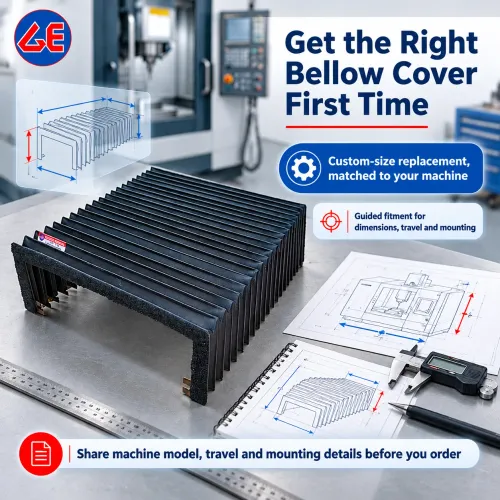
A shaft diameter and a requested length do not give a manufacturer enough information to produce a reliable cover. Before requesting a quotation, you need a measured motion envelope, confirmed fluid and temperature exposure, defined mounting details, and a drawing that makes the installation and performance limits explicit.
Key takeaways
- Measure minimum and maximum travel, shaft size, lateral movement, and nearby fixed faces.
- Choose rubber compound and construction for heat, oil, chips, chemicals, and flexing cycles.
- Specify mounting method, compressed length, extended length, clearance, and drainage.
- Request identical dimensions, materials, limits, and documents from every supplier.
Measure the complete motion envelope, not only the shaft
A quote needs the complete motion envelope: measure the protected component at both minimum and maximum travel, not only the shaft diameter. A rod, screw, spindle, guide, or actuator can run out, shift laterally, or approach a fixed face closer than expected. These movements determine whether the cover folds freely or rubs through its convolutions.
1. Record the shaft or screw outside diameter, protected component diameter, and the smallest opening the cover must pass over. Measure collapsed length, extended length, usable stroke, and the mounting length available at each end.
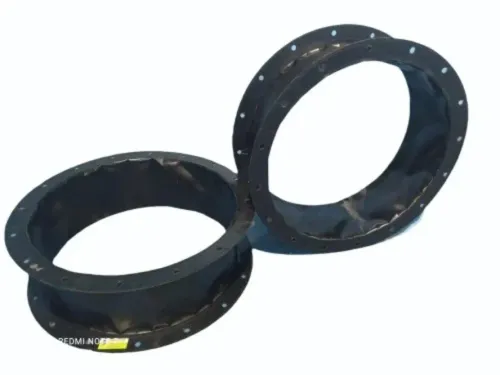
2. Measure the outside diameter over the fully formed convolutions, material thickness, and required clearance from nearby guards, tooling, chips, and moving machine parts. Include the mounting-face diameter and every flange, collar, groove, or bolt-circle dimension.
3. At minimum and maximum travel, record radial offset, angular misalignment, rotation, eccentricity, and visible runout. Mark the cover’s fixed and moving ends; axial stroke alone will not show whether a lateral shift will pull the bellows sideways.
4. Specify the end-cuff dimensions and attachment method at both ends: clamp, collar, flange, adhesive, or another connection. State whether the cover must exclude chips, abrasive dust, coolant, cutting oil, water, or welding spatter.
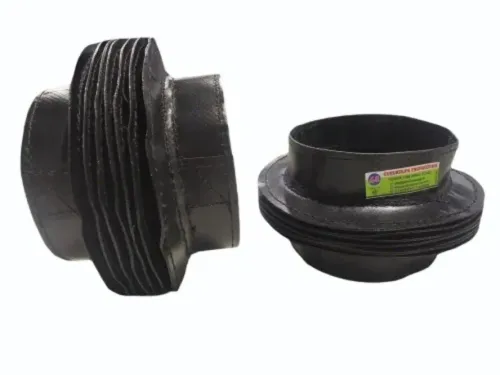
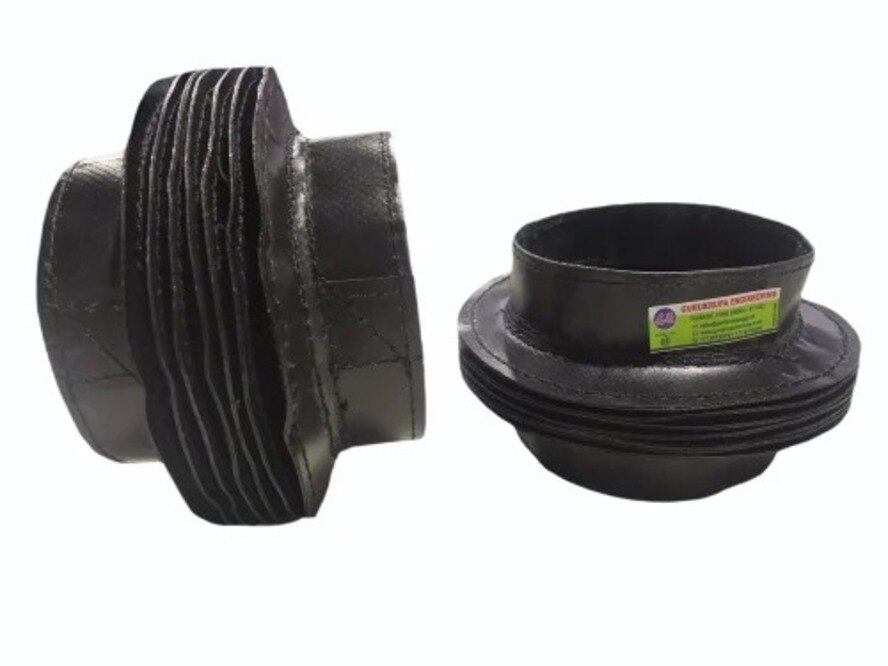
Send a dimensioned sketch or drawing showing these round rubber bellow cover details, with tolerances where space is tight. Giving only rod diameter and overall length leaves the supplier guessing about collapse space, attachment, and interference—and can produce a cover that cannot be installed.
Match the compound and design to the machine environment
Select the compound from the actual contaminant and temperature, then select the construction from the stroke, speed, and flexing pattern. “Rubber” alone says nothing about coolant resistance: the wrong compound can swell, crack, soften, or shed fragments onto the guideway.
Record these conditions before requesting custom round rubber bellows:
- Coolant brand, chemical family, concentration, temperature, and exposure frequency
- Cutting oil, solvent, cleaning chemical, abrasive dust, welding spatter, UV, and ozone exposure
- Minimum and maximum temperature, stroke, cycle rate, shaft speed, runout, and lateral movement
- Required resistance to tearing, abrasion, flame, and compression set
| Compound or construction | Best fit | Main caution |
|---|---|---|
| Molded NBR bellows | Mineral oil, hydraulic oil, and ordinary shop contamination | Confirm the specific coolant; water-based fluids can still attack the compound |
| EPDM bellows | Water-based coolant, water, steam, and weather exposure | Do not select it for mineral oil or petroleum grease without compatibility evidence |
| FKM bellows | Higher-temperature service and many oils or solvents | Cost, low-temperature flexibility, and resistance to particular chemicals require confirmation |
| Silicone bellows | Wide temperature variation and clean environments | Lower tear and abrasion resistance makes it unsuitable for sharp chips or heavy rubbing |
| Fabric-reinforced rubber | Long stroke, higher flexing load, or a need for dimensional stability | Extra thickness reduces minimum bend radius and available clearance |
Ask for a chemical compatibility recommendation or immersion data; ASTM D471 provides a recognised liquid-exposure test method. Have the supplier confirm the tooling method, reinforcement, tolerances, and prototype approval before production.
Specify construction, mounting, clearance, and drainage
A cover that seals at rest can still fail on the first stroke. Specify enough flexibility and clearance for misalignment, shaft runout, and lateral movement; otherwise the convolutions rub the rod, catch on a guideway, or buckle against a flange.
Choose an attachment that holds during repeated extension and compression, not merely one that fits the opening. Sewn or bonded cuffs, hose clamps, retaining rings, flanges, and molded mounting beads suit different removal and sealing needs. State whether you must remove the cover without dismantling the shaft or actuator.
Put these details on the drawing or dimensional schedule:
- Collapsed length, extended length, usable stroke, and material thickness
- Smallest inside diameter, outside diameter over the convolutions, and required radial clearance
- End-cuff dimensions, mounting-face diameter, groove or flange dimensions, and available clamping length
- Attachment method at each end, clamp type, fastener access, and removable-versus-permanent installation
- Clearance at minimum and maximum travel, including space for lateral movement and runout
Round rubber bellow covers are environmental guards, not pressure vessels or substitutes for pressure-rated seals. Identify the contamination to exclude, such as chips, abrasive dust, coolant, cutting oil, water, or welding spatter, then confirm that the chosen construction will not snag or puncture.
Give coolant a deliberate escape route. Use a low-point drain or an orientation that prevents liquid pooling between convolutions, and check that any opening does not direct spray onto the protected component. Do not claim an IP rating for the standalone cover; the complete installation, including cuffs, seams, openings, and drainage, determines protection.
Set performance limits and a maintenance plan before installation
Set the service limits before installation: maximum and minimum travel, stroke rate, cycle count, temperature, coolant or oil exposure, chip load, minimum bend radius, lateral movement, and available clearance. Do not assign an IP rating to the bellows alone; IEC 60529 protection belongs to the complete installed enclosure, including cuffs, seams, openings, and drainage.
| Option | Strength | Limitation |
|---|---|---|
| Round rubber bellows | Flexible protection around moving shafts and screws | Fails from puncture, abrasion, trapped chips, or excessive heat |
| Telescopic steel cover | Resists hot swarf and heavy chip impact | Needs more space and precise alignment; adds mass |
| Spiral guard | Handles rotary motion with compact coverage | Does not seal against fine coolant or dust |
| Split sleeve or fabric bellows | Easy removal and large-area coverage | Offers less sealing or abrasion resistance than a formed rubber cover |
Record a baseline after fitting, then inspect at an interval tied to cycle count and contamination:
- Check cuffs, clamps, retaining rings, beads, and flanges for loosening, tearing, or pulled edges.
- Look inside convolutions for chips, dried coolant, oil swelling, cuts, pinholes, and fabric exposure.
- Move the machine through its full stroke and watch for rubbing, buckling, snagging, twisting, or contact with guides.
- Replace the cover when cracks, permanent deformation, leakage, exposed reinforcement, or a shortened stroke appears.
- Stop and reassess the design if chips lodge repeatedly, hot swarf burns the material, or the cover reaches its bend or compression limit.
Build a comparable enquiry for price and supplier evaluation
Send every bidder the same enquiry pack so a round bellow covers price reflects the same scope. Include the latest drawing or dimensional table, plus photographs of the mounting faces and the machine at minimum and maximum travel.
- Quantity, prototype or production status, and target delivery location
- Collapsed length, extended length, usable stroke, inside and outside diameters, cuff dimensions, thickness, and attachment method
- Shaft or screw runout, lateral movement, misalignment, available clearance, and mounting-face or flange dimensions
- Rubber compound identification, reinforcement, operating temperature, cycle rate, and contamination to exclude
- Exposure to coolant, cutting oil, water, solvents, abrasive dust, chips, or welding spatter
- End fittings, drainage needs, packing for humid or monsoon storage, inspection requirements, and replacement expectations
- Tooling method, tooling charge, reusable-tool ownership, first-article approval, dimensional tolerances, flash acceptance, lead time, and repeat-order reference
Ask each supplier for compound traceability, dimensional inspection records, stated temperature and chemical limits, a sample-approval process, manufacturing lead time, and its replacement policy. Do not treat an IP claim as proof for the installed cover; the attachments, seams, openings, and drainage determine the machine-side result.
Whether you contact GURUKRUPA BELLOWS PVT LTD or another round rubber bellows supplier in Mumbai, compare the quotation line by line: separate unit price, tooling, inspection, packing, freight, and taxes. A low unit price can conceal a custom tool or reinforced construction omitted from a competing quote.
Related product
 | Round Bellow Covers ₹1000 To match with our reputation in the market, we are here to present an unparalleled assortment of Round Bellow Covers. View product → |
Frequently asked questions
What dimensions do you need for round rubber bellow covers?
Provide the protected component’s minimum and maximum travel, shaft or guide diameter, lateral movement, compressed and extended lengths, and nearby fixed-face clearances.
How do you choose the rubber compound for a round bellow cover?
Match the compound and construction to temperature, oil, coolant, chemicals, chips, dust, fire exposure, flexing frequency, and required service life.
What mounting and drainage details should an enquiry include?
State the end-ring or flange arrangement, fixing-hole pattern, attachment method, orientation, clearance limits, and whether drainage holes are required.
How can you compare round bellow covers price between suppliers?
Send every supplier the same drawing, dimensions, material requirements, performance limits, mounting details, quantity, inspection documents, and delivery terms.