A suitable cover must follow the loading spout through its full stroke, contain dust without obstructing displaced air, and survive abrasive ash, moisture, heat and repeated folding. By the end, you will have a measurement sheet, material specification and acceptance checklist for comparing bulk-loading bellow covers.
Key takeaways
- Match the cover to the loading spout’s movement and operating envelope.
- Measure compressed, extended, and lateral movement before specifying spot bellow cover size.
- Keep dust control effective without sealing off required airflow paths.
- Confirm fabric, heat resistance, testing, and acceptance criteria before ordering.
Match the cover to the loading point and its movement
Choose bellow covers for fly ash bulk loading equipment by the movement they must follow, not by the material name alone. A cover around a loading spout is a flexible contamination and abrasion barrier; it is not a pressure vessel or the primary dust-containment boundary.
Use the cover type that matches the loading point:
- At a fixed silo outlet or stationary spout, use a short fixed skirt or collar cover to shield the surrounding mechanism.
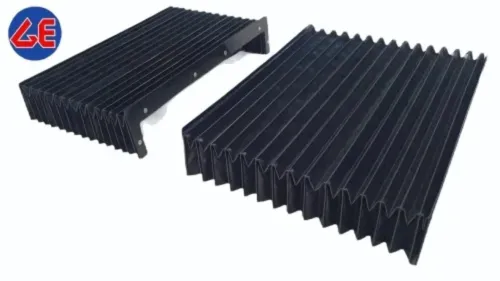
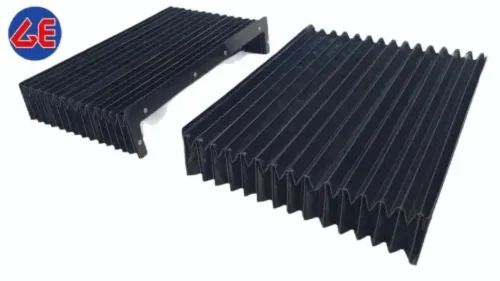
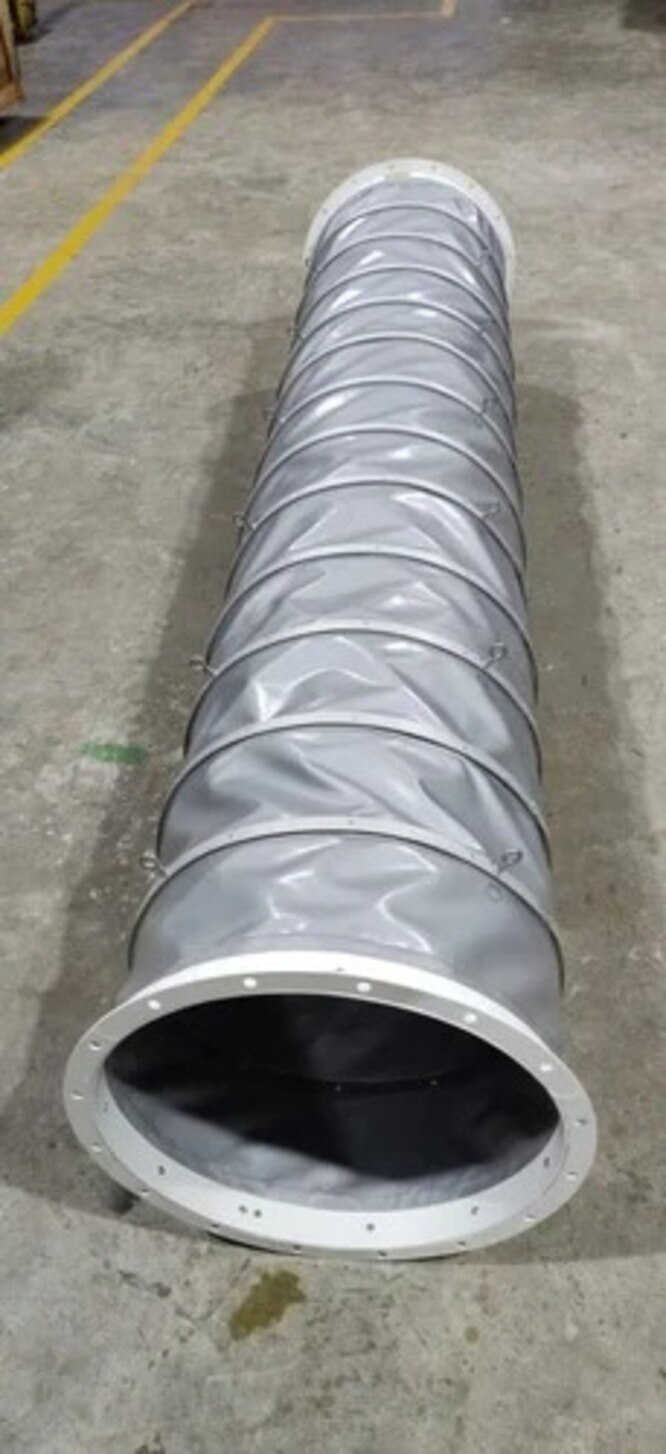
- Between a fixed collar and a vertically moving or telescoping loading chute, use a spot bellow cover that expands, compresses and folds with the chute stroke.
- Where the spout shifts sideways or rotates to meet a tanker inlet, use a guided or articulated bellow arrangement with enough lateral and angular freedom.
- Where falling ash strikes the folds directly, add a deflector, wear skirt or sacrificial liner instead of relying only on thicker fabric.
The loading spout, tanker connection, hood, duct and seals form the dust-control system. Keep the bellow clear of the aspiration opening; a tight fold across that path can reduce airflow and push dust into the work area. The cover must also remain clear of the tanker collar throughout connection and disconnection.
Specify the actual ash stream, because particle size, residual carbon, moisture and temperature vary by collection point. Wet ash can cake inside folds and stop the cover reaching its compressed position.
Measure the complete spot bellow cover movement envelope
A manufacturable spot bellow cover size starts with the full movement envelope, not the loading spout’s nominal diameter. Measure the cover at maximum extension and minimum compression, with the spout connected to the tanker inlet and moved through its actual travel.
Measuring only the stationary opening can produce a cover that bottoms out, pulls on its mounting ring, or folds into the ash stream.
Record these dimensions on a sketch or installation drawing:
- Fully extended length and fully compressed length
- Required protected travel, allowable compressed height, and number of convolutions or folding pitch
- Inside and outside diameter, or the width and height of a rectangular section
- Clearance around the spout, including the minimum bend radius
- Lateral offset and rotation at both travel limits
- Flange or collar dimensions, bolt-circle diameter, hole count, overlap, and clamp positions
- Clearance from the cover to the tanker connection, deflector, duct, and nearby structure
| Measurement | Record | If missed |
|---|---|---|
| Stroke | Extended and compressed lengths | The cover bottoms out or stays taut |
| Section | Inside and outside dimensions | The spout rubs the folds |
| Mounting | Flange, bolt circle, holes, collars | The ring cannot be fitted |
| Motion | Offset, rotation, bend radius | The cover twists or pulls loose |
| Clearance | Minimum gap through the full stroke | Folds obstruct the ash stream |
Give the manufacturer photographs from both travel limits, plus a marked drawing showing fixed and moving attachment points. That evidence supports a usable spot bellow cover size rather than a nominal diameter that fails during loading.
Protect dust control without restricting airflow
Keep the cover around the loading spout as a flexible contamination and abrasion barrier, not as a pressure vessel or the primary dust seal. The spout must extend, retract and align without transferring its weight to the cover; use independent supports for the spout, hose, actuator and counterweight.
At the tanker connection, let the loading spout and its sealing interface establish the dust-tight contact. The cover should accommodate movement around that connection without being clamped so tightly that it restricts the spout or pulls on its seams. Check the compressed cover against the tanker inlet, clamp and access hardware before operation.
Design the aspiration path through the spout hood, loading enclosure and ducting. Do not place a closed cover across the air inlet or let folds collapse against the suction opening. A restricted path reduces capture velocity, while excessive suction can pull the cover inward and accelerate rubbing at the attachment ring.
Specify bulk loading bellow covers with clearance for the full operating stroke, lateral offset and rotation. Cycle the installed cover through those positions, then inspect for interference, ash packed into folds and seam separation. Wet ash can add weight and cake between convolutions, so provide drainage and prevent the cover from becoming a load-bearing pocket.
The cover also cannot replace local exhaust ventilation or respiratory-exposure controls for respirable crystalline silica.
Select fabric and construction for ash, heat and weather
Choose fabric from the ash stream’s temperature, moisture and chemistry, not from the label “fly ash.” Ask for temperature at the loading point, particle size, residual carbon, moisture content and any chemical analysis; these determine heat resistance, abrasion resistance and chemical compatibility.
| Fabric option | What it provides | When it applies |
|---|---|---|
| Coated polyester or PVC-coated fabric | Flexible, weather-resistant abrasion barrier | Moderate temperatures with damp ash and outdoor exposure |
| Silicone-coated fibreglass | Higher heat resistance with good flexibility | Hot loading points where ordinary coated fabric softens or cracks |
| PTFE-coated fibreglass | Heat and chemical resistance with low sticking | Severe heat or ash that cakes on ordinary coatings |
Wet ash can harden on convolutions and stop full compression. Specify a smooth, cleanable outer coating, drain paths, sealed or protected seams, and storage instructions for the compressed position.
For a fly ash bulk loading bellow cover in surat, include monsoon humidity, UV exposure and standing-water risks rather than treating the location name as an environmental specification.
Reinforce convolution crests, seams, collar edges and attachment rings because trapped ash flexes these areas repeatedly. Use corrosion-resistant rings and clamps where wet-dry cycles occur; add abrasion patches where the cover contacts the spout or tanker inlet.
Select anti-static fabric, conductive yarn or bonding straps only after the site’s combustible-dust assessment. Request the test method, surface-resistance value and grounding route; “anti-static” without those details proves little. The cover remains an abrasion barrier, not a dust-control enclosure, so never let it obstruct aspiration.
Specify testing, support and acceptance before ordering
A “heavy-duty” label proves nothing without a test method, movement data and acceptance criteria. For bulk loading bellow covers, require evidence tied to your actual ash stream, temperature, moisture, stroke and mounting arrangement.
1. Send the supplier a drawing showing collapsed and extended lengths, inside and outside diameters, attachment rings, bolt holes, clearances and the loading spout’s lateral movement. Ask for the proposed fabric, seam construction, reinforcement and ring material.
2. Provide an ash sample or written process data: particle size, temperature, moisture, residual carbon and collection point. The label “fly ash” is not enough to select a cover or assess combustible-dust risk.
3. Request test records for the stated electrical property. An anti-static claim must identify the test method and surface-resistance value; select bonding straps and electrical equipment through your site’s combustible-dust procedure, not by assumption.
4. Define a witnessed trial at the installed loading point. Cycle the bellow covers for fly ash bulk loading equipment through the full extension, compression, lateral offset and rotation while the spout, tanker connection and aspiration system are connected.
5. Accept the cover only after checking seam separation, convolution-crest damage, ring distortion, interference, lost clearance and ash packed into folds. Test wet ash conditions if caking is possible, and inspect drainage, clamps and corrosion after wet-dry cycling.
GURUKRUPA BELLOWS PVT LTD can be asked for a drawing and installation-specific test record rather than a generic catalogue statement. Keep local exhaust ventilation and silica-exposure controls independent: the cover is not the primary dust boundary.
Related products
 | Fly Ash Bulk Loading Spot Bellow Fly Ash Bulk Loading Spot Bellow ₹10000 Product Details: Minimum Order Quantity 01 Number Brand GURUKRUPA Size ANY We manufacture a wide range of Fly Ash Bulk Loading Spot Bellow in various... View product → |
 | Cement Plant Bulk Loading Unloading Bellows Cement Plant Bulk Loading Unloading Bellows ₹5000 Product Details: Brand GURUKRUPA Size ANY Having rich experience and thorough understanding of the market operations, we are engaged in manufacturing... View product → |
Frequently asked questions
How do you match a bellow cover to a fly ash loading point?
Identify the loading spout’s travel, bending, rotation, and attachment points, then choose a cover that follows that movement without becoming the primary pressure boundary.
What measurements determine spot bellow cover size?
Record the fully compressed and extended lengths, lateral offset, bend radius, opening dimensions, mounting space, and nearby interference points.
How can a cover support dust control without restricting airflow?
Keep the cover flexible around the moving spout, preserve designed vent or extraction paths, and avoid folds or restraints that collapse the airflow route.
What should you specify for fly ash bulk loading bellow covers?
Specify fabric construction, abrasion and heat resistance, weather exposure, attachment details, movement limits, inspection tests, documentation, and acceptance criteria.