A moving guideway, ball screw, or hydraulic component can collect metal chips, abrasive dust, coolant, and oil long before the damage becomes visible. By the end, you will know what these covers protect, how steel and fabric designs differ, how to measure a machine axis, and what evidence to request before ordering.
Key takeaways
- Nested sections shield guideways while the machine axis moves.
- Steel covers suit hot, abrasive environments better than flexible bellows.
- Measure travel, collapsed length, height, width, and mounting points before ordering.
- Inspect wipers, overlaps, fasteners, and smooth movement during service.
How a Telescopic Bellow Cover Protects a Moving Axis
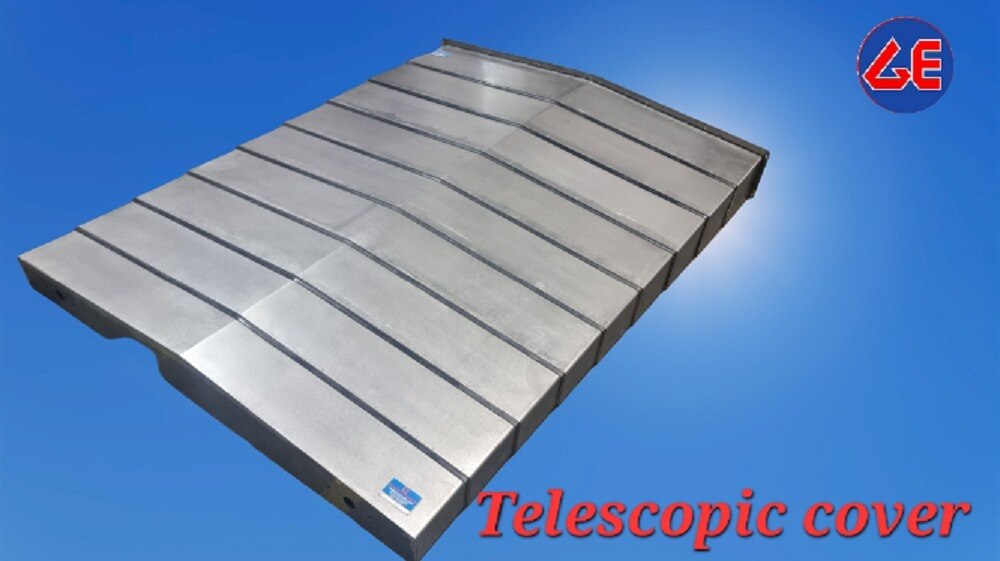
Nested sliding sections protect a moving axis by expanding and contracting along the machine’s travel direction. Each section overlaps the next, so the guideway remains covered as the slide advances; during return, the sections telescope into a shorter stack. The cover connects a fixed machine structure to the moving component without blocking the axis.
The cover’s envelope is larger than the guideway alone. A correct design must allow space for:
- Overlapping sections and their travel
- Rollers, guides, and intermediate supports
- Wipers and end seals
- Mounting brackets and fasteners
- Chip clearance and drainage
The working envelope describes where the tool, fixture, and machine component move. The cover’s envelope includes the space occupied during retraction. A fixture may clear the guideway yet strike a section when the cover folds into its closed length.
That is why the cover must be designed around the complete motion profile, not chosen for appearance or stroke alone.
What are telescopic bellow covers used for machines in Surat? They control contamination around guideways, rails, screws, and other moving elements. The telescopic bellow covers uses are protective, not structural: the cover is not a load-bearing platform, personnel guard, or replacement for enclosure interlocks.
It reduces exposure to chips, dust, coolant, and oil, while lubrication, cleaning, guarding, and inspection remain necessary.
Which Surat Machines and Components Use Them
CNC turning centres, CNC milling machines, vertical machining centres, grinding machines, boring machines, and special-purpose machines use telescopic bellow covers where exposed travel paths collect contamination. These are practical telescopic bellows for machines with linear guideways, slideways, or other moving interfaces.
| Machine type | Protected components | Main exposure |
|---|---|---|
| CNC turning centre | Linear rails, guideways, ball screws, racks | Sharp chips, coolant, cutting oil |
| CNC milling machine or VMC | Guideways, ball screws, drive mechanisms | Abrasive dust, chips, contaminated lubrication |
| Grinding machine | Slideways, linear rails, hydraulic cylinders | Fine abrasive dust, coolant, corrosion |
| Boring machine | Guideways, racks, ball screws, pneumatic components | Heavy swarf, oil, moisture |
| Special-purpose machine | Hydraulic cylinders, pneumatic components, moving drives | Sparks, hot chips, layout-specific contamination |
Sharp metal chips can dent sections or jam their movement. Abrasive dust wears rolling elements and wipers, while coolant and cutting oil contaminate lubrication. Sparks and hot chips can attack flexible materials; moisture promotes corrosion.
The indirect accuracy benefit is important: a cover does not create machining precision. It helps stop contamination from damaging the guideway surfaces and moving elements that support repeatable positioning. Those telescopic bellow covers uses depend on each Surat workshop’s coolant chemistry, chip load, humidity, cleaning practice, axis duty, and machine layout—not the city name alone.
When Steel Telescopic Covers Beat Flexible Bellows
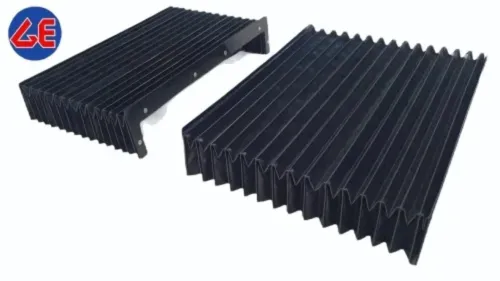
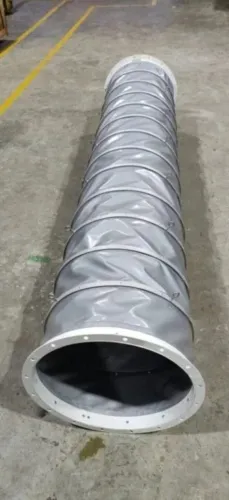
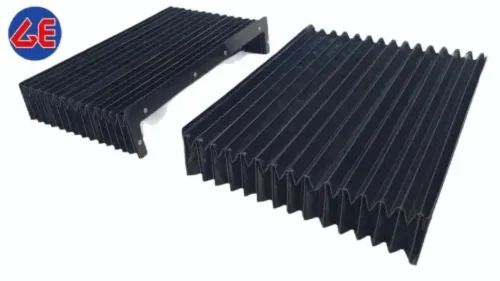
Steel telescopic covers suit an axis exposed to sharp, heavy, or hot chips. They use overlapping formed metal boxes or slats, while fabric bellows use folded coated textile, elastomer, or laminated material. Because suppliers may call either product a “telescopic bellow cover,” confirm the actual construction before comparing quotations.
| Option | Main advantage | Main limitation |
|---|---|---|
| Steel telescopic cover | Rigid protection against sharp, heavy, and hot chips | Dents, seized rollers, misalignment, and greater moving mass |
| Fabric bellows | Low moving mass, compact folded length, and flexible geometry | Poorer resistance to direct hot-chip impact, heavy swarf, and aggressive wash-down |
| Steel or fabric | Available as industrial telescopic bellow covers or telescopic bellows for machines | The name alone does not identify the construction |
Choose fabric when an axis has irregular multi-axis movement, very tight bends, limited retracted space, or a strong need to minimise moving mass. Its flexibility suits complex shapes, but direct chip impact can puncture or abrade the folds. Choose steel when impact protection matters more than compactness and acceleration load.
A steel cover is the wrong choice when its mass overloads the axis, its retracted stack occupies essential space, or rigid sections cannot follow the movement. Large chips can still dent slats and jam rollers, so chip evacuation or a deflector remains important.
Severe chemical exposure, high-pressure coolant, and directed wash-down require confirmed material, wiper, seal, and drainage compatibility—not a generic corrosion-resistance claim.
How to Measure a Machine Before Ordering
A telescopic cover in Surat must be sized from the machine’s motion, not the guideway alone. This is the practical answer to what are telescopic bellow covers used for machines in Surat: protection works only when the cover fits the actual axis envelope.
1. Record the axis stroke, required extended length, available closed length, section count, section height and width, mounting-face dimensions, and guideway geometry. Extended length normally follows the required stroke; closed length must clear the column, chuck, fixture, tool changer, guard, and nearby tooling when retracted.
2. Measure the cover’s physical envelope, not only the guideway. Reserve space for section movement, wipers, mounting hardware, chip clearance, and drainage, then record clearance at both ends of travel to prevent fouling.
3. Check the installation as horizontal, vertical, inclined, and inverted. Gravity changes chip accumulation, coolant drainage, and section loading, so a design suitable for a horizontal X-axis may fail on a vertical Z-axis.
4. Give the supplier axis speed, acceleration, duty cycle, travel direction, coolant type, cutting-fluid pressure, chip size, temperature, cleaning method, and expected impact. Ask for a dimensional drawing, mounting drawing, material and wiper specification, travel calculation, operating limits, and inspection or test record.
Require written confirmation that the design suits the actual axis. A cover with the same stroke can still collide, overload its guides, or drain poorly if its geometry and motion profile differ.
What to Check During Service and Procurement
Installation can require machine downtime, removal of nearby guards, alignment checks, shimming, and verification through the complete stroke. For a telescopic cover in Surat, treat installation as a machine-fitting job, not a bolt-on accessory.
Before accepting a quotation for industrial telescopic bellow covers, ask whether it includes:
- Slat material and thickness
- Rollers or guides and intermediate supports
- Wipers, end seals, and drainage
- Mounting fasteners and lubrication instructions
- Maximum speed, acceleration, and permitted orientation
| Quotation evidence | What to verify | Risk if absent |
|---|---|---|
| Dimensional drawing | Closed length, extended length, section clearance, and mounting points | Retraction collision or fouling |
| Operating specification | Speed, acceleration, orientation, coolant exposure, and chip conditions | Premature wear or excessive drive load |
| Maintenance details | Wiper profile, roller lubrication, drainage path, and replacement parts | Hidden service cost and avoidable failures |
GURUKRUPA BELLOWS PVT LTD is one Surat supplier a workshop could ask for this machine-specific information; compare the written drawing and operating limits, not a catalogue description.
During service, move the cover through full travel, listen for binding or abnormal noise, check wiper contact, clear chips between sections, inspect dents and corrosion, tighten loose fasteners, and verify drainage. Repair or replace damaged wipers, bent slats, seized rollers, leaking joints, or any part linked to rising drive load.
A telescopic cover reduces contamination exposure but does not replace lubrication, chip evacuation, coolant control, enclosure guarding, or periodic guideway inspection.
Related products
 | Telescopic Bellow Cover ₹1000 Product Details: Brand GURUKRUPA Ours is a distinguished name in the business that manufactures and supplies Telescopic Bellow Cover that is vastly... View product → |
 | Bellow Cover ₹1000 Product Details: Brand GE Color Black-Blue - Gray -White Size ANY ( C shape, Square, Round, Rectangular) Ours is a trustworthy name in the business... View product → |
Frequently asked questions
How does a telescopic bellow cover protect a moving machine axis?
Nested sliding sections overlap as the axis travels, shielding guideways and components from chips, dust, coolant, and other debris without restricting movement.
Which machines and components use telescopic bellow covers in Surat?
CNC machining centres, turning centres, grinding machines, milling machines, and other machine tools use them to protect guideways, linear rails, screws, and moving axes.
When do steel telescopic covers beat flexible bellows?
Steel telescopic covers are the stronger choice when the machine produces hot chips, heavy debris, abrasive dust, or repeated mechanical impact. Flexible bellows suit applications that need lower weight or more adaptable shapes.
What measurements do you need before ordering a telescopic cover?
Record the axis travel, fully collapsed and extended lengths, cover height and width, mounting locations, available clearance, section pitch, and the machine’s speed and acceleration.
What should you check during telescopic cover service?
Check wipers, section overlaps, guide rollers, fasteners, seals, dents, corrosion, coolant ingress, and smooth extension and retraction. Replace damaged parts before they expose the guideway.
Related product
 | Telescopic Cover Product Details: Brand GURUKRUPA Being one of the trustworthy names of the industry, we bring forth CNC Telescopic Cover that can be availed at... View product → |