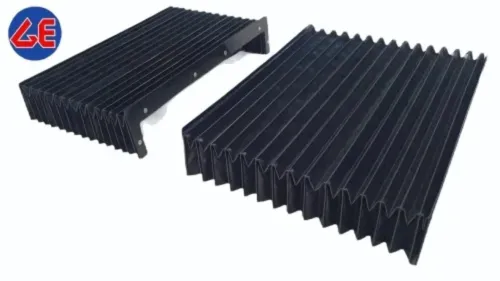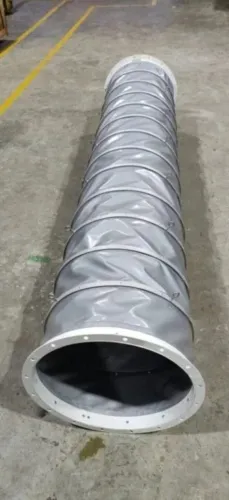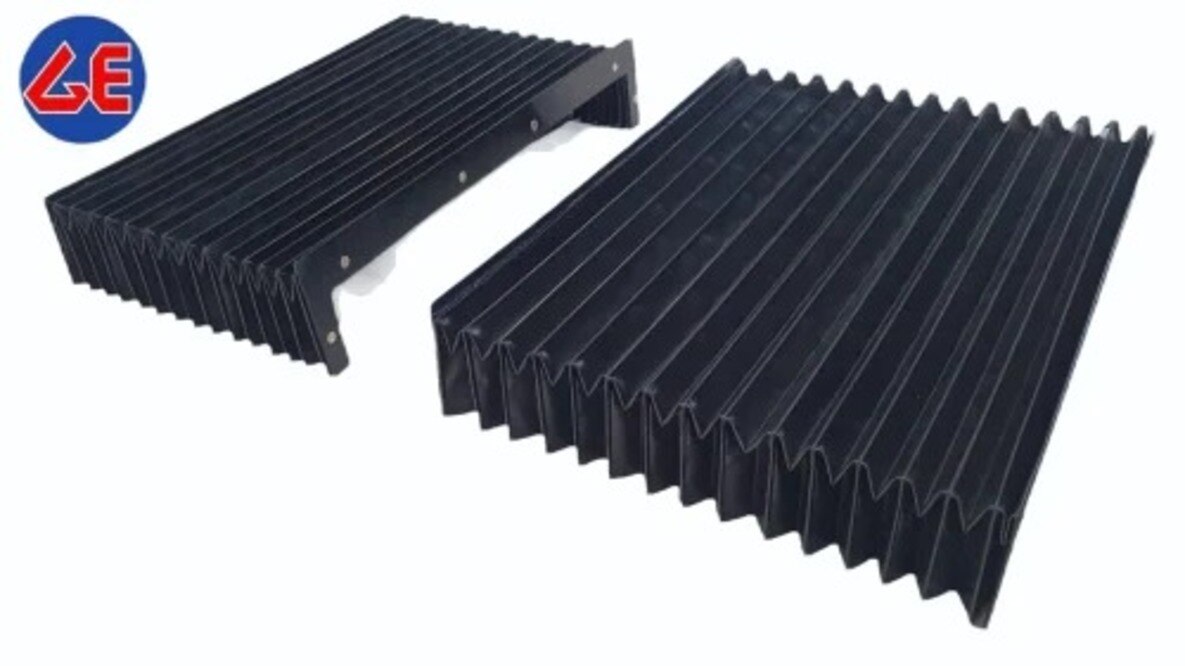
Repeated extension and compression rarely tear a CNC bellows cover because of cycle count alone. Damage usually starts when the cover is over-compressed, pulled sideways, twisted, rubbed by chips or machine parts, or exposed to a coolant, oil, heat, or spark condition that its construction cannot handle. By tracing the tear pattern, measuring the movement envelope, and checking the machine before ordering a replacement, you can separate a cover failure from a machine problem and specify a better-fit solution.
Key takeaways
- Check compressed length, bend radius, fold height, and lateral clearance before replacement.
- Match tear patterns with rubbing, misalignment, friction, loose mounts, or excessive travel.
- Choose fabric, coating, reinforcement, and construction for the actual chips, coolant, heat, or sparks.
- Send drawings, measurements, travel data, and operating conditions to a Surat supplier.
What repeated machine movement does to a CNC bellow cover
Cycle count alone does not tear a CNC bellow cover. Damage starts when repeated travel forces the cover beyond its designed compressed length, bend radius, fold height, or lateral clearance. Many cnc bellow cover problems begin with excessive guide friction, uneven axis motion, loose mounting hardware, or a support rubbing the machine.
| Movement type | Normal condition | Harmful result |
|---|---|---|
| Smooth axial extension and compression | Folds open and close evenly | Normal flexing with low stress |
| Over-compression | Folds meet without flattening | Creases stay crushed and fabric fatigues |
| Excessive extension or speed | Travel follows the specified envelope | The pack surges, slaps, or pulls at its ends |
| Lateral offset or side loading | Cover remains centred on its guide | Corners stretch and folds rub sideways |
| Twisting or out-of-square mounting | Fold faces stay parallel | Seams and mounting points carry uneven tension |
| A sharp edge, trapped chip, or adjacent guard | Clear movement across the full stroke | Repeated abrasion cuts the fold or coating |
High acceleration is especially damaging because the bellows pack can move unevenly instead of following the axis smoothly. Impact loads then exceed those assumed in a basic stroke calculation.
Check the cover at both end positions, not only at mid-stroke. Look for rubbing marks, flattened creases, stretched corners, pinholes, and exposed guideways. If the machine guide binds or the cover touches a way, chip guard, or neighbouring cover, replacing the bellows without correcting that movement fault will produce another tear.
How to read tear patterns and find the first failure cause
A tear at the compressed end points to a different failure than a tear at the mounting frame. Inspect the cover fully extended and fully compressed, then compare its actual folded height, bend direction, and clearances with the supplier’s drawing. Cycle count alone rarely explains cnc machine bellow cover damage.
1. Longitudinal shiny marks, scraped coating, or parallel cuts indicate rubbing against a guide, support, sharp edge, or loose hardware. Check guideway edges and mounting screws before fitting another cover.
2. Even cracks across several fold creases indicate repeated over-compression, an incorrect folded height, or a bend radius smaller than the design allows. Flattened creases confirm that the folds are being crushed rather than flexed.
3. A tear on one side, stretched corner, or diagonal wrinkle indicates lateral offset, twisting, or uneven axis travel. Excessive guide friction, a damaged linear way, or loose mounting can force the cover sideways.
4. Punctures, pinholes, and isolated cuts point to trapped chips, burrs, welding sparks, or a sharp machine edge. Exposed guideways show that the opening or support arrangement is already failing.
5. Swelling, softened fabric, brittle coating, or seam separation indicates coolant, oil, heat, or chemical incompatibility. Compare the damaged area with the coolant spray path and hottest nearby component.
After identifying the pattern, move the axis slowly by hand or at low speed and watch for pack surge, slap, snagging, or unequal folding. Correct the motion fault first; replacing the bellows without removing side load or interference usually produces the same tear in a shorter time.
Measure the cover and check alignment before ordering a replacement
Before ordering, measure the actual axis and verify the cover’s alignment through the full stroke. Nominal machine travel alone is not enough: a cover can tear while the axis remains within its specification if it over-compresses, twists, or rubs.
1. Record usable travel, fully compressed length, fully extended length, folded height, overall width, bend direction, and clearance to the guideway, chip guard, adjacent cover, and workpiece.
2. Measure the mounting-hole pattern and pitch at both ends. Check that brackets are square, fasteners are tight, and the cover is not laterally offset or twisted at either end position.
3. Run the axis slowly, then at production speed. Watch for uneven folding, pack surge, slapping, stretched corners, rubbing marks, or a support that contacts the machine. Record maximum speed and acceleration for the replacement design.
4. Inspect the guideway for sharp edges, trapped chips, damaged rails, excessive friction, and uneven motion. Correct these faults before fitting a new cover; otherwise the same load will tear it again.
5. Measure temperature at the cover surface during cutting, including short peaks near a spindle, grinding operation, hot workpiece, or chip stream. Document coolant type, oil exposure, humidity, dust, and spark contact.
A quotation for cnc machine bellow covers for tearing in surat should include these measurements, failure photographs, and the machine’s actual service conditions. Ask for confirmation of the compressed clearance, guide arrangement, seam position, and full-stroke fit before production.
Construction and material choices for chips, coolant, heat, and sparks
Choose the construction by the hazard, movement envelope, and joint exposure—not by cycle count. A coated fabric that handles coolant can still fail when steel chips pack its folds, while welding sparks can burn through it before fatigue becomes relevant. These service conditions are central to CNC bellow cover problems.
| Construction | Main advantage | Failure risk and suitable use |
|---|---|---|
| Sewn | Flexible, repairable, and practical for complex shapes | Needle holes and thread can wick coolant or loosen under abrasion; use where temperatures and fluids are moderate and repair access matters |
| Heat-sealed | Continuous seam without needle perforations | The coating must tolerate the sealing temperature and coolant; use for coated fabrics needing a closed, chip-resistant seam |
| Bonded | Smooth joint with fewer exposed edges | Adhesive can soften, crack, or lose grip under heat, oil, or coolant; use only after checking adhesive compatibility and service temperature |
Sewn bellows suit frequent handling, but seal the stitch line when coolant can reach the reinforcement. Heat-sealed joints suit compatible thermoplastic-coated fabrics; an incorrect sealing temperature creates a weak seam. Bonded joints need a documented adhesive and curing process, not just a neat appearance.
Choose a different protection method when the hazard exceeds fabric capability:
- Use a telescopic steel cover or metal lamella apron for hot sparks, heavy chips, or sharp swarf.
- Add a spark shield or sacrificial outer layer when occasional welding spatter reaches the bellows.
- Specify wipers, chip deflectors, or supported guides when debris prevents folds from closing evenly.
- Use a roller shutter cover when limited space or frequent chip packing makes folded bellows unsuitable.
Clean folds with a vacuum or soft brush; compressed air can drive chips and coolant deeper into the cover.
How to request and evaluate a replacement from a Surat supplier
A quotation based only on the machine model is not enough. Give a cnc machine bellow covers supplier in Surat the actual travel envelope and the conditions that caused the failure, including local heat, humidity, dust, coolant, and machining debris.
Send:
- Usable stroke, fully extended and compressed lengths, width, height, fold pitch, and bend direction
- Mounting-hole pattern, guide arrangement, clearances, and photographs of both end positions
- Axis speed, acceleration, cycle pattern, and any surge or uneven movement
- Coolant or oil type, chip size, welding-spark exposure, and operating temperature
- Failure photographs showing tears, rubbing, flattened folds, split seams, and exposed guideways
Compare quotations by asking for a dimensioned drawing, material and seam construction, compressed-length limit, guide-support details, and the supplier’s fit-check procedure.
| Option | What to compare | Warning sign |
|---|---|---|
| Geometry | Travel, fold height, clearance, mounting pitch | “Standard size” without a drawing |
| Construction | Coating, seam, wiper, and chip protection | Same fabric offered despite changed coolant or heat |
| Fit-check | Trial installation through the full stroke | No check for twist, rubbing, or side load |
| Support | Marked-up drawing and corrective advice | Replacement supplied without investigating guides |
| Total effort | Price, downtime, installation, and rework risk | Cheapest quote requiring repeated adjustment |
Ask whether the supplier will review guide friction, loose hardware, damaged ways, and out-of-square mounting. GURUKRUPA BELLOWS PVT LTD is one Surat contact to include when comparing CNC bellow covers for tearing in Surat, provided its quotation addresses these measured conditions rather than repeating a catalogue description.
Related products
 | CNC Telescopic Cover Product Details: Brand GURUKRUPA Being one of the trustworthy names of the industry, we bring forth CNC Telescopic Cover that can be availed at... View product → |
 | Bellow Cover The range of CNC Bellow Cover is manufactured on our premises, under the guidance of our expert professionals. View product → |
Frequently asked questions
What causes CNC bellow covers to tear during repeated machine movement?
Tears begin when travel exceeds the cover’s designed compressed length, bend radius, fold height, or lateral clearance. Guide friction, uneven axis motion, loose mounting hardware, and rubbing supports add stress.
How can you identify the first cause of CNC bellow cover damage?
Inspect the tear location and shape. Long splits at folds suggest repeated bending or over-compression, while polished rub marks, one-sided wear, and damaged mounting points indicate contact, misalignment, or loose hardware.
What should you measure before ordering a replacement CNC bellow cover?
Measure extended and compressed lengths, width, height, fold height, mounting-hole positions, travel direction, bend radius, and available clearance. Record guideway dimensions and check alignment throughout the full stroke.
How should you choose a bellow cover for chips, coolant, heat, and sparks?
Specify the chip size, coolant type, temperature, spark exposure, travel speed, and cleaning method. Select the fabric, coating, reinforcement, wipers, and construction details for those conditions rather than cycle count alone.
What information should you send to a CNC bellow cover supplier in Surat?
Send photographs of the damage, a dimensioned sketch, extended and compressed measurements, axis travel, speed, mounting details, guideway geometry, temperature, coolant, chip, and spark conditions.
Related products
 | CNC Bellow Cover Product Details: Brand GURUKRUPA Color BLACK Size ANY We are considered a well-known name in the business that manufactures and supplies CNC Bellow... View product → |
 | Telescopic Cover Product Details: Brand GURUKRUPA Being one of the trustworthy names of the industry, we bring forth CNC Telescopic Cover that can be availed at... View product → |
 | Rollway Cover Product Details: Brand GURUKRUPA Color Steel Material Steel Size Customised Our company is engaged in manufacturing Rollaway Cover that is quite... View product → |
 | Machine Enclosure Our company is engaged in manufacturing Machine Enclosure that is specifically designed for providing protection to the operators and machinery, from... View product → |