A price quoted only by diameter or piece count tells you little because a round rubber bellow’s cost depends on its working envelope, compound, reinforcement, end attachment, quantity, and delivery basis. By the end, you will know which dimensions to measure, how to compare Surat quotations, and how to specify a custom cover that will not fail through overextension, chemical swelling, or incorrect mounting.
Key takeaways
- Compare quotes using identical dimensions, materials, quantities, and delivery terms.
- Measure compressed, extended, and installed lengths before requesting round bellow cover sizes.
- Specify rubber, reinforcement, temperature, chemicals, and movement limits for the application.
- Check the cover’s working envelope against machine travel before approving production.
What determines the price of a round rubber bellow cover in Surat?
A comparable quotation requires identical dimensions, materials, and commercial terms; otherwise, the lowest figure may describe a different cover. There is no standard round rubber bellow covers price in surat because each cover is priced from its working envelope, construction, and delivery basis.
| Quote item | What must match | Why it changes the price |
|---|---|---|
| Bore and geometry | Inside diameter, outside diameter, free length, compressed length, number of convolutions, fold pitch, and wall thickness | More rubber, deeper folds, tighter clearances, or longer travel increase manufacturing effort |
| Construction | Rubber compound, fabric or wire reinforcement, end collars, rings, plates, and attachment method | NBR, EPDM, silicone, and FKM have different material costs; reinforcement and metal ends add labour and components |
| Commercial basis | Order quantity, sample or tooling charge, GST treatment, packing, freight, and delivery location | A single prototype costs more per piece, while tooling may be charged separately or amortised across a batch |
Ask the supplier to state whether the amount is ex-works, delivered within Surat, or delivered to your plant. “Per piece” or “per diameter” alone is not a technical comparison; two covers with the same shaft diameter can have different outside diameters, lengths, folds, and end connections.
Also confirm whether the cover excludes dust and chips or must withstand pressure, vacuum, pulsation, or pressure washing. Ordinary protective bellows are not automatically pressure-rated, so a cheaper quote can be unsuitable even when its dimensions appear similar.
How to measure round rubber bellow cover sizes before requesting a quote
Submit a dimensioned sketch, not only the shaft diameter. Round rubber bellow cover sizes depend on the protected part, working movement, available clearance, and both end mounts.
End view: OD = outer circle; ID = clear opening for the shaft or guide.
Side view: mount |<— closed height —>|<— extended height —>| mount
| Dimension | Meaning |
|---|---|
| Inside diameter | Clear opening over the shaft, rod, spindle, or guide. |
| Outside diameter | Maximum external diameter, including folds and reinforcement. |
| Nominal diameter | The stated size used for ordering; confirm whether it refers to ID, OD, or shaft size. |
| Mounting diameter | Diameter at the collar, flange, clamp, or end ring where the cover attaches. |
| Closed height | Shortest installed length when folds are compressed. |
| Extended height | Longest specified working length without overextension. |
| Stroke | Extended height minus closed height; this is the usable axial travel. |
| Fold pitch | Distance from one convolution centre to the next. |
| Wall thickness | Rubber and reinforcement thickness at the fold or straight section. |
| End-connection dimensions | Collar length, flange diameter, bolt-circle diameter, holes, groove, clamp width, and attachment orientation. |
Attach this measurement checklist:
- Shaft or equipment diameter, ID, OD, closed height, and extended height.
- Radial clearance to nearby guards, chips, cables, and moving parts.
- Fold count, fold pitch, wall thickness, and mounting diameters.
- End-connection dimensions and a photograph showing both attachment points.
- Temperature, oil or coolant exposure, motion frequency, and sealing requirement.
- State whether pressure, vacuum, pulsation, or pressure washing occurs; request a design-specific rating.
Choosing rubber and reinforcement for the operating environment
Choose the compound from the actual fluid and temperature, not from “rubber.” Check the coolant’s formulation, peak temperature, motion frequency, and whether the cover seals dust or acts only as a shield. These choices also affect round rubber bellow cover sizes because thicker, reinforced walls need more fold space and a larger bend radius.
| Compound | Best resistance | Limits and suitable exposure |
|---|---|---|
| NBR | Mineral oil, hydraulic fluid, grease, abrasion, many coolants | Poor ozone, sunlight, and high heat; avoid outdoor service without protection |
| EPDM | Water, steam, aqueous coolants, ozone, weather, outdoor use | Swells in petroleum oil and many hydrocarbon fluids |
| Silicone | Wide temperature range, ozone, weather, clean environments | Tears and abrades easily; limited resistance to oils and sharp chips |
| Neoprene | Weather, ozone, moderate oil, abrasion, and better spark or flame resistance | Not fireproof; limited against strong chemicals and high temperatures |
| FKM | High heat, mineral oils, fuels, and demanding chemicals | Higher cost; unsuitable for hot water or steam unless the grade is approved |
Fabric reinforcement controls shape and improves tear resistance, but reduces flexibility and increases the minimum bend radius. Wire rings hold each convolution open; they prevent collapse yet make tight bending harder. End plates or collars improve clamping and pressure resistance, while adding weight and stiffness.
For sparks, chips, or pressure washing, specify a protective outer layer and a design-specific rating; an ordinary bellow is not a pressure vessel.
How custom round bellows are specified and made in Surat
A supplier can start from a drawing, photograph, old sample, equipment details, or a site measurement.
For custom round bellows in Surat, provide shaft or equipment diameter, protected length, minimum and maximum working length, axial stroke, radial clearance, temperature, oil or coolant exposure, motion frequency, and whether the cover seals dust or acts only as a shield.
Ask the quotation to show:
- Inside diameter, outside diameter, free length, compressed length, extended length, fold count, fold pitch, wall thickness, and both end-connection dimensions
- Rubber compound, fabric or wire reinforcement, collars, rings, end plates, and agreed tolerances for critical mounting or sealing dimensions
- Piece price separately from mold or tooling cost, sample-production cost, inspection cost, and repeat-order price
- GST, packing, freight, and delivery basis: ex-works, delivered within Surat, or delivered to your plant
- Sample-approval procedure, revision charges, warranty, delivery time, and tooling amortisation
The supplier reviews the drawing against available clearance, stroke, fold compression, material compatibility, and any pressure or vacuum requirement. Ordinary protective bellows are not pressure vessels, so request a design-specific rating for pressure washing, pulsation, internal pressure, or vacuum.
After approval, the manufacturer produces a sample, checks dimensions and fit, records any agreed revision, and inspects the finished batch using the approved measurement method. A local manufacturer such as GURUKRUPA BELLOWS PVT LTD can verify dimensions at the machine when a drawing is missing or an old sample has changed shape.
Keep the approved drawing and sample reference for repeat orders.
Related product
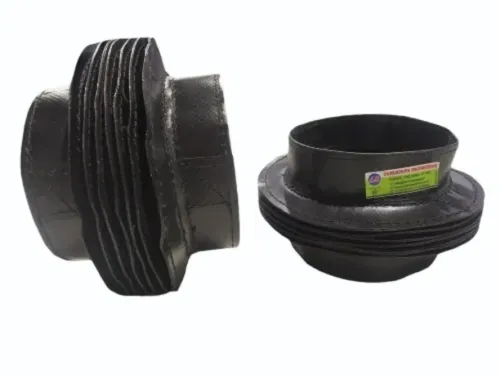
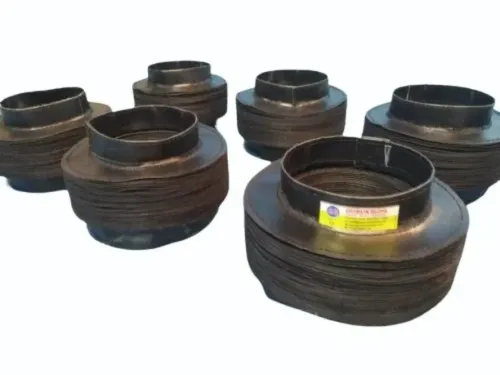
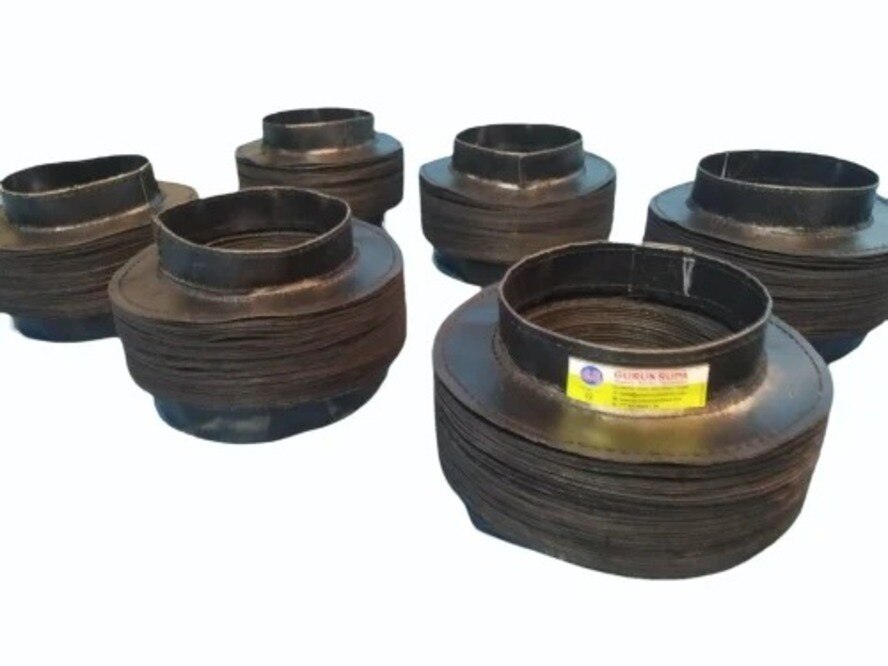
 | Round Bellow Covers ₹1000 To match with our reputation in the market, we are here to present an unparalleled assortment of Round Bellow Covers. View product → |
How to check the working envelope before approving the cover
Approve the cover only after its working envelope includes movement and installation error, not just the shaft diameter. Usable stroke equals the specified extended length minus the compressed length; do not consume either limit, because material set or overextension can destroy the folds.
1. Record the minimum and maximum working lengths, axial stroke, installation tolerance, thermal growth, misalignment, lateral offset, and angular movement. Specify rotating-shaft clearance, minimum fold clearance, chip accumulation between convolutions, and any torsion from twisting.
2. Check compression at the shortest position. Leave space so adjacent folds do not crush, rub, or buckle, and confirm that the cover will not overextend at the longest position.
3. Verify the end-clamping method, mounting diameters, clamp width, and retention under motion. A loose end can leak dust; excessive clamping can cut rubber or restrict the stroke.
4. State whether the cover is a shield or a seal, then obtain pressure or vacuum confirmation from the supplier. Internal pressure, suction, and trapped air can change the required reinforcement and end attachment.
5. Before comparing a round rubber bellow covers price in Surat, require a quotation showing bore, outside diameter, lengths, folds, compound, attachments, quantity, and delivery basis.
For custom round bellows in Surat, check that it separately lists GST, freight, packing, tooling, sampling or sample approval, warranty, and whether delivery is ex-works, delivered within Surat, or delivered to your plant.
Frequently asked questions
What determines the price of a round rubber bellow cover in Surat?
Price depends on the cover’s dimensions, working envelope, rubber compound, reinforcement, construction method, quantity, testing, packaging, and delivery terms. Compare quotations only when these details match.
How do you measure round rubber bellow cover sizes before requesting a quote?
Record the smallest and largest diameters, compressed length, extended length, installed length, mounting dimensions, stroke, bend or lateral movement, and clearance from nearby machine parts.
How do you choose rubber and reinforcement for the operating environment?
Match the rubber compound and reinforcement to temperature, oil or chemical exposure, abrasion, dust, coolant, fire risk, pressure, and required flexibility. Give the supplier the actual exposure conditions.
How do you check the working envelope before approving a round bellow cover?
Compare the cover’s compressed and extended lengths, diameter changes, stroke, bend radius, mounting position, and clearance with the machine’s full travel. Check for rubbing, buckling, stretching, and interference at both travel limits.