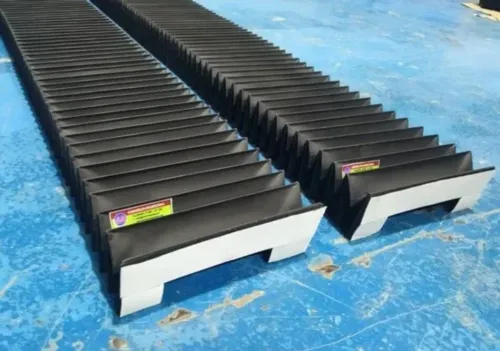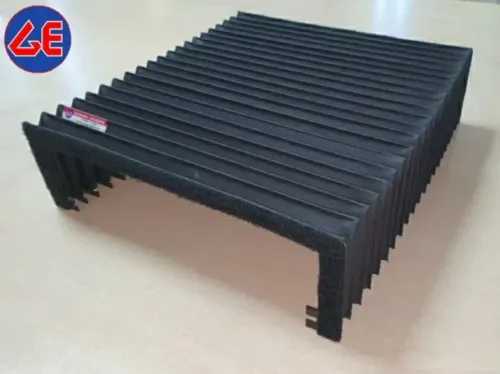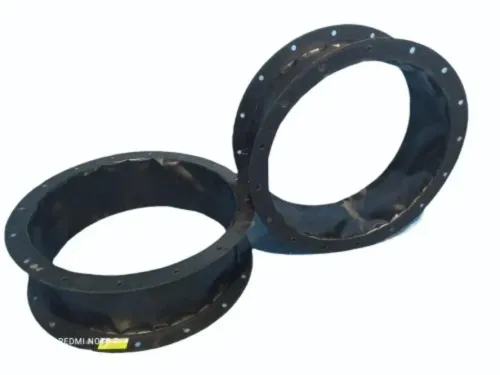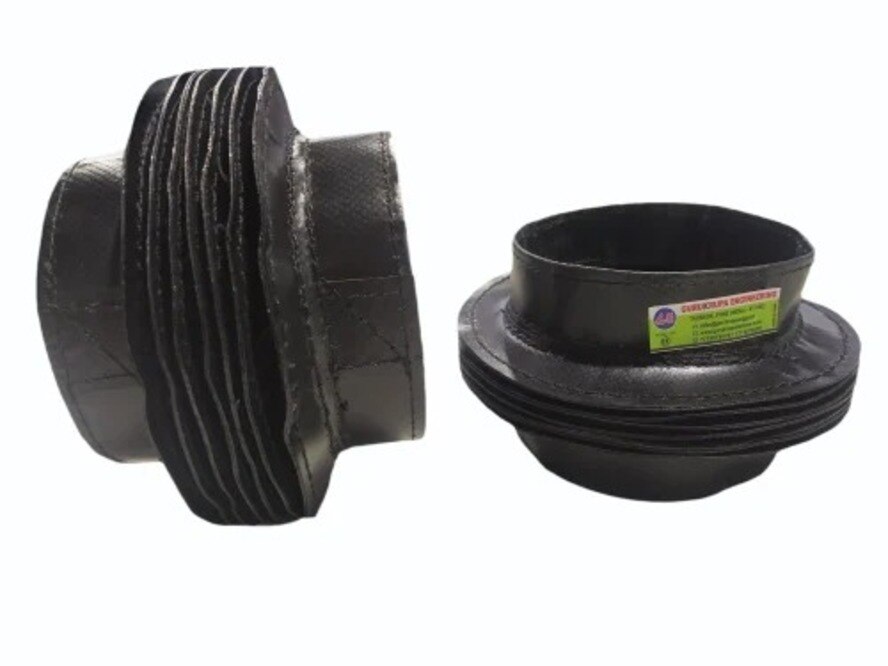
A cylindrical bellow cover fails gradually: chips settle in its folds, coolant changes the coating, and misalignment creates rubbing that may remain hidden at the home position. A documented inspection, careful cleaning routine, and accurate replacement measurement let you identify damage early and verify safe movement across the machine’s full stroke.
Key takeaways
- Inspect after installation, machine changes, and worsening contamination.
- Brush chips out of folds; do not force debris deeper with compressed air.
- Replace covers when cracks, pinholes, distortion, or abnormal rubbing appear.
- Measure the installed cover and test full travel before ordering replacements.
Set an Inspection Schedule Based on Contamination and Machine Hours
Inspect a cylindrical bellow cover immediately after installation, after any maintenance that changes the carriage, guideway, cable carrier, hose routing or mounting frame, and whenever contamination records show worsening exposure.
- At installation or reinstallation, run the machine through its complete stroke at low speed. Watch for twisting, inverted pleats, uneven compression, rubbing, sagging and restricted travel.
- During every daily or shift-start check, look for accumulated chips, coolant pooling, torn pleats and new contact marks.
- On machines exposed to cast-iron dust, grinding particles, heavy coolant or frequent chip loading, perform a detailed inspection every week.
- In cleaner applications, set the interval by machine hours and contamination records, not an arbitrary calendar period. Shorten it immediately when abrasive dust or liquid appears inside the folds.
Record the fully extended and compressed positions, mounting condition, visible gaps and any debris inside the folds. The maintenance log should also include machine hours, coolant name and concentration, cleaning method, defects found and corrective action.
Use these records to identify trends in cylindrical bellow cover care. A cover that rubs or loses travel can fail before the fabric looks damaged.
Treat cylindrical machine protection covers as flexible protective components, not platforms or structural guards. Keep tools and parts off the cover, and assess the machine’s guarding and overall risk separately from cover maintenance.
Clean Chips and Coolant Without Driving Debris Into the Folds
A soft nylon brush and a vacuum protect folded fabric better than a high-pressure jet. This approach removes chips without driving abrasive particles into pleats, seams, coatings or the guideway.
1. Stop the machine and isolate it under the machine’s lockout procedure. Do not retract or compress the cover before removing large chips; compressed pleats can conceal cuts, trapped swarf and seam damage.
2. Brush loose, dry chips away with a soft nylon brush. Use a vacuum for grinding dust and other abrasive particles rather than sweeping them deeper into the folds.
3. Use compressed air only at low pressure, directing the stream away from seals, bearings and end-frame gaps. A forceful jet can drive debris into the folds or protected guideway.
4. Avoid routine pressure-washing unless the supplier has explicitly rated the construction for it. High-pressure water can penetrate seams, damage coated fabric and carry chips through end-frame gaps.
5. Wipe residue with a clean, damp cloth, or use low-pressure water only after confirming that the fabric and coating tolerate it. Remove residue promptly, then let the cover dry in its natural geometry.
6. Do not apply grease or oil to bellows fabric unless the manufacturer specifies the treatment. Oily surfaces retain abrasive particles; lubrication belongs on the guideway or seals under the machine-tool maker’s procedure.
7. Obtain compatibility confirmation for the actual material and coating against cutting-fluid residue, alkaline wash solutions, solvents, degreasers, tramp oil and biocides. Water-based coolant is not automatically safe. Stop using any cleaner that softens, whitens, swells, cracks or makes the coating tacky.
This disciplined cylindrical bellow cover care supports reliable round bellow cover maintenance without sacrificing fold flexibility.
Read Wear Patterns Before a Small Defect Becomes a Failure
Open cylindrical machine protection covers far enough to inspect every fold, then examine both outside and inside surfaces. This round bellow cover maintenance check must include the fabric, coating, seams, hardware and travel geometry.
| Inspection point | Failure sign | What it indicates |
|---|---|---|
| Folds | Pinholes, cuts or abrasion | Puncture or particle penetration |
| Fabric and coating | Cracking, hardened coating or stretched fabric | Ageing, chemical attack, repeated flexing or loss of flexibility |
| Fabric layers | Oil swelling or delamination | Chemical exposure or separation between fabric and coating |
| Seams and corners | Torn corners, failed stitching, separated seams or loose bonding | Structural weakening and possible ingress |
| Frames and fittings | Loose or distorted end frames, mounting rings, sliders, guide strips, wipers or fasteners | Misalignment, uneven wear or loss of support |
| Contact surfaces | Marks on one side only | Concentrated rubbing from a shifted cover or nearby machine part |
| Travel shape | Ballooning, inward-collapsing pleats, restricted folding or failure to reach compressed length | Misalignment, trapped debris, permanent deformation or internal damage |
| Horizontal folds | Pooled coolant or chips | Sagging, inadequate support, added weight, chemical exposure or developing delamination |
Compare both sides and run the cover slowly through its travel; it must compress evenly without rubbing, twisting or leaving trapped folds. Do not make silicone, adhesive tape or a sewn patch the permanent repair for damaged fabric, reinforcement, seams or frames.
Obtain a manufacturer assessment before production resumes because a repair can change fold geometry and travel clearance.
Measure the Replacement and Prove It Clears the Machine
A correct replacement specification starts with measurements, not the nominal diameter. Record the cover and machine interface in a drawing or table before requesting a quotation.
1. Measure the fully extended length, compressed length, effective stroke, outside diameter, inside diameter, fold height, number of folds and fold pitch. Measure end-frame length, width and thickness, then record each mounting-hole diameter, bolt spacing, hole pattern and end-ring orientation.
2. State the travel direction and motion type: linear, rotary or combined. Add the machine’s maximum speed and acceleration, available clearance, and the minimum bend or compression radius specified for the construction. Cylindrical machine protection covers can fail when a nominally correct diameter is forced into a tighter radius.
3. Photograph both end connections and the complete travel area. Suppliers of cylindrical bellow covers for maintenance in Vadodara need to see the tool, chuck, carriage, guideway, cable carrier, lubrication lines, hoses, clamps and chip conveyor around the proposed route.
GURUKRUPA BELLOWS PVT LTD can use this evidence to check the interface rather than guess from a size label.
4. Before approval, move the carriage slowly through its entire stroke in both directions. Confirm that the cover stays concentric, does not twist axially, opens fully and compresses without pleats rubbing, inverting, ballooning or fouling any listed component.
Ask for material, coating, temperature range, chemical compatibility and bend-radius limits in writing. After installation, repeat the low-speed full-stroke test and recheck every fastener.
Related products
 | Bellow Cover ₹1000 Product Details: Brand GE Color Black-Blue - Gray -White Size ANY ( C shape, Square, Round, Rectangular) Ours is a trustworthy name in the business... View product → |
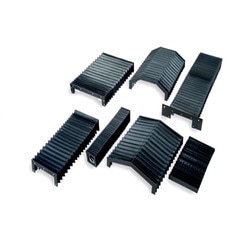 | CNC Bellow Cover Product Details: Brand GURUKRUPA Color BLACK Size ANY We are considered a well-known name in the business that manufactures and supplies CNC Bellow... View product → |
Match the Construction to the Hazard and Store It Correctly
Shape is not a specification: choose cylindrical machine protection covers by motion and exposure, not by diameter alone. Dry chips need abrasion-resistant fabric and folds that shed debris, while cast-iron dust and grinding particles require tighter sealing, reinforcement and access for cleaning.
| Hazard | Construction evidence to request | Failure prevented |
|---|---|---|
| Dry chips | Abrasion-resistant material and debris-shedding fold design | Cut fabric and packed folds |
| Cast-iron dust or grinding particles | Sealed construction, reinforced folds and practical cleaning access | Abrasive ingress and rapid wear |
| Coolant mist, cutting oil or alkaline wash | Compatibility for the exact fluid, concentration and temperature | Swelling, cracking or softened coating |
| Sparks or hot swarf | Spark rating and measured continuous and peak contact temperatures | Burn-through or impact damage |
| UV, chemical vapour, fire risk or humidity | Separate coating and fabric resistance data, including fire behaviour | Ageing, chemical attack or moisture damage |
Ask for the material grade, coating type, temperature limits, chemical compatibility data and cleaning limitations. If those limits are unavailable, test a sample or choose a documented alternative before installation. Cylindrical bellow cover care starts with recording the actual exposure, including linear, rotary or combined motion.
After removal, clean and dry the cover, support it in its natural cylindrical geometry, and shield it from sharp bends, crushing, direct sunlight and solvents. Do not tightly fold or stack it long term; permanent creases alter travel. Keep a replacement record of dimensions, exposure, inspection findings and failure cause.
Frequently asked questions
How often should you inspect a cylindrical bellow cover?
Inspect it after installation, after changes to the carriage, guideway, cable routing, hose routing, or mounting frame, and when contamination worsens. Set routine checks using machine hours and the amount of chips, coolant, heat, or abrasive dust present.
How do you clean a round bellow cover without damaging it?
Remove loose chips from the outside before wiping. Use a soft brush or vacuum to lift debris from the folds, then use a compatible cleaner for coolant residue. Avoid driving chips into the folds with high-pressure air or directing tools at the fabric seams.
What signs indicate that a cylindrical machine protection cover needs replacement?
Look for cracked or hardened fabric, pinholes, torn folds, failed stitching, distorted sections, loose mounting strips, coolant seepage, and rubbing marks. A cover that bunches unevenly or fails to extend across full travel also needs investigation.
How do you verify a replacement cylindrical bellow cover will fit?
Measure compressed length, extended length, folded height, width or diameter, mounting-hole spacing, and travel direction. Check clearance through the machine's full stroke, including nearby cables, hoses, carriers, guards, chips, and coolant lines.
Related products
 | Round Bellow Covers ₹1000 To match with our reputation in the market, we are here to present an unparalleled assortment of Round Bellow Covers. View product → |
 | Bellow Cover We are considered a well-known name in the business that manufactures and supplies Bellow Cover. View product → |