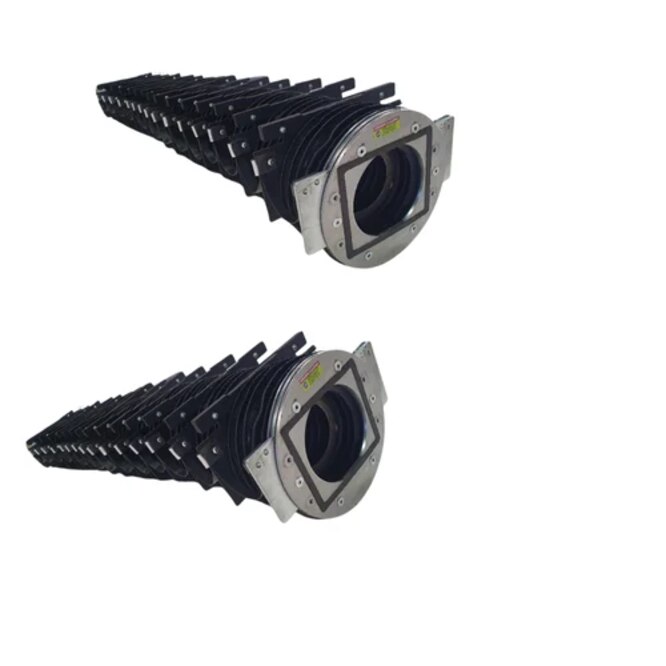
Owners of Trumpf laser equipment need a bellow cover when a moving axis exposes guideways, screws, cables, hoses, or other precision components to hot debris and contamination. By the end, you will know which machines need protection, how to identify a failed cover, what measurements determine compatibility, and which safety and installation checks belong in the purchase decision.
Key takeaways
- Match the cover to the exposed axis and protected assembly, not only the Trumpf model.
- Replace bellows with torn fabric, exposed guides, heat damage, or contaminated folds.
- Record compressed length, extended length, width, height, mounting holes, and travel direction.
- Verify clearance, material compatibility, mounting details, and movement before installation.
Which Trumpf laser machines need bellow covers?
Flatbed laser cutters, tube-cutting systems, laser welders, and marking machines need bellow covers when their moving axes expose precision components to dust, fumes, chips, sparks, or heat. Trumpf laser bellow covers are selected for the protected assembly, not simply for the machine brand.
| Machine type | Assemblies to inspect | Cover application |
|---|---|---|
| Flatbed laser cutter | Z-axis, cutting head, guideways, linear rails | Protect the vertical head carriage and exposed travel paths |
| Tube-cutting system | Chuck travel, cutting-head axis, rails, racks | Cover long horizontal or rotary-axis movements |
| Laser welder | Robot slide, weld-head axis, cable and hose routing | Shield guides while preserving head movement |
| Marking system | Z-axis, focusing head, linear slide | Protect compact slides from smoke and particulate residue |
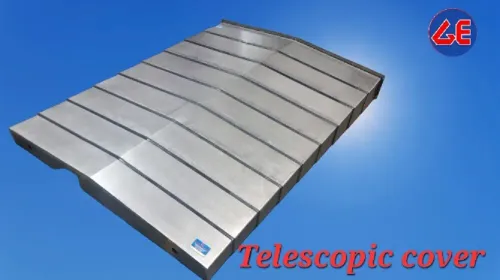
Trumpf laser bellows can also protect ball screws, linear motors, cable carriers, fibre paths, and coolant or gas hoses. A cover that fits one assembly may fail on another because its compressed length, fold pitch, cross-section, mounting frames, or minimum bend radius differs.
Check the nameplate, model, serial number, axis designation, and photographs before requesting a quotation. Include the axis stroke and clearance around the moving assembly; a brand name alone cannot identify the correct part.
These covers protect machinery, not people from laser radiation, so they do not replace an enclosure, interlock, or engineered Class 4 laser control.
What damage do laser machine bellow covers prevent?
A failed cover lets contamination reach precision surfaces and moving parts, where it can score rails, clog threads, increase friction, or cause positioning errors. Laser machine bellow covers form a moving barrier around vulnerable assemblies rather than treating the contamination after it has entered.
Protection commonly extends to:
- Guideways, keeping cutting dust, metal particles, and abrasive debris off sliding surfaces.
- Linear rails, preventing fines and slag from grinding into bearing blocks.
- Ball screws, stopping dust, fumes, and hot particles from contaminating the threads.
- Racks and pinions, reducing buildup that causes uneven motion and premature tooth wear.
- Linear motors, shielding magnets and tracks from conductive particles, slag, sparks, and heat.
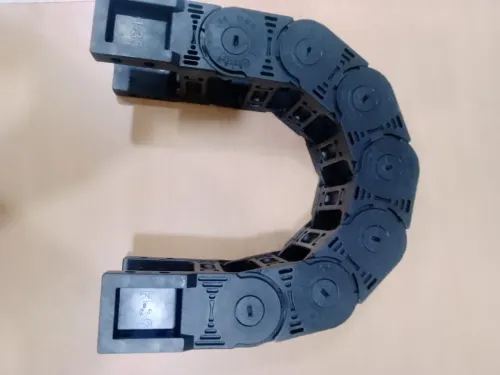
- Cable carriers, protecting cables from sparks, heat, coolant, lubricants, and abrasion.
- Hose or fibre-routing paths, preventing cutting residue, coolant, and sharp debris from damaging flexible lines or fibre cables.
The correct material and coating must match the process. Laser cutting can expose a cover to smoke condensate, hot sparks, molten metal, coolant, lubricants, cleaning chemicals, and repeated heat cycles; an unsuitable fabric can stiffen, burn, delaminate, or leak at its seams.
Laser protection bellows are machine-protection components, not laser-radiation guards. They do not replace a beam enclosure, laser safety curtain, interlocked access panel, fixed guard, or the machine’s risk controls. A replacement cover must preserve those clearances and safety functions rather than merely enclosing the axis.
How do you know an existing Trumpf bellow cover needs replacement?
Replace the cover when it no longer forms a continuous barrier or moves freely through the axis stroke. Inspect Trumpf laser bellows with the machine stopped, clean enough to see each fold, and check the cover both extended and compressed.
1. Examine the fabric for torn sections, exposed folds, punctures, delamination, cracked or stiffened material, and embrittlement. Discoloration, burn marks, melted coating, or brittle edges indicate heat damage from sparks or hot particles.
2. Open the pleats and check for collapsed folds, trapped metal dust, and seams that have separated or are leaking light, smoke residue, or debris. A pleat that stays flattened can buckle during compression.
3. Inspect every wiper for cuts, missing sections, hardening, or loss of contact with the protected surface. A damaged wiper lets contamination pass even when the bellows fabric looks intact.
4. Check mounting frames, guide strips, end plates, and fasteners for looseness, distortion, pulled holes, or fasteners pulling through the fabric. Replacing fabric alone will not correct damaged mounting geometry.
5. Move the axis through its full programmed travel at reduced speed. Stop if the laser machine bellow covers rub, snag, invert a fold, pinch against hardware, interfere with travel, or produce abnormal drag.
6. After movement, inspect the guideway, rail, rack, ballscrew, or linear motor area. Cutting dust or metal particles reaching the guideway proves the cover has already lost protection.
Record photographs and the affected axis before ordering; a recurring tear can signal incorrect clearance, excessive compression, or frame damage rather than worn fabric alone.
What measurements make a replacement cover fit the machine?
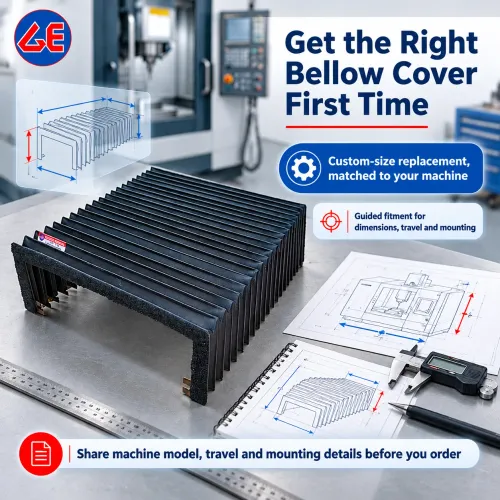
“Any size” is not a usable specification: a cover can match the visible length yet strike the carriage, buckle at compression, or overload its frames. Record the machine and axis before requesting a price.
1. Copy the machine model, serial number, axis designation, and existing cover part number from the nameplate, service file, or frame tag. State whether the cover protects a Z-axis, guideway, cable path, or another moving assembly.
2. Measure the cover fully extended and fully compressed. Record width, height, fold height or fold pitch, internal opening, external envelope, and the axis travel direction. Measure the compressed state carefully; insufficient compression space causes pleats to rub, buckle, or hit an end stop.
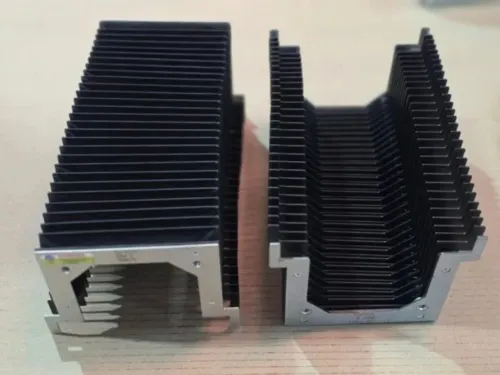
3. Measure both mounting frames and end frames, including overall length and width, frame thickness, hole pattern, hole diameter, hole spacing, and attachment method. Identify sewn flanges, plates, clamps, screws, hook-and-loop fasteners, or other connections.
4. Check full-travel clearance with the carriage at both limits. Note nearby rails, hoses, fibre lines, cable carriers, guards, sensors, and access panels; the cover must not pinch or abrade against any of them.
Send a dimensioned drawing, photographs from both ends and from the side, the part number, and measurements from the existing cover when dimensions are uncertain. That evidence helps GURUKRUPA BELLOWS PVT LTD distinguish a frame-reuse job from a complete replacement.
Buyers sourcing trumpf laser bellow covers for industrial laser machines washington should provide this same data; “trumpf laser bellow covers” alone does not identify the correct assembly.
Related products
 | Trumpf Laser Bellows Product Details: Minimum Order Quantity 1 Number Brand GE Color Black Size any We offer bellows made specifically for your Trumpf® laser machine. View product → |
 | Laser Machine Bellows We are committed to manufacture, export, and supply a qualitative range of Laser Machine Bellows for our esteemed clients. View product → |
What should you verify before ordering and installing the cover?
Choose the supply scope before approving the quotation. A fabric-only replacement saves time only when the existing frames are square, undamaged, and reusable; otherwise, a complete assembly avoids fit and attachment problems.
| Option | What to verify | When it applies |
|---|---|---|
| Original Trumpf replacement | Correct model, axis, part number, frames, screws, plates, clamps, and attachment method | Use when factory fit and documentation matter |
| Fabric-only replacement | Fold pitch, compressed envelope, minimum bend radius, and hook-and-loop or sewn attachment | Use only with sound reusable frames |
| Complete assembly | End frames, fasteners, mounting plates, and clearances included | Use when frames are bent, loose, or missing |
| Compatible custom-made cover | Drawings, photographs, travel data, and clearance measurements | Use when the original is unavailable or a retrofit is required |
Ask whether installation requires removing the carriage or guideway. Confirm access to lubrication points, inspection panels, guards, interlocks, and the emergency-stop risk assessment; a new laser protection bellows must not create a pinch point, block an access route, or interfere with a guard.
In Washington, treat machine protection separately from occupational laser safety. The employer remains responsible for state workplace laser controls and the manufacturer’s guarding requirements. Do not assume Trumpf laser bellows stop radiation unless the material, seams, joints, wavelength, power, exposure duration, and failure mode have been evaluated.
After installation, run the full programmed travel at reduced speed, checking rubbing, fold inversion, frame interference, abnormal drag, and lost access. Repeat at normal speed before release.
Frequently asked questions
Which Trumpf laser machines need bellow covers?
Flatbed laser cutters, tube-cutting systems, laser welders, and marking machines need covers when moving axes expose precision components to dust, fumes, chips, sparks, or heat. Select the cover for the protected assembly rather than the machine brand alone.
What damage do laser machine bellow covers prevent?
They shield guideways, cables, hoses, drive components, and other precision parts from abrasive dust, metal chips, welding spatter, fumes, heat, corrosion, and mechanical wear.
How do you know an existing Trumpf bellow cover needs replacement?
Inspect for cracks, holes, torn stitching, separated folds, burned fabric, hardened material, collapsed sections, exposed guideways, and restricted movement. Replace the cover when contamination reaches the protected assembly or the bellows no longer extend and compress smoothly.
What measurements make a replacement cover fit the machine?
Record the compressed length, extended length, overall width and height, travel direction, mounting-hole pattern, frame dimensions, fold pitch, and clearance around cables, hoses, tooling, and adjacent machine parts.
What should you verify before ordering and installing the cover?
Verify the protected assembly, travel range, operating temperature, exposure to oil and chemicals, spark or laser-related heat, fabric and coating requirements, mounting method, hole locations, clearance, and movement through the full axis stroke.
Related product
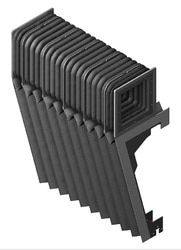 | Laser Cutting Machine Bellows We offer Laser Cutting Machine Bellows made specifically for your laser machine. View product → |