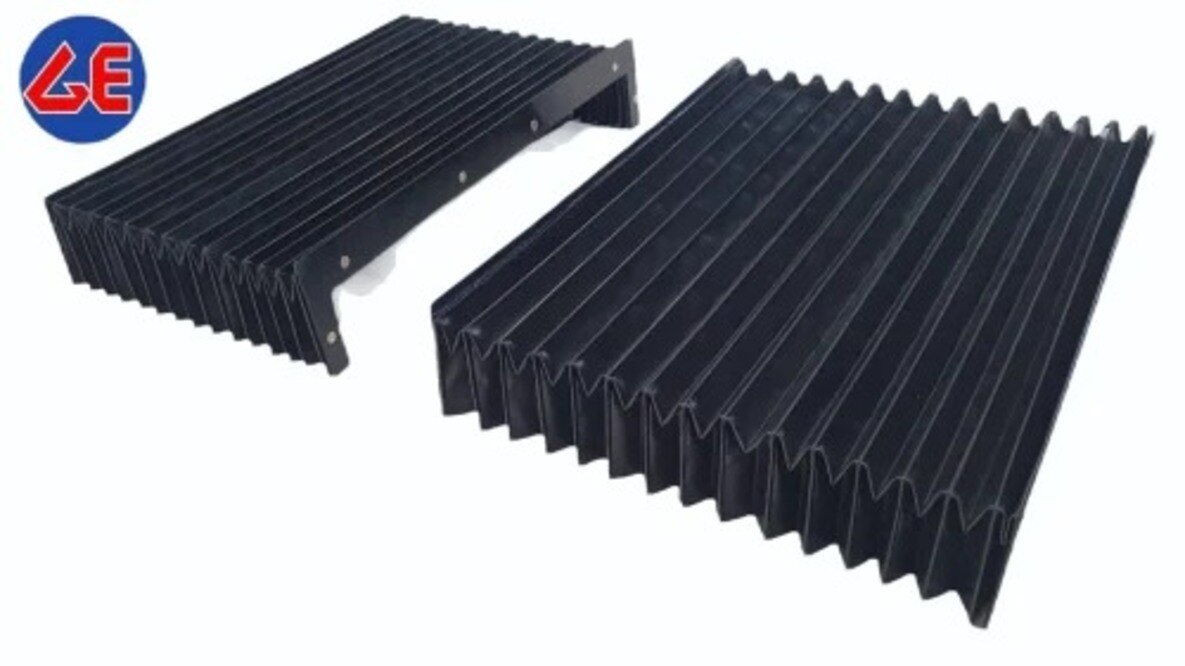
A CNC telescopic cover is not just a sheet-metal box or folded bellows fitted over an axis. The complete assembly depends on the machine’s travel, mounting geometry, motion profile, contamination, coolant and service access. By the end, you will know which components belong in the assembly, which measurements and operating details to provide, and how to compare a quotation without overlooking critical hardware.
Key takeaways
- Specify travel, closed length, open length and section count.
- Match wipers, seals and drainage to chips, coolant and heat.
- Request guide, mounting, material and test details in the quotation.
- Verify smooth travel, section alignment, sealing and access for service.
What belongs to a complete telescopic cover assembly?
A complete CNC telescopic bellow-cover assembly includes the structures that move, guide, seal, mount and drain it—not just the visible cover. Nested steel boxes or slats provide rigid protection; sliding shoes or rollers and guide rails or strips keep sections aligned; inter-box seals limit contamination; external scrapers or wipers remove chips and coolant.
Confirm that the quotation names these CNC telescopic bellow cover components:
- End frames, mounting flanges, brackets, stops and fasteners for secure installation and controlled travel.
- Drainage holes, channels or a collection path so coolant and chips do not pool at the closed end.
- Service access to wipers, shoes, rollers, seals and fasteners without removing the entire cover where practical.
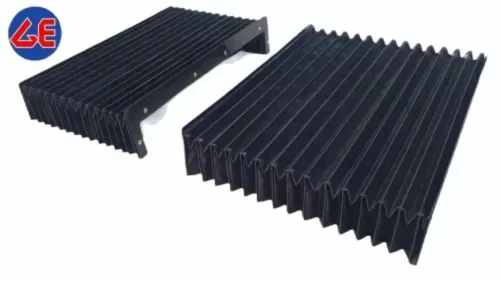
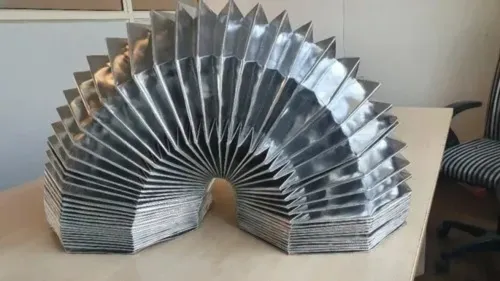
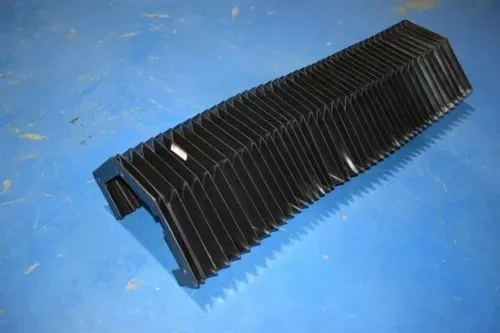
- A fabric or elastomeric bellows section, support frames, attachment strips and defined fold pitch when the design combines rigid and flexible protection.
| Design | What it includes | Best fit |
|---|---|---|
| Rigid metal telescopic cover | Nested steel boxes, guides, rollers or shoes, seals and wipers | Sharp chips, heavy mechanical impact and fixed linear travel |
| Flexible fabric or elastomeric bellows | Folded material, attachment strips and support frames | Lighter contamination, irregular movement or limited space |
| Combined cover | Steel telescopic sections plus a flexible bellows transition | Machines needing impact protection in one zone and flexible coverage in another |
A bellows-only quotation does not automatically include telescopic guidance, end frames or wiping hardware. Ask for each item separately, because missing guidance causes rubbing and poor alignment, while missing wipers allows coolant and chips into the moving joints.
Which dimensions and motion data must the specification contain?
State closed length, maximum extended length and usable stroke—not travel alone. CNC telescopic cover specifications must also give the number of boxes, overall box width and height, sheet thickness, material grade, total weight, travel direction, mounting orientation and allowable unsupported span.
Add rapid-traverse speed, acceleration, cycle frequency, guide arrangement, permitted lateral or vertical misalignment and clearance between nested sections.
- Record guideway width, available height, mounting-face locations and mounting-hole datums.
- Measure maximum extension, retracted clearance, adjacent obstructions and the cover’s position relative to the tool and workpiece.
- Mark travel direction, cable or hose crossings and every possible interference point.
Machine model and axis name are not enough; two axes with the same nominal travel can have different envelopes and support conditions.
| Item | Calculation or check | Failure prevented |
|---|---|---|
| Closed-stack space | Measure the retracted cover envelope, including nested boxes and end frames | Bottoming out against guards or nearby hardware |
| Full-axis coverage | Cover the distance between mounting faces at maximum extension, with required overlap | Exposed guideway at the far limit |
| Limit clearance | Check tool, workpiece, cables and guards at both retracted and extended positions | Box collision and guard interference |
| Unsupported span | Compare the open span with the stated limit and guide support | Sag, uneven loading and stepped opening |
Confirm lubrication points remain accessible. Also check overextension, box-to-box contact and guide alignment before approval; rubbing, noise and premature wiper wear often begin at a limit position.
How do chips, coolant and temperature change the included parts?
An external scraper removes chips and liquid from an exposed surface; an internal seal limits contamination entering between boxes, guides or bellows folds. Neither replaces the other. A scraper is a wear part, so a profile suitable for coolant mist can fail quickly against hot, sharp chips or abrasive cast-iron dust.
Match the parts to the contamination and heat load:
- Dry chips or hot chips: specify a heat-resistant scraper profile, suitable steel grade, protective coating, heat-tolerant fasteners and joints, and guide shoes or rollers that will not seize as temperatures rise.
- Flood coolant: check chemical compatibility for wipers, seals, coatings, laminates and adhesives. Provide a slope, drain path or collection tray so liquid cannot pool at the closed end.
- High-pressure coolant: require a scraper and seal arrangement that resists jet penetration, plus protected joints and fasteners. Do not treat a nominally closed gap as pressure-tight.
- Abrasive cast-iron dust or grinding swarf: use wear-resistant wiper material, sealed guide interfaces and coatings that tolerate abrasion. Fine dust can destroy rollers and sliding shoes even without large chips.
- Horizontal, vertical or inverted mounting: define where chips and coolant fall, how they leave the cover, and whether a pocket forms between folds or boxes.
- Flexible sections: state fabric or laminate construction, fold height, fold pitch, support frames, attachment method, temperature range, minimum bend radius and permitted compression.
These conditions decide whether a telescopic cover, flexible bellow, or combined system will survive the machine’s actual duty.
What should you include in an order and protection quotation?
A complete telescopic CNC cover order details package starts with a dimensioned interface drawing, not photographs alone. Add machine photographs with a scale, axis limits, reference datums, mounting-hole patterns, installation envelope, adjacent obstructions, cable or hose crossings, and required open and closed positions.
This prevents a cover that fits the drawing but strikes a guard or hose at full travel.
- Assembly dimensions: closed length, extended length, stroke, box count, width, height, thickness and weight.
- Construction: material grade, wipers, seals, guide rails or strips, sliding shoes, rollers, stops, fasteners and drainage.
- Operating inputs: travel speed, acceleration, cycle frequency, mounting orientation, temperature, coolant, chip size and abrasive contamination.
- Commercial scope: delivery, site measurement, installation, lifting, alignment, commissioning, transport, GST, replacement wipers or rollers, and service visits.
A CNC machine protection quotation is comparable only when exclusions and interface responsibilities are written down. For cnc machine bellow covers for telescopic systems in Bangalore, ask GURUKRUPA BELLOWS PVT LTD whether site access, lifting, GST, delivery, installation and post-installation rework are included.
| Value | Must be guaranteed in writing | Must not remain an assumption |
|---|---|---|
| Travel | Usable stroke and both end positions | Nominal axis length |
| Motion | Speed, acceleration and cycle frequency | Machine model alone |
| Environment | Temperature and contamination limits | “Standard shop conditions” |
| Interface | Hole pattern, datums and clearances | Supplier-selected mounting points |
Related products
 | CNC Telescopic Cover Product Details: Brand GURUKRUPA Being one of the trustworthy names of the industry, we bring forth CNC Telescopic Cover that can be availed at... View product → |
 | Telescopic Cover ₹5000 Product Details: Brand GURUKRUPA Being one of the trustworthy names of the industry, we bring forth CNC Telescopic Cover that can be availed at... View product → |
How do you verify movement, safety and service life after selection?
Approve the cover only after running it through the machine’s complete axis stroke at production speed and acceleration. Check retracted clearance, full extension, box-to-box spacing, roller loading, guide alignment, wiper contact, unsupported-span behaviour and drainage at both travel limits.
- Watch for rubbing, noise, stepped opening, dents or jerky motion. Unequal guide loading, excessive lateral movement and excessive acceleration create these faults even when the overall dimensions are correct.
- Confirm that rollers or sliding shoes share the load, nested boxes never collide, and the unsupported span does not sag, buckle or strike nearby parts.
- Run coolant and chips through the normal path, then inspect pooling at the closed end. The cover must not block lubrication points, cable access or adjacent guards anywhere along its travel.
- Request a service schedule for wipers, guide shoes, rollers, seals and fasteners. Record each replacement interval, access method, required tools and whether technicians must remove the complete cover to reach the part.
- Add the assembly to the machine risk assessment. A telescopic cover does not replace fixed guarding or interlocking for moving parts, trapped-body hazards or ejected chips. Apply ISO 16090-1 for machining centres and ISO 23125 for turning machines alongside the cover’s mechanical protection.
Reject approval if service access depends on dismantling an adjacent guard without a documented safe procedure, or if the supplier cannot state the tested speed, acceleration and alignment limits. A low purchase price becomes expensive when wipers fail frequently or rollers cannot be reached.
Frequently asked questions
What belongs to a complete telescopic cover assembly?
A complete assembly includes nested steel boxes or slats, guide rails or strips, sliding shoes or rollers, inter-box seals, external scrapers or wipers, mounting hardware and drainage provisions where required.
Which dimensions and motion data must a CNC telescopic cover specification contain?
Provide the protected guideway dimensions, total travel, closed length, open length, cover height and width, section count, mounting points, maximum speed, acceleration, orientation and available clearance.
How do chips, coolant and temperature change the included parts?
Heavy chips require robust scrapers and chip-resistant construction; coolant requires compatible seals, wipers and drainage; elevated temperatures require materials, finishes and clearances rated for the actual operating temperature.
What should you include in a telescopic CNC cover order and quotation?
Include the machine and axis details, drawings or photographs, dimensions, motion data, contamination type, temperature, mounting arrangement, material requirements, quantity, delivery location and inspection or testing requirements.
How do you verify movement, safety and service life after selection?
Check full-stroke movement for binding, section alignment, wiper contact, seal continuity, drainage, mounting security, access for maintenance and repeated-cycle performance under representative chips, coolant and temperature conditions.
Related products
 | Telescopic Cover Product Details: Brand GURUKRUPA Being one of the trustworthy names of the industry, we bring forth CNC Telescopic Cover that can be availed at... View product → |
 | Industrial Telescopic Covers Our company is known as one of the eminent names of the industry to manufacture and supply Industrial Telescopic Covers. View product → |
 | Bellow Cover ₹1000 Product Details: Brand GE Color Black-Blue - Gray -White Size ANY ( C shape, Square, Round, Rectangular) Ours is a trustworthy name in the business... View product → |
 | Steel Telescopic Cover Product Details: Brand GURUKRUPA Our company is considered a renowned name in the field that manufactures and supplies Steel Telescopic Cover. View product → |