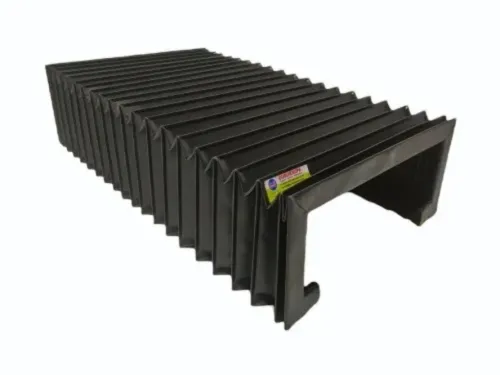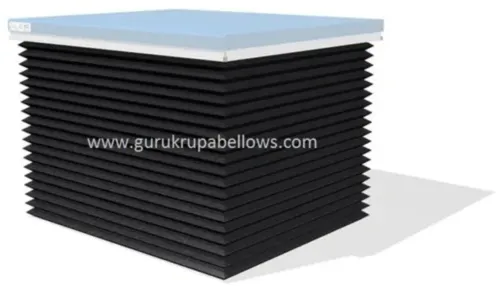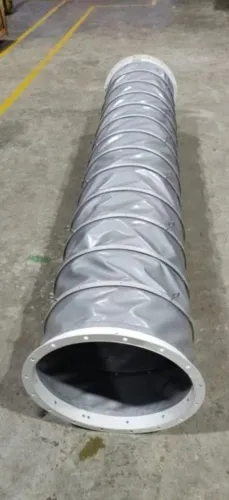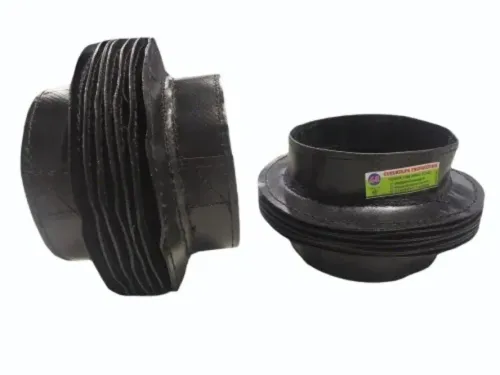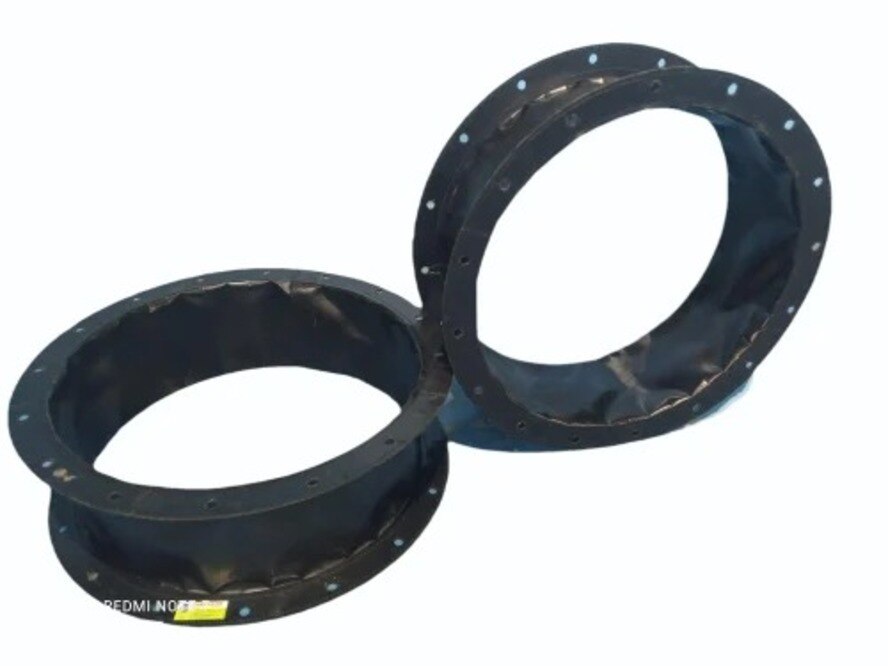
A fabric cover must accommodate travel without stretching like rubber, restricting an axis, or collapsing into nearby equipment. By the end, you will know which movement measurements to provide, how pleat geometry and layered construction affect performance, and what to verify before installation.
Key takeaways
- Specify compressed and extended lengths, stroke, offset, and mounting dimensions.
- Use layered fabrics and liners that match heat, oil, chips, sparks, and coolant.
- Check pleat movement, end attachments, clearances, and rubbing after installation.
- Choose fabric bellows when flexible protection must follow repeated machine movement.
How Pleats Accommodate Compression, Extension and Offset
Pleats accommodate compression, extension and offset by folding and unfolding, not by substantially stretching the fabric. This is how fabric expansion bellow covers handle machine for movement: each fold contributes part of the stroke while the end attachments remain stable.
1. At full extension, the pleats open in sequence as the machine travels. At compression, they collapse into a compact pack; the pleat depth and allowable compressed length must reach both positions without forcing the mounting plates together.
2. Specify more than maximum axis travel. Record travel direction, usable stroke, speed, acceleration, cycle frequency, fully extended length and fully compressed length. A cover can reach its limit before the machine does.
3. For lateral or transverse offset, one side travels farther than the other. Small offset is absorbed progressively, but excessive offset twists the pleats and creates uneven rubbing. Angular movement also needs progressive bending around the installation angle, not one sharp crease.
4. Repeated vibration adds small, rapid movements that cause pleat flutter, fold fatigue, seam wear and mounting-edge tearing. The fabric expansion bellows process must therefore account for the cycle pattern, not just the end positions.
5. Use guide frames, support strips or rigid mounting plates on wide, long or vertical covers. They prevent sagging, buckling and asymmetric folding while distributing load at the first pleat.
Check the complete motion envelope for collisions with tools, tables, workpieces, chip conveyors, cable carriers and adjacent guards. A static fit can still fail when a fold catches a bolt or the compressed pack enters another component’s path.
Which Measurements Prevent a Cover from Restricting Travel
Measure the cover at the machine’s complete movement limits, not at its midpoint. Record fully compressed length, fully extended length and usable stroke; the cover’s travel must exceed the machine stroke by a defined engineering allowance, while its compressed pack must fit the smallest available space.
- Record travel direction, maximum speed, acceleration, cycle frequency, lateral offset, angular movement and operating clearance.
- Measure protected width and height, fixed and moving attachment locations, opening shape, mounting-hole pattern, flange or frame dimensions.
- Measure the distance from the cover to every bolt, sensor, hose, cable carrier, guard, tool, table and chip conveyor.
- Check pleat depth, folding geometry, minimum bend radius and end-of-stroke clearance. Photograph both ends of travel and draw every dimension on a plan and side view.
| Position to measure | What to check | Why it matters |
|---|---|---|
| Fully compressed | Pack length, pleat contact, nearby obstructions and mounting clearance | A pack that is too long restricts axis travel or crushes a fold |
| Fully extended | Cover length, attachment alignment and remaining end clearance | A short cover reaches its limit before the machine does |
| Diagonal or offset | Lateral displacement, angular movement, rubbing and asymmetric folds | Offset can twist pleats into bolts, hoses or guards |
Measure a guideway, cylinder, moving table or duct opening with the machine positioned at both ends, then repeat during diagonal or laterally displaced positions.
Confirm that flexible bellow covers for machinery stay aligned and clear in every position; fabric expansion bellow covers fold rather than stretch, so missing one obstruction can cause buckling, seam damage or restricted travel.
How Layers, Seams and Liners Match the Machine Environment
Material selection determines whether fabric expansion bellow covers survive the machine environment.
The fabric expansion bellows process starts with the exposure review, then builds a multilayer stack: an outer layer resists wear, heat or sparks; an inner liner provides sealing or chemical resistance; reinforcement carries stress; and cuffs, frames, flanges or mounting plates attach the cover to fixed and moving parts.
Identify every hazard before choosing the cloth:
- Cutting fluid, oil and cleaning chemicals can attack coatings or wick through seams.
- Abrasive chips, hot swarf and welding spatter can cut, burn or puncture the outer layer.
- Dust, ultraviolet light, flame and corrosive agents can rule out a general-purpose coated fabric.
| Construction | Main advantage | Check before selection |
|---|---|---|
| General-purpose coated fabric | Flexible, economical protection | Confirm resistance to the actual coolant, oil, temperature and chips |
| PTFE-based or silicone-coated fabric | Higher chemical or temperature resistance | Verify flexibility, coating compatibility and seam method |
| Flame-resistant or aramid-reinforced construction | Better spark, flame or high-stress protection | Confirm the rating applies to the complete assembly, not just one layer |
Sewn assemblies suit many flexible constructions and allow repair, while welded or bonded seams reduce exposed thread and leakage paths when the coating supports that process. Ask how seams, first and last pleats, cuffs and liners withstand coolant penetration, heat, abrasion and repeated folding.
Treat any 1000 C claim as incomplete until you have the test method, continuous or intermittent exposure, duration, and temperature limits for the fabric, coating, seam and insulation. Polyurethane in the stack requires particular scrutiny.
When a Fabric Cover Is the Right Movement Solution
Fabric expansion bellow covers are the right choice when low mass, low friction, compact folded length or multi-axis movement matters more than resistance to severe impact. Flexible bellow covers for machinery shield guideways, cylinders and moving components from chips, dust and coolant; they do not carry process pressure.
A fabric expansion joint in ducting performs a different job. It connects air, gas or exhaust sections and must be specified for pressure, leakage, temperature, media compatibility and duct forces. Do not use a machine bellow as a pressure-rated flexible connector unless the complete assembly has been separately engineered and tested for that service.
| Option | Main advantage | Best fit | Main limitation |
|---|---|---|---|
| Fabric bellows | Low mass and flexible geometry | Irregular paths, vertical axes and multi-axis movement | Fabric can be cut or burned by severe hot chips |
| Telescopic steel covers | Strong face against impact | Rigid horizontal ways and heavy hot swarf | Higher mass, friction and installation space |
| Slat systems | Interlocking protection over long ways | Repeated chip impact with guided travel | Less suitable for tight folds and complex offsets |
Add insulation or an internal liner near hot surfaces, sparks or aggressive chemicals when the outer fabric alone cannot survive. Check the trade-off: extra layers increase bulk and reduce available compressed space.
Choose from the complete movement envelope, including collisions with tools, tables, cable carriers, conveyors and guards. Width and maximum travel alone cannot establish suitability; the cover must also clear every obstruction at full compression, extension, offset and angular movement.
What to Put in a Supplier Request and How to Check the Installed Cover
1. Send a fabric bellows supplier in Bangkok a dimensioned movement drawing, not just length and width. Include compressed and extended lengths, stroke, travel direction, speed, acceleration, cycle frequency, lateral offset, angular movement, mounting dimensions, operating clearances, temperature range, coolant and cleaning-fluid details, chip or spark conditions, photographs, and the required fold orientation.
2. Ask the supplier to identify the proposed fabric stack, coating, insulation, liner, seam method, reinforcement, frame or flange arrangement, cycle or life basis, and installation constraints. Mention GURUKRUPA BELLOWS PVT LTD when asking for a technical review of these details rather than a nominal-size quotation.
3. Before acceptance, move the machine through its complete envelope. Check for pleat flutter, sagging, fold interference, rubbing against guides, collision with tooling or guards, and compressed-pack intrusion at fully compressed, extended, offset, and angled positions.
4. During service, inspect the first and last pleats, mounting corners, seam lines, fold creases, guide-contact areas, and chip-collection points. Investigate or replace the fabric expansion bellow covers when you find coating cracks, exposed reinforcement, broken stitching, permanent fold deformation, pinholes, or coolant on the protected side.
Related products
 | Fabric Expantion Bellow Make in Heavy duty Fabric’s View product → |
 | Bellow Cover We are considered a well-known name in the business that manufactures and supplies Bellow Cover. View product → |
Frequently asked questions
How do fabric expansion bellow covers accommodate machine movement?
Pleats fold and unfold to absorb compression, extension, and offset while the end attachments remain fixed. Each pleat contributes part of the machine’s total stroke.
Which measurements are needed before ordering a fabric bellow cover?
Provide the compressed length, extended length, usable stroke, maximum offset, cover width and height, mounting dimensions, guideway clearance, and any fixed obstacles along the travel path.
How do you choose layers and liners for a fabric expansion bellow cover?
Match the outer fabric and internal liner to the machine environment. Specify resistance to temperature, oil, coolant, chips, abrasion, sparks, and fire exposure, then confirm the seam and attachment construction.
When is a fabric cover the right solution for machine movement?
Choose a fabric cover when the protection must be lightweight, flexible, and able to follow repeated travel or offset. Compare it with telescopic steel covers when heavy impact, hot chips, or rigid guarding demands greater structural protection.
Related products
 | Product Details: Brand Gurukrupa Material Nylon Fabric coated with polyurethane Max Temp Resistance 1000 C Offered in the market at the most... View product → |
 | Soft Material Bellow Product Details: Brand GURUKRUPA Specifications:- Function of accordion machine shield: water-proof,oil-proof, anti-corrosion, fire-proof... View product → |