A CNC cover is engineered around the machine’s travel, acceleration, contamination and available installation space, then built as a coordinated assembly of boxes, guides, wipers and stopping elements. By the end, you will know which production stages control reliability and which measurements a manufacturer needs before producing custom protection.
Key takeaways
- Map clearances, loads and motion—not axis travel alone.
- Form and assemble telescoping boxes around the machine’s actual geometry.
- Use fabric bellows where flexible sealing is needed between rigid sections.
- Send drawings, travel data, speeds and environmental details for a custom cover.
From machine drawing to a cover design
A manufacturer turns CNC geometry into a telescopic cover specification by mapping motion, clearance and loads—not by copying axis travel.
1. Collect the axis travel, extension speed, acceleration, cycle frequency, mounting orientation and available side clearance. Record mounting-face dimensions, maximum cover height and the required retracted length.
2. Draw the machine envelope at both travel limits. Show the guideway, saddle, spindle head, tooling, access doors and nearby guards, including every space the cover occupies at full extension and retraction.
3. Calculate extended length, closed length, usable stroke, box width, box height, overlap and installation clearance together. Each nested box must retain sufficient overlap throughout the stroke; reducing overlap to shorten the closed package can create leakage paths, skew and box lift during acceleration.
4. Shape the design for service conditions. Add drainage paths, inclined or stepped roofs that move chips away, mounting flanges, limit stops and access openings. Account for coolant, chip accumulation and the clearance needed for cleaning.
5. Check the drawing through travel reversal before fabrication. Verify that sections will not bind, collide with tooling or adjacent guards, or lose clearance at maximum speed and acceleration.
This review forms the foundation of telescopic bellow cover manufacturing. Nominal axis travel alone cannot define the finished cover, because the usable stroke is limited by nesting geometry, minimum overlap and the machine’s complete moving envelope.
How the telescoping boxes are formed and assembled
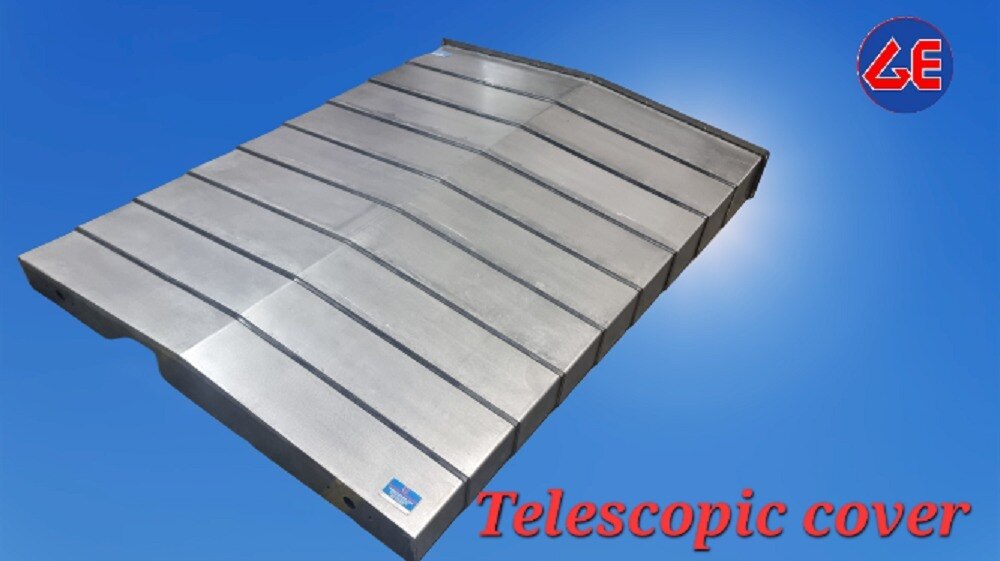
Sheet grade and thickness are chosen for chip impact, coolant pressure, corrosion exposure, temperature and required stiffness. The maker then cuts each sheet to its developed dimensions, allowing for bend deductions and the overlap between nested sections.
- A press brake or forming tool bends the blanks into individual pans or boxes.
- Corners, seams, ribs and reinforcement pieces are welded or mechanically joined.
- Welds are dressed, and the steel is cleaned and prepared for painting, plating or another specified surface treatment.
- Inspectors check each box for flatness, squareness and parallelism. A small error can make the nested cover bind.
The steel structure also includes parts that control motion:
| Part | Construction | Purpose |
|---|---|---|
| Guideways | Rails, rollers or sliding shoes | Control lateral movement |
| Wipers or scrapers | Contact strips at the machine way | Limit chip and coolant entry |
| Mounting flanges | Fixed attachment faces | Connect the cover to moving and stationary parts |
| Bumpers and limit stops | Impact and travel-control components | Prevent overtravel and hard contact |
| Damping or synchronization devices | Motion-control elements | Sequence sections and reduce impact |
Assembly starts with the largest box and proceeds inward to the smallest. Fasteners secure the guides, wipers, flanges and stops; high-speed telescopic bellow covers for CNC machines may use synchronization so sections open in sequence instead of striking one another. The result is a guided mechanism, not a single folded shell.
Where fabric bellows fit into the construction
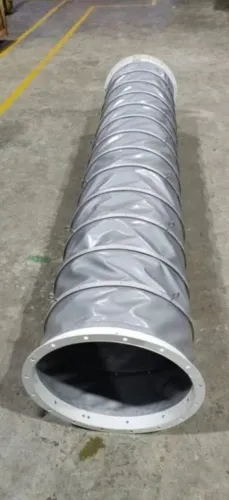
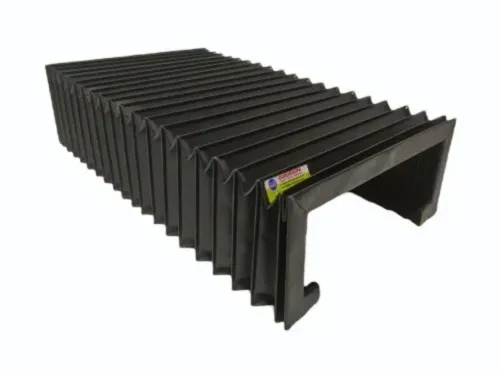
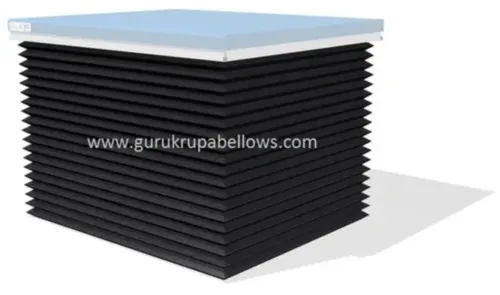
A fabric or elastomeric concertina bellow suits irregular moving envelopes, restricted access and compact closed packages; it does not replace steel where sharp chips, heavy debris or direct high-pressure coolant impact the protection.
| Option | Construction | Best fit | Main limitation |
|---|---|---|---|
| Telescopic steel cover | Nested sheet-metal boxes with guides, wipers and stops | Sharp chips, heavy debris and direct coolant impact | Needs space for box overlap and retraction |
| Fabric or elastomeric bellow | Coated fabric or polymer laminate formed into pleats | Irregular geometry, restricted access and small closed length | Lower resistance to impact and cutting |
| Hybrid cover | Folded bellow attached to a steel telescopic structure | Mixed hazards and tight installation envelopes | Two subassemblies require separate checks |
How telescopic bellow covers are made in fabric form begins with cutting the selected base fabric. Choose the coating or laminate for coolant, oil, abrasive dust, heat and sparks; ambient temperature alone misses short-duration hot spots from chips. Form the material into pleats, then join it by sewing, adhesive bonding, high-frequency welding or hot-air welding.
Match the seam method to the coating, because a sewable fabric is not automatically weldable.
Insert frames or lamellas when the pleats need shape retention. Bond or stitch the corners, then check leakage and alignment. Shallow pleats save retracted space but raise bending stress; deep pleats consume room and can catch chips. Compression and extension tests verify pleat recovery, closed length and resistance to sticking.
Test the finished bellow separately before attaching it to a telescopic structure.
How the cover is tested against real CNC motion
A finished cover is proven by a full-stroke dynamic test on the machine, not by a bench fit alone. The test must reproduce the axis orientation, programmed speed, maximum acceleration, reversals, coolant or oil exposure and representative chip loading.
1. Check closed length, extended length, box width and height, mounting-hole positions, box overlap and clearance from the machine envelope. Inspect welds, corner squareness, guide alignment, roller or shoe contact, fasteners, wiper preload, scraper continuity and limit-stop position.
2. Run the cover through the complete axis stroke, including repeated reversals at the specified speed and acceleration. A static check will not expose unequal section motion, dynamic rubbing, box impact, wiper lift-off or coolant migration through an overlap.
3. Apply representative chips and coolant or oil while observing horizontal ledges, box overlaps and wipers. Look for chip accumulation, debris entering beneath a wiper and sections telescoping out of sequence. Excessive wiper preload raises drive load; insufficient preload lets abrasive particles through.
4. Confirm that rollers, guide shoes, lateral restraints and damping parts control the cover’s weight and acceleration forces. Poor stopping control can create impact, vibration, cracked welds, loose fasteners and premature wiper wear.
Record the result against the drawing revision, material grades, surface treatment, wiper compound and every corrective change. That record lets you match replacement covers to the configuration that passed the machine test.
What to send when ordering a custom cover
A manufacturer needs measured machine data, not just the CNC model and axis stroke, to build custom telescopic bellow covers that fit and survive. Send the protected axis travel, maximum and minimum positions, mounting-face length and width, maximum permitted height, desired retracted length, extension speed, acceleration, cycle frequency, expected machine-tool accuracy and available side clearance.
- Add photographs or a measured sketch showing the guideway, saddle, spindle head, tooling, adjacent guards and both end positions. Measure from fixed datums, not the machine’s nominal model.
- Record guideway width, exposed height, mounting-hole pattern, and clearance above, below and beside every moving part. Move the axis slowly through its complete range; check both reversals, then allow for thermal growth, hose loops and tooling changes.
- Identify cast-iron chips, sharp steel chips, grinding dust, dry abrasive dust, high-pressure coolant, oil, sparks or hot intermittent chips. State coolant chemistry, temperature, mounting orientation and cleaning method.
- Ask for the proposed steel grade, sheet thickness, wiper material, internal liner, guide system, surface treatment and stopping method.
Use the hazard and space data to select the construction:
| Option | Best fit | Main trade-off |
|---|---|---|
| Steel telescopic assembly | Sharp chips and high-pressure coolant | Needs space for nested boxes |
| Folded fabric bellow | Irregular movement or very short closed length | Lower resistance to impact |
| Hybrid cover | Mixed hazards and tight geometry | More interfaces to inspect |
GURUKRUPA BELLOWS PVT LTD can assess these inputs before deciding which construction suits the actual machine.
Related products
 | CNC Telescopic Cover Product Details: Brand GURUKRUPA Being one of the trustworthy names of the industry, we bring forth CNC Telescopic Cover that can be availed at... View product → |
 | Telescopic Bellow Cover ₹1000 Product Details: Brand GURUKRUPA Ours is a distinguished name in the business that manufactures and supplies Telescopic Bellow Cover that is vastly... View product → |
Frequently asked questions
How does a CNC machine drawing become a telescopic bellow cover design?
The design maps axis motion, retracted and extended lengths, clearances, mounting points, loads and contamination risks.
How are the telescoping boxes formed and assembled?
Manufacturers form accurately sized metal sections, add guides and stops, then assemble the boxes so they extend and retract without binding.
Where do fabric bellows fit into a telescopic cover?
Fabric bellows seal flexible gaps and irregular transitions where rigid telescoping boxes cannot follow the required movement.
How is a telescopic bellow cover tested for CNC motion?
The assembled cover is cycled through the machine’s travel while checking alignment, friction, noise, interference, sealing and repeatable retraction.
What information is needed to order a custom telescopic bellow cover?
Provide machine drawings, axis travel, speed, acceleration, mounting dimensions, retracted length, clearance, temperature, coolant and debris conditions.
Related products
 | Telescopic Cover ₹5000 Product Details: Brand GURUKRUPA Being one of the trustworthy names of the industry, we bring forth CNC Telescopic Cover that can be availed at... View product → |
 | Telescopic Cover Product Details: Brand GURUKRUPA Being one of the trustworthy names of the industry, we bring forth CNC Telescopic Cover that can be availed at... View product → |