A damaged thermally bonded bellow cover cannot be judged by the size of the visible hole alone. By the end, you will know how to inspect the cover in both travel positions, decide between a controlled repair and replacement, prepare the right information for a recovery service, and verify that the restored cover moves safely.
Key takeaways
- Inspect every fold at full extension and compression before repairing.
- Use a local repair only when bonding and movement remain reliable.
- Match replacement fabric, coating, adhesive, and heat process.
- Test the cover through its complete stroke before production resumes.
Inspect the Cover Extended and Compressed Before Touching the Damage
Start with the machine isolated and its motion controls locked out. Determine thermally bonded bellow cover damage by inspecting the clean, dry cover at full extension and full compression, not by judging one visible hole. Remove chips and coolant film, then photograph every fold, seam, mounting edge, and guide area.
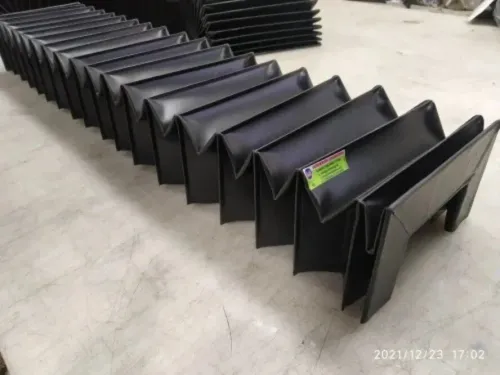
1. Extend the cover slowly. Look for cuts, punctures, open seams, lifted bonded layers, cracked coating, and gaps that appear only while the folds open.
2. Compress the cover through its normal stroke without forcing it. A small tear can spread across a fold, while damage hidden inside a compressed fold becomes visible.
3. Classify each finding as surface damage, delamination, torn seam, heat distortion, melted fabric, or loss of flexibility. Press adjacent material lightly; brittle, hard, or permanently deformed fabric indicates broader damage than a clean puncture.
4. Inspect the mounting frames, end plates, guide hardware, and clearance around the moving cover. Rubbing marks, trapped chips, sharp edges, misalignment, or a compressed fold reveal the likely failure mechanism.
5. Compare the cover’s actual travel and fold shape with its normal geometry. Excessive travel, forced compression, new motion resistance, or coolant exposure points to a cause that must be corrected before bonding.
Record the damaged fold numbers, seam lengths, hole sizes, affected layers, and photographs in both positions. Do not cut away loose material or pull apart a seam during inspection; that can enlarge the defect and hide its original extent.
A single clean outer puncture is a different problem from burned, embrittled, repeatedly patched, or extensively delaminated material.
Decide Whether a Local Repair Can Restore the Cover Safely
A single clean puncture in an otherwise flexible cover is the clearest candidate for local repair. Choose it only when the hole stays outside the bonded fold structure, the base fabric and coating remain supple, and the cover still clears the guideway through its full stroke.
A patch must restore the sealed perimeter, not merely close the visible opening.
Use this decision screen:
| Condition | Decision | Why |
|---|---|---|
| Small puncture in sound material | Local repair | The damage is isolated and the surrounding bond still carries the folding load. |
| Seam, edge bond, reinforcement, mounting hardware, or end plate damage | Workshop recovery or replacement | The load path or attachment geometry is compromised. |
| Burning, melted fabric, embrittlement, widespread delamination, cracked coating, or repeated patches | Complete recovery or replacement | Local bonding cannot restore lost flexibility and strength. |
| Poor clearance, misalignment, excessive compression, or recurring chip contact | Correct the cause, then recover or replace | A new patch will fail at the same contact point. |
For thermally bonded bellow covers repair, identify why the damage occurred before approving any work. Chips trapped in folds, sharp machine edges, incompatible coolant, excessive travel, and restricted clearance all turn a successful patch into a short-lived fix.
The repair must recreate the compatible thermoplastic bond. Stitching, cyanoacrylate, epoxy, or silicone can add stiffness, leak paths, or temporary adhesion without restoring the original seam.
Ask the repairer to identify the coating, such as PVC or TPU, and confirm heat, pressure, dwell, and tooling through a controlled sample test before attempting to restore thermally bonded bellow covers.
Use Compatible Materials and a Controlled Bonding Process
A reliable repair starts with material identification, not heat. Confirm the thermoplastic coating—PVC, polyurethane/TPU, or another specified polymer—along with the fabric reinforcement and any existing seam construction. Do not set a universal welding temperature: heat, pressure, dwell time and tooling must match that combination.
1. Isolate the machine, remove the cover, and clean away chips, coolant and oil. Dry it fully; contamination prevents fusion and traps weak spots beneath the patch.
2. Trim only loose, burnt or delaminated material. If the coating is embrittled, melted into the fabric or cracked beyond the puncture, stop and reassess the cover for section replacement or complete recovery.
3. Use patch material with the same coating family and compatible fabric flexibility. A supplier’s material identification, welding recommendation or controlled sample test should confirm that the layers fuse without scorching the reinforcement.
4. Prepare a patch with rounded corners and enough overlap beyond sound material. Keep it out of the sharpest fold apex whenever possible; added thickness across an active fold can alter the folding radius and create rubbing.
5. Apply controlled heat and pressure with tooling that supports the bellows shape. Hold the specified dwell time, allow the bond to cool without disturbing it, and inspect for continuous fusion, lifted edges, bubbles and pinholes.
Stitching, cyanoacrylate, epoxy and silicone do not recreate a flexible thermoplastic seam. Include the repair method, material batch and sample-test result in the thermally bonded bellows maintenance record.
Prepare Measurements Before Choosing Field Repair or Recovery Service
Keep a repair at the machine only when the damage is a small, clean puncture or short surface cut, the thermoplastic bond remains intact, the cover still flexes normally, and the repairer can reach both sides safely.
Correct the cause first: remove trapped chips, restore clearance, realign the cover, and confirm that travel is not forcing excessive compression. A patch over a sharp contact point will fail again.
| Route | Suitable condition | Main risk |
|---|---|---|
| Field repair | Isolated outer-surface damage; flexible base fabric; intact folds, seams, frames, and mounting points | A hidden delamination or misalignment remains untreated |
| Workshop bellow covers recovery service | Torn seam, edge-bond failure, damaged reinforcement, several punctures, heat distortion, ageing, or uncertain material compatibility | Transport and removal take time, but the cover can be assessed and recovered as an assembly |
| Replacement | Burnt, embrittled, extensively delaminated, repeatedly patched, or dimensionally distorted cover | Local bonding cannot restore lost flexibility or protection |
Send a workshop these details:
- Cover photographs fully extended and compressed, with a ruler beside each damaged area.
- Overall length, compressed length, width, height, fold pitch, stroke, and mounting-hole spacing.
- Machine make and model, guideway dimensions, end-frame details, and available clearance.
- Damage type: puncture, cut, seam separation, delamination, melted fabric, cracked coating, or failed hardware.
- Cause, operating temperature, coolant or oil used, cleaning chemicals, machine speed, and cycle frequency.
- Any drawing, previous quotation, material specification, and restrictions you need confirmed.
GURUKRUPA BELLOWS PVT LTD can use this information to distinguish a recoverable local defect from a cover requiring complete workshop recovery. Ask for the repaired material, bonding method, affected dimensions, and limits on speed, stroke, temperature, coolant, and cleaning.
Related product
 | Thermally Bonded Bellows ₹1000 Product Details: Brand GURUKRUPA Color BLACK & OTHER Size ALL On offer from us is available Thermally Bonded Bellows for the clients. View product → |
Test Full-Stroke Movement and Prevent the Same Failure
A repaired cover is safe to run only after it completes its entire designed travel without rubbing, buckling, snagging, or pulling at a bonded joint. Start with the machine in manual or jog mode at low speed, keep personnel clear, and stop immediately if movement resistance changes.
- Extend and compress the cover through the full stroke while watching every fold, guide strip, corner, mounting frame, and end attachment.
- Check compressed height and extended length against the original dimensions. Excess compression can crush folds and reopen a repaired seam.
- Inspect the repair after several cycles for lifting edges, new cracks, heat distortion, delamination, or exposed reinforcement.
- Confirm that chips and debris cannot enter the folds, and verify clearance from cutters, sharp edges, clamps, hoses, and nearby machine structures.
- Record the repaired material, bonding method, affected dimensions, and any limits on speed, stroke, temperature, coolant, or cleaning. Do not treat the cover as equivalent to new without this confirmation.
- Correct the failure source before returning to production: realign the cover, adjust travel limits, restore clearance, remove trapped chips, or replace incompatible coolant.
Continue preventive checks at the start of each shift. Investigate new rubbing, a change in motion resistance, scorch marks, or folded material immediately; a visible tear often appears after hidden fold or seam damage has already spread.
If the material is burnt, brittle, extensively delaminated, or repeatedly patched, stop relying on local repairs and arrange replacement or manufacturer-style recovery.
Frequently asked questions
How should you inspect thermally bonded bellow cover damage?
Isolate and lock out the machine, clean the cover, then inspect it fully extended and compressed. Photograph folds, seams, mounting edges, and guide areas.
When can you repair thermally bonded bellow covers locally?
Choose a local repair when the damage is limited, surrounding fabric remains flexible, seams hold, and the patch will not restrict folding or full travel.
What materials and process are needed for thermally bonded bellows maintenance?
Match the original fabric, coating, adhesive or weldable layer, and bonding temperature. Prepare clean, dry surfaces and control pressure, heat, and cooling.
What measurements does a bellow covers recovery service need?
Provide compressed and extended lengths, width, height, fold pitch, mounting-hole pattern, guide-clearance dimensions, damaged areas, and machine travel.
How do you verify a repaired bellow cover?
Run the cover through its complete stroke slowly, checking fold alignment, rubbing, seam opening, mounting security, compression, and clearance from chips and moving parts.