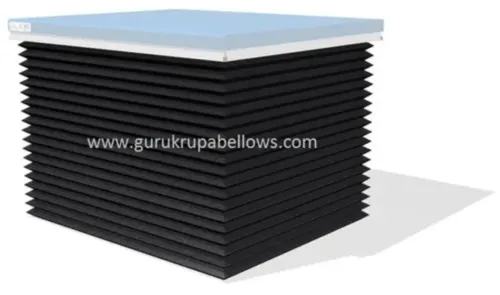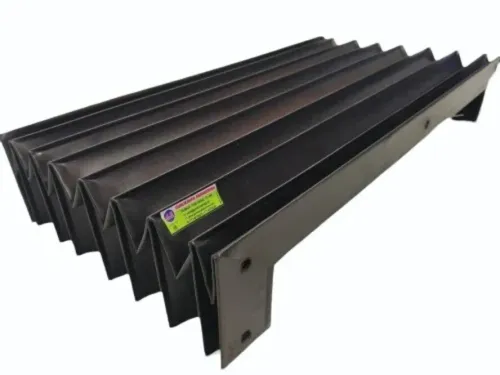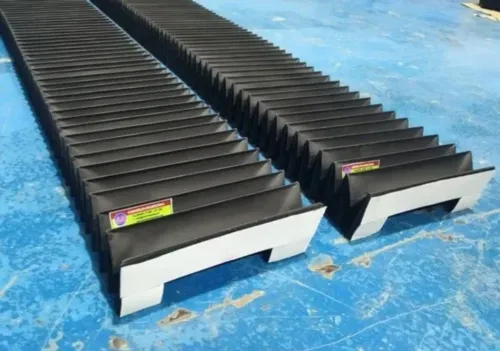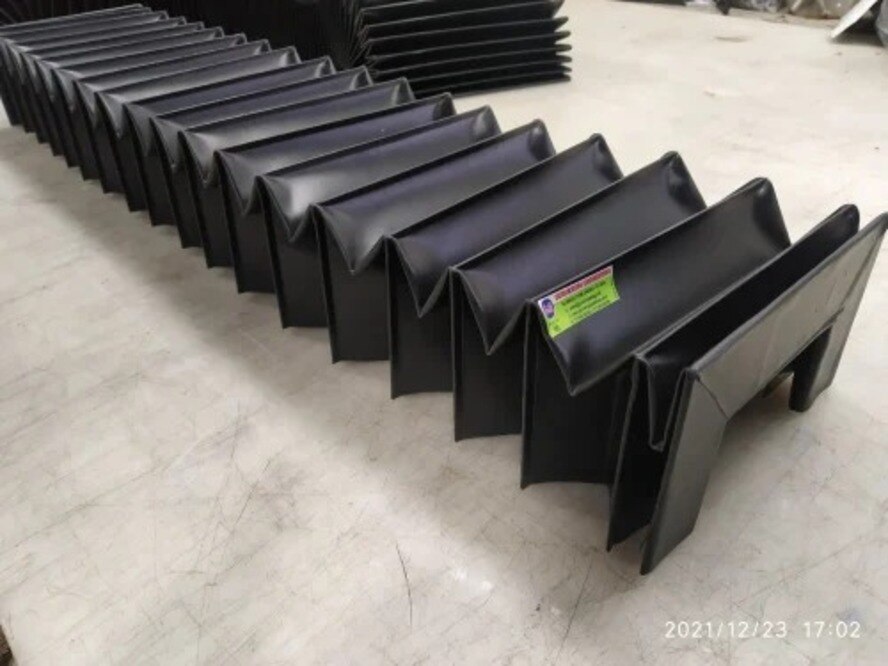
A laser-axis cover must survive more than ordinary chips: sparks, molten dross, abrasive dust, coolant, oil mist and repeated high-speed compression all affect the choice. By the end, you will be able to compare material evidence, select a construction style, measure an existing cover and prepare a fit specification for suppliers in Gurgaon.
Key takeaways
- Match the cover to dross heat, sparks, dust, oils, and cleaning chemicals.
- Request flame, temperature, abrasion, and seam test evidence before approval.
- Measure travel, compressed length, height, width, and mounting holes precisely.
- Compare stitching, coatings, guides, wipers, lead time, and replacement support.
Which material matches the laser-cutting hazard?
Hot metallic spatter is a harsher test than ordinary chips. Select laser machine bellow covers against dross temperature, trapped sparks, abrasive dust, coolant or oil mist, cleaning chemicals, and the axis temperature range—not the fabric name alone.
| Material | Strength under laser-cutting conditions | Main limitation |
|---|---|---|
| Coated polyester, neoprene or nitrile | Flexible; resists abrasion, oil and coolant | Coating can burn, melt or embrittle under sustained flame, concentrated radiation or trapped hot dross |
| Aramid fabric | Tough, lightweight and resistant to abrasion and flame exposure | Needs a suitable coating; fibres alone may absorb smoke, oil and chemicals |
| Glass-fibre fabric | High-temperature capability and good resistance to sparks and hot particles | Less flexible; repeated sharp folds can cause cracking, fraying or puncture |
| Silicone-coated glass fabric | Higher heat capability than ordinary elastomer-coated textile; sheds residue | Silicone can suffer repeated sharp-edge abrasion and puncture without reinforcement or lamellae |
| Polyurethane-coated fabric | Good flexibility, abrasion resistance and chemical resistance | Lower heat and flame tolerance; polyurethane can soften, melt or degrade |
| Metallic lamellae or steel alternatives | Strong protection from dross, impact and abrasion | Heavy, noisy and less flexible; metal can reflect laser energy and conduct heat into mounts |
For laser cutting machine bellow covers, request separate continuous-temperature and short-duration peak limits for the fabric, coating, seams and complete assembled cover. A “fire-retardant” label proves little without a named flame or spark test and wavelength-specific evidence for fibre lasers near 1 micrometre or CO2 lasers near 10.6 micrometres.
Use fabric for fast, compact travel when the beam is shielded. Choose reinforced fabric-metal combinations where hot dross, direct line-of-sight exposure or severe puncture risk dominates.
How should temperature, flame and seam performance be verified?
Require evidence for the complete cover assembly, not a fabric datasheet alone. The report must state continuous operating temperature, short-duration peak temperature, exposure time, and the failure limit: ignition, melting, shrinkage, cracking, delamination, hole formation, or loss of flexibility. Check that these values apply to the coating, fold creases, attachment strips, and seams.
Ask for the named flame test and its result, rather than accepting “fire-retardant”:
- Test method and edition, such as ISO 15025, EN ISO 14116, or ASTM D6413
- Classification, specimen orientation, flame application time, and afterflame or afterglow duration
- Whether the test used the finished laminate or only the base fabric
- Spark, hot-dross, and molten-metal exposure evidence, including the particle temperature, exposure time, and whether perforation or smouldering occurred
- Chemical, oil, coolant, and cleaning-agent exposure results where residue could remain in folds
A flame test does not prove resistance to concentrated laser energy. If laser radiation could reach an operator, treat laser machine bellow covers as one part of the enclosure and request an assessment against the applicable laser safety requirements, including wavelength, accessible emission, seams, joints, and viewing gaps.
Seams need their own proof. Request tensile or peel strength, flex-cycle results at the specified temperature, and inspection criteria after cycling. A sewn seam can abrade or wick contamination; a welded seam can crack after repeated compression. Reject any quotation that gives a temperature rating without test duration, failure criterion, and seam-specific results.
How do you measure a replacement bellow for an exact fit?
Record the axis stroke and the bellows’ actual retracted and extended lengths before ordering. Stroke alone will produce a cover that either bottoms out or pulls its seams apart.
Measure the X, Y or Z axis with the machine at both travel limits, then allow space for the moving attachment, end frames, fold pitch, installation tolerance and controlled reserve at each end.
- Measure usable opening width, folded height and overall cover height, including any side guides or support frames.
- Photograph and sketch each mounting face, noting its orientation, datum edge, hole count, hole diameter, centre-to-centre spacing and fastener type.
- Record the moving mass, travel speed and acceleration; high acceleration requires enough reserve to prevent fold impact.
- Mark the required clearance from the laser head, cable carrier, guideway, sheet-handling equipment and nearby guards.
- Measure lateral offset and parallelism between fixed and moving mounting faces; a cover that rubs during acceleration will fail at its edges.
- Note coolant, oil mist, dry dust, monsoon moisture and cleaning agents present around the axis.
| Measurement | Record | Ordering consequence |
|---|---|---|
| Retracted length | Fully closed length plus end-frame depth | Sets minimum packed size |
| Extended length | Travel limit to travel limit | Sets usable stroke and reserve |
| Width and height | Clear opening, not outside frame size | Prevents rubbing and obstruction |
| Mounting pattern | Face orientation, holes and fasteners | Ensures direct installation |
| Fold geometry | Fold pitch and compressed height | Prevents forced flattening |
For laser machine bellows in Gurgaon, send these figures with photographs and a full-scale mounting sketch. Do not treat the cover as a laser-safety enclosure unless the complete assembly has been assessed for wavelength, seams, joints and accessible emission.
Which construction and cover type suits a fast laser axis?
Choose a low-mass, sealed textile bellows with controlled fold geometry for a fast laser axis. The construction must survive repeated compression, acceleration, hot dross and dust without becoming a drive load.
| Option | Choose it when | Main failure or penalty |
|---|---|---|
| Thermal welding | The coated fabric needs sealed, smooth seams and resistance to dust, oil mist and cleaning fluid | Heat, poor weld settings or fold stress can open the seam |
| Sewn seams | You need flexible sections, repairs or a detachable panel | Needle holes can admit contamination; thread and stitching may burn or abrade |
| Perforated folds | Air pumping and trapped debris are the main concern, and the opening cannot expose a hazard | Dust, sparks or laser energy can pass through; use only with a suitable inner barrier |
| Combination construction | The hot zone needs welded or reinforced panels while access zones need sewn, replaceable sections | Different stiffnesses can create stress concentrations at the joins |
| Rollway or telescopic steel cover | A rigid, impact-heavy enclosure is more important than minimum moving mass | Steel adds inertia, vibration, noise and settling time on a rapid axis |
| Accordion guard or simple equipment cover | The travel is slow and contamination is light | Generic folds can rub, snag, collapse or leave gaps during acceleration |
For laser cutting machine bellow covers, specify retracted height, fold pitch, moving mass and clearance from the head, cable carrier and sheet. Laser machine bellow covers are not automatically laser-safety enclosures; assess seams, joints and accessible emissions separately.
What should a Gurgaon supplier comparison document contain?
A useful supplier comparison document converts your machine’s exposure, movement and installation limits into pass/fail purchase requirements. Do not compare material names alone. Use one row per supplier and require evidence for every claim.
| Supplier evidence | Supplier A | Supplier B |
|---|---|---|
| Material and coating | Record fabric, coating, thickness and fold construction | Record fabric, coating, thickness and fold construction |
| Exposure resistance | State limits for sparks, dross, dust, coolant, oil mist and cleaning agents | State limits for sparks, dross, dust, coolant, oil mist and cleaning agents |
| Temperature and flame evidence | Give continuous and short-duration temperatures, test method, duration and failure criterion | Give continuous and short-duration temperatures, test method, duration and failure criterion |
| Laser exposure | Identify evidence for the machine wavelength, including fibre near 1 micrometre or CO2 near 10.6 micrometres | Identify evidence for the machine wavelength |
| Fit and motion | Confirm stroke, retracted and extended length, folded height, width, speed, acceleration and clearances | Confirm the same dimensions |
| Mounting and service | Show hole pattern, face orientation, moving mass, lead time and replacement conditions | Show the same details |
Your purchase specification for laser machine bellow covers for material comparison in Gurgaon should state the actual dry dust, monsoon moisture, wet abrasive contamination and cleaning chemicals. Require a drawing before approval; a compact fold that retains slurry can fail despite a suitable fabric.
- Attach photographs and measurements of the existing cover, mounting faces and laser-head clearance.
- Reject “fire-retardant” claims without test documents.
- Ask GURUKRUPA BELLOWS PVT LTD, or any competing supplier of laser machine bellows in Gurgaon, to mark material, seams and fold direction on the approved drawing.
Related products
 | Laser Machine Bellows Product Details: Minimum Order Quantity 1 Number Brand GURUKRUPA Color BLACK, SILVER Size ALL Specifications: Capabilities Applied/Processes: Thermal... View product → |
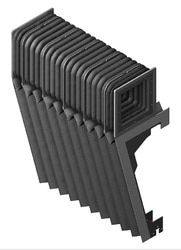 | Laser Cutting Machine Bellows ₹1000 We offer Laser Cutting Machine Bellows made specifically for your laser machine. View product → |
Frequently asked questions
Which material matches a laser-cutting hazard?
Choose the material and coating against the actual exposure: hot dross, trapped sparks, abrasive dust, oil mist, coolant, and cleaning chemicals. Do not select from the fabric name alone; request its temperature, flame, abrasion, and chemical-resistance data.
How should temperature, flame, and seam performance be verified?
Ask for test reports or datasheets stating the temperature range, flame test method, exposure conditions, and result. Check seam construction separately because stitching, adhesive, welded joints, and edge binding can fail before the fabric.
How do you measure a replacement bellow for an exact fit?
Record guideway width, cover height, required travel, compressed and extended lengths, fold height, mounting-hole pattern, flange dimensions, and clearance at full speed. Measure the machine in both end positions and compare the drawing with the installed space.
Which construction and cover type suits a fast laser axis?
Compare folded bellows, guided bellows, slat or apron covers, and hybrid designs against axis speed, acceleration, stroke, debris size, and access for cleaning. A fast axis needs low moving mass, stable guidance, controlled compression, and no interference with the beam path or cable routing.
What should a Gurgaon supplier comparison document contain?
List the supplier's material and coating, temperature and flame evidence, seam design, dimensions, mounting drawing, cycle or speed limits, inspection plan, delivery time, warranty, replacement process, and exclusions. Record the same fields for every laser machine bellow covers quotation so comparisons remain defensible.