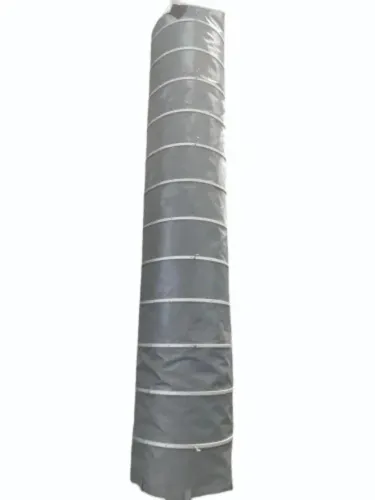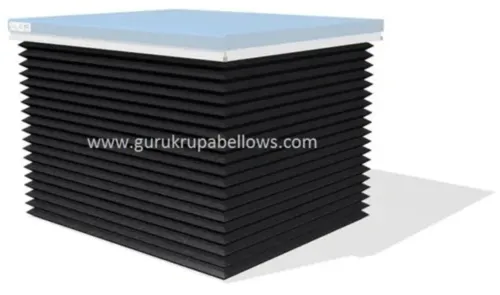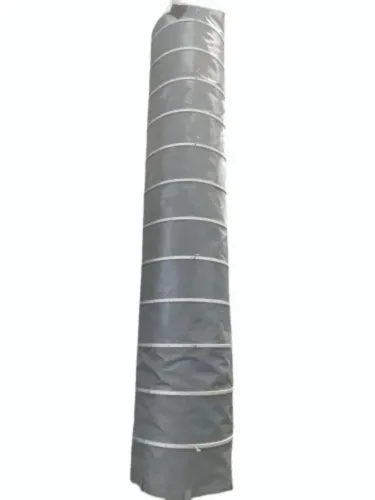

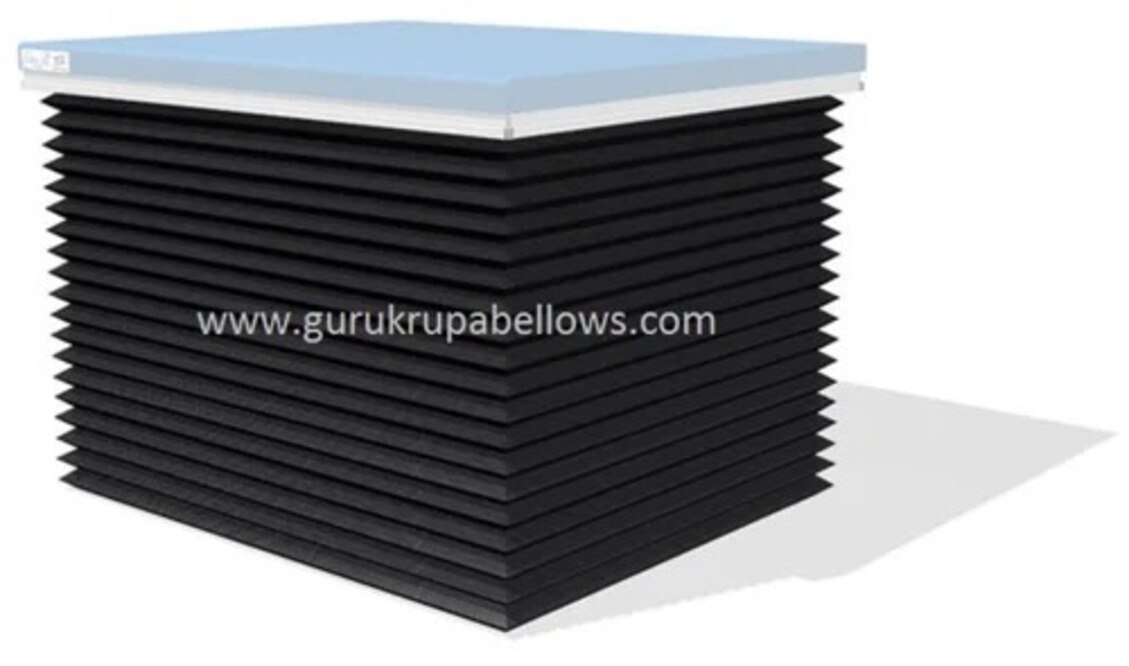
A scissor lift cover must follow the machine’s full folding movement without binding, trapping debris, or creating a new pinch point. By comparing bellows with rigid, sliding, rolling, and safety-guarding options, then checking the motion envelope and operating hazards, you can request a protection system that fits the lift rather than the nominal platform size.
Key takeaways
- Use a flexible bellow when the lift opening follows repeatable folding geometry.
- Choose rigid guarding for heavy impact, crushing loads, or fixed openings.
- Measure stroke, folded length, width, height, and attachment clearance before ordering.
- Match fabric, coatings, seams, and guides to chips, heat, oil, and coolant.
Which protection concept fits the lift mechanism?
Choose the protection concept by asking whether the opening changes shape as the scissor arms fold. A flexible bellow follows guided, repeatable geometry; a rigid guard suits a fixed opening where chips, impact, or a heavy load above the cover would crush fabric.
| Option | Movement handled | Best fit | Main limitation |
|---|---|---|---|
| Accordion bellow | Folding vertical travel | Clean, guided scissor motion | Folds can trap debris or interfere with arms |
| Telescopic steel cover | Straight extension and retraction | Fixed openings exposed to chips or impact | Needs accurate guides and installation space |
| Sliding or roller cover | Linear travel across an opening | Compact protection for a stable aperture | Does not follow changing geometry |
| Rigid guard or flexible skirt | Fixed barrier or broad perimeter gap | Personnel exclusion or splash control | May restrict access, travel, or visibility |
For scissor lift bellow covers for comparison in pune, inspect the complete folded and extended envelope, not only the lift height. The cover is not structural: the platform, scissor mechanism, and safety guarding must carry loads independently. Use flexible or guided mounts that do not pull fabric into the mechanism.
Before choosing a bellow, check these failure points:
- Folds, clamps, rails, and mounting edges can create new pinch points.
- Lateral arm movement can snag or tear a cover designed only for vertical travel.
- Hot slag, sharp chips, or a falling load favour steel slats or a rigid guard.
- A cover must not serve as a fall-arrest surface or personnel barrier unless separately engineered and tested.
Which operating conditions control the specification?
The complete motion envelope—not platform size—controls the specification. Record closed length, maximum extended length, compressed height, lateral offset, minimum bend radius, and mounting dimensions; a cover sized only to nominal width can restrict travel or fold into a pinch point.
| Condition | What to specify | Suitable protection response |
|---|---|---|
| Stroke and collapsed height | Full raised-to-lowered travel, fold compression, and clearance at every crossing | Accordion or scissor-lift bellows for changing openings; rigid guards for fixed openings |
| Speed and cycle frequency | Extension speed, cycles per hour, tested cycle life, fold geometry, seams, and attachments | Choose proven fold-fatigue life, not tensile strength alone |
| Movement and vibration | Lateral offset, platform sway, vibration, and minimum bend radius | Flexible bellows with controlled movement; sliding or rolling covers for guided travel |
| Contamination | Coolant, oil, abrasive dust, chips, sparks, and outdoor weather | Coated fabric for dust and coolant; steel slats or chip shields for sharp, hot debris |
| Temperature | Continuous and peak surface temperature, including welding heat | Silicone-coated fabric for higher heat; reject materials that soften or crack |
| Parts requiring protection | Scissor crossings, cylinders, screws, guideways, cables, and hoses | Guard the mechanism separately from cable management; an energy chain guides lines but is not a physical guard |
For scissor lift bellows in Pune, require material limits, contamination assumptions, inspection access, and a dimensioned drawing before purchase. Keep cables and hoses outside pinch zones, with strain relief and spare length through the complete stroke. Test every fold, clamp, and mounting edge during a full raise-and-lower cycle.
How do you measure and size a cover before ordering?
Measure the complete moving envelope, not the platform size or nominal lift stroke. Before ordering scissor lift machine covers in Pune, record the dimensions, clearances, and motion limits that the cover will experience at every point of the raise and lower cycle.
1. Measure the lift fully lowered and fully raised. Record closed length, maximum extended length, compressed height, platform clearance, cover width, cylinder or screw diameter, mounting-face dimensions, and the required number of folds.
2. Trace the motion envelope. Note travel direction, lateral offset, tilt, vibration, speed, and cycle frequency. Mark the nearest scissor arms, crossing points, guide rails, sensors, hydraulic lines, fittings, and platform underside.
3. Check the folded package in the smallest available space. Include the bellows’ compressed stack, mounting frames, clamps, guides, and minimum bend radius. Leave clearance so folds do not collide with the mechanism or trap debris.
4. Specify the cover’s usable stroke separately from its maximum stretch. Excessive extension pulls seams and mountings; insufficient compression reduces platform travel. State the required access opening for inspection, lubrication, and cleaning.
5. Ask for a dimensioned drawing showing open and closed positions, fold count, mounting points, lateral clearances, and interference zones. Review a full-scale motion envelope or CAD model, then trial-fit the cover through complete cycles.
Inspect every fold, rail, clamp, and mounting edge for new pinch points. The cover is not load-bearing or fall protection; the scissor structure and guarding must carry those duties independently.
Which materials and constructions survive the working environment?
PVC-, polyurethane-, or silicone-coated fabric is the right starting point for clean-to-moderately contaminated lifts; sharp chips, trapped debris, or hot slag demand metal protection. Compare the options against the actual coolant, oil, detergent, temperature, impact, and cleaning method, not a generic “coolant-resistant” label.
| Option | Chemical exposure | Abrasion, heat and puncture | Access, visibility and airflow | Cleaning and tested cycle life |
|---|---|---|---|---|
| Coated fabric | PVC suits general coolant; polyurethane handles tougher flex and abrasion; silicone handles higher heat | Light-to-moderate abrasion; poor against sharp chips unless shielded | Opaque; seals well but restricts airflow and access | Wipe or wash carefully; require fold-fatigue cycles with contamination stated |
| Reinforced bellows | Select coating for the named chemicals; verify seam and adhesive compatibility | Frames, slats, and deflectors resist pleat collapse and puncture | Opaque; protects moving gaps while preserving guided motion | Inspect pleats and seams; demand tested cycles, geometry, and attachment details |
| Steel slats | Good against oils and coolant; check corrosion resistance | Best for sharp chips, impact, and higher heat | Limited visibility; slats reduce airflow and access | Chips wash off; require cycle testing for hinges, guides, and seals |
| Rigid guards | Material-specific chemical resistance | Highest impact resistance; heat choice depends on metal or polymer | Best visibility if transparent panels are used; airflow requires openings | Easy to brush or wash; life depends on hinges, mounts, and impact tests |
| Flexible skirts | Choose rubber or coated fabric for the chemicals | Handles splash and dust, not concentrated sharp impacts or hot slag | Good access and airflow; visibility remains open | Simple to replace; verify tear resistance and tested flex cycles |
A folding textile can survive millions of clean cycles yet fail after chips lodge in its pleats. Specify pleat orientation, support frames, chip deflectors, cleaning access, and a defined replacement method. Ask for test results that include the lift’s stroke, speed, cycle rate, and contamination.
When is a bellow the wrong choice, and how should you verify the supplier?
A bellow is the wrong choice when it can snag on the scissor arms, receive direct impact, or follow lateral movement beyond its guided range. Hot slag can burn fabric, while chips and dropped tools can puncture it. Never use the cover as a load-bearing part, fall-protection device, or substitute for guarding a pinch point.
- Reject a fabric bellow if the mechanism has large lateral movement, uncontrolled vibration, or repeated impact. Compare a telescopic steel cover, sliding plate, roller shutter, flexible skirt, or fixed safety guard.
- Check every fold, clamp, rail, and mounting edge for finger and clothing traps during closing. Keep the platform, scissor mechanism, and guard capable of carrying mechanical loads independently.
- For industrial lift bellow covers in Pune, require a dimensioned drawing showing closed length, extended length, compressed height, width, folds, bend radius, lateral offset, mounting faces, clearances, and inspection or lubrication access.
- Obtain written material limits for temperature, hot slag, oil, coolant, chemicals, abrasion, puncture, and cleaning. Ask for cycle-life evidence and the spare-part lead time.
- Trial the installed cover through the complete raise-and-lower cycle at operating speed. Check compressed-stack interference with arms, rails, sensors, cylinders, and the platform underside before acceptance.
GURUKRUPA BELLOWS PVT LTD should be compared on local measurement and replacement capability, but Pune location never replaces a full-scale fit test or CAD motion-envelope review. Reject any proposal based only on nominal platform size or extended height.
Related products
 | Bellow Cover ₹5000 Product Details: Brand GURUKRUPA Color Black-Blue Size Customised With the support of our excellent team workers, we have been delivering the best... View product → |
 | Product Details: Brand GURUKRUPA Color Black-Blue Size Customised With support of our excellent team workers, we have been delivering the best... View product → |
Frequently asked questions
Which protection concept fits a scissor lift mechanism?
Use a guided flexible bellow when the opening changes shape as the scissor arms fold. Choose a rigid guard when the opening stays fixed or the cover faces crushing loads, heavy chips, or impact.
Which operating conditions control a scissor lift cover specification?
Specify the cover around stroke, cycle speed, temperature, chips, coolant, oil, sparks, abrasion, and the available space for folded material and guides.
How do you measure a scissor lift bellow before ordering?
Record the fully open and closed positions, opening width and height, required stroke, folded length, mounting edges, guide paths, clearance, and attachment details. Include photographs and a dimensioned drawing.
When is a bellow the wrong choice?
A bellow is the wrong choice when a rigid guard can better resist impact, crushing, sharp scrap, or a load placed over the opening. Verify the supplier's drawings, material data, cycle requirements, seam construction, and test evidence before approval.