
Chips, abrasive dust, coolant, oil and repeated movement can shorten the life of screws, rods, guideways and spindle-related shafts. By the end, you will be able to match a round bellows cover to the machine motion, contamination level, materials, dimensions and maintenance access the job actually requires.
Key takeaways
- Use round bellows to shield moving rods and screws from chips, dust, coolant and oil.
- Allow the cover’s compressed length, extended length and stroke to match machine travel.
- Choose coated fabric and construction for the actual coolant, oil, temperature and abrasion exposure.
- Switch to telescopic steel covers when heavy chips, hot swarf or impact exceeds bellows limits.
Which machine-tool problems does a round bellows cover address?
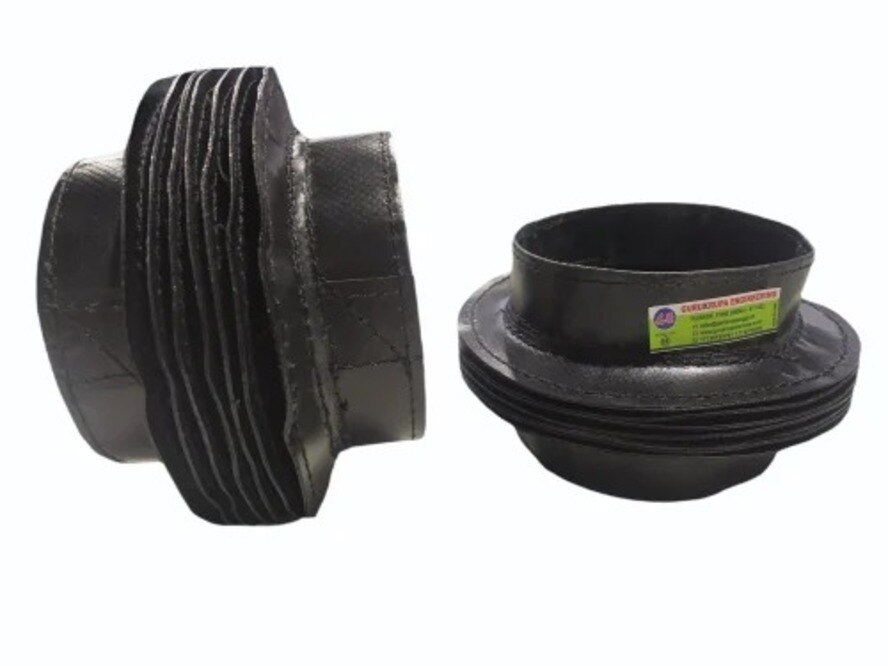
A round bellows cover solves contamination problems around cylindrical moving parts. Its folds extend and compress along ball screws, lead screws, guide rods, hydraulic rods, linear actuators and spindle-related shafts, blocking abrasive chips, dust, swarf, coolant splash, oil and machining residue.
If you are asking what problems do round bellow covers for solve, the main answer is wear reduction.
Contamination can grind into a lubrication film, damage rolling races, cut seals, corrode shafts and increase friction; the cover also limits repeated contact between loose debris and moving machine parts on CNC lathes, machining centres, turning machines and similar equipment.
| Protection method | Main problem addressed | Important limit |
|---|---|---|
| Round bellows | Axial contamination around a cylindrical screw, rod or shaft | Not a pressure seal or personnel guard |
| Telescopic steel cover | Heavy, sharp or hot swarf striking a moving area | Requires space and rigid mounting |
| Rubber boot or shaft wiper | Local sealing or residue removal at a shaft | Does not provide long flexible travel |
| Rectangular bellows | Debris protection over broad flat guideways | Poor fit around a single round member |
A round cover does not replace lubrication, shaft wipers, drainage or inspection. Chips can lodge between folds, and coolant can pool around the shaft without a drainage path. Fabric or elastomeric folds and their end attachments can also leak air or liquid.
Treat the cover as a contamination barrier, not a pressure-rated enclosure. If an operator can reach the shaft or a pinch point, add guarding, interlocking or other risk controls.
Where do round bellows work, and how must they move?
Round bellow cover applications suit cylindrical members that move mainly along their axis. CNC lathes and turning machines use them around lead screws, ball screws, hydraulic rods and spindle-related shafts; machining centres use them around actuators or cylindrical guides where a flat bellows would consume too much lateral space.
| Application | Suitable motion | Main trouble to check |
|---|---|---|
| CNC lathe or turning machine | Axial reciprocation | Shaft alignment, chips and coolant splash |
| Machining centre | Axial actuator or guide movement | Limited clearance and fold compression |
| Grinding machine | Controlled axial movement | Abrasive dust, sparks and hot debris |
| Rotating shaft | Only with a rotation-rated design | Torsion, friction and centrifugal force |
The cover must match the actual stroke, speed, acceleration, cycle frequency and movement direction. A correct nominal stroke does not prevent failure: non-concentric mounting, side loading or lateral movement can make folds rub, twist or collapse.
Check the complete motion cycle for:
- Compression and extension without bottoming out or exposing the shaft
- Stable accordion folding during vibration and repeated cycling
- Clearance from tooling, guards, cables, chips and adjacent machine parts
- Fold contact when the cover reaches its shortest length
Continuous rotation requires a design that explicitly manages torsion, friction and centrifugal effects. An ordinary axial bellows can wind up, rub against the shaft or fail when used as a rotary seal. Grinding machines need extra scrutiny because hot debris can attack soft folds even when the movement is purely axial.
How do materials determine performance against coolant, oil and heat?
A round machine bellow cover performs according to its construction and environment, not its shape alone. Give the supplier the exact exposure: water-soluble coolant and concentration, neat cutting oil, lubricant, alkaline cleaner, washdown chemical or outdoor moisture. Coated fabric, elastomer, reinforcement, stitching and adhesive can react differently to each fluid.
Request compatibility evidence for those named fluids, not a generic “heat-resistant” claim. Ask for a numeric operating-temperature range and the test conditions behind it. Radiant heat, hot chips and heated coolant impose different loads; grinding sparks or hot swarf can require a heat shield or another bellows construction.
Specify these checks before approval:
- Confirm reinforcement and an abrasion-resistant outer coating when chips repeatedly strike the folds.
- Check for sharp or stringy swarf that can cut fabric, wedge into folds or abrade the coating.
- Verify that end rings, clamps, stitching and adhesives tolerate the same chemicals and temperature as the bellows body.
- Ask whether the construction suits outdoor exposure, how it is cleaned and whether fold geometry traps coolant.
- Treat heated coolant differently from radiant heat; a hot liquid can attack the material throughout each fold.
- Reject any claim of pressure sealing or flame containment unless the supplier provides a construction specification and test data for that duty.
A cover that survives coolant can still fail under grinding sparks, trapped chips or incompatible adhesive. Specification must cover every exposed component, not just the bellows fabric.
When should you choose another protection method?
Choose another protection method when the machine’s motion or exposure exceeds what a flexible axial cover can handle. A telescopic steel cover is the stronger choice when heavy, sharp or hot swarf needs a rigid deflector, or when the guard must carry no load but withstand direct chip impact.
| Option | What it protects against | When it applies |
|---|---|---|
| Telescopic steel cover | Direct impact from heavy, sharp or hot chips | Rigid deflection matters more than flexible travel |
| Spiral guard or conduit | Abrasion and entanglement around cables or hoses | Routing moves with a cable or hose, not a cylindrical reciprocating shaft |
| Rubber boot or shaft seal | Leakage, pressure and surface sealing | You need a compact interface with a defined sealing lip |
| Wiper | Residue at the shaft surface | Surface wiping matters more than enclosed flexible travel |
| Rectangular bellows | Contamination across broad flat areas | The machine has wide guideways or large flat moving sections |
Reconsider a round machine bellow cover for high-speed rotation, severe hot-chip exposure, flame contact, large lateral movement, strong torsion or any duty requiring a rigid load-bearing guard. An ordinary axial bellows can wind up, rub or collapse under those loads.
Before choosing, confirm that:
- Tooling and nearby guards leave installation clearance.
- End attachments do not create an ingress gap.
- The cover can be removed for lubrication and inspection.
- Its motion, contamination, heat, rigidity and access requirements match the actual duty.
The quotation’s search term is not a specification.
What dimensions and purchasing details produce a workable fit?
Measure the protected member before requesting a round bellow cover for machine tools. Record inside diameter, outside diameter, extended length, compressed length and total stroke; shaft diameter alone is not enough. Too little compressed length bottoms out the folds, while too little extension leaves the screw or rod exposed.
Send the supplier this checklist:
- Mounting flange or end ring, bolt pattern, fastener clearance and available envelope
- Minimum bend radius, movement direction, concentricity at both ends and clearance from nearby parts
- Speed, acceleration, cycle frequency, vibration, lateral movement and any rotation
- Dry dust, abrasive swarf, flood coolant, minimum-quantity lubrication, grinding debris or washdown exposure
- Material compatibility, numeric temperature limits, cleaning instructions, drainage provisions and lubrication access
- Clamp, flange and fastener details that prevent swarf snagging
Compare the proposed drawing with the measured envelope before approval.
| Item | What to compare | Failure if overlooked |
|---|---|---|
| Stroke | Extended length minus compressed length versus actual travel | Exposed shaft or crushed folds |
| Diameter | Inside and outside diameters versus member and surrounding envelope | Rubbing, obstruction or trapped debris |
| Mounting | Flange, end ring, bolt pattern and concentricity | Twisting, leakage or uneven wear |
| Motion | Axial travel, lateral movement and rotation | Collapse, torsion or premature failure |
For round bellow covers in Pune, provide this operating data rather than asking for an unspecified “round cover.” GURUKRUPA BELLOWS PVT LTD can be included in that supplier comparison when its drawing and construction are checked against your measurements.
Related product
 | Round Bellow Covers ₹1000 To match with our reputation in the market, we are here to present an unparalleled assortment of Round Bellow Covers. View product → |
Frequently asked questions
Which machine-tool problems does a round bellows cover address?
It shields cylindrical moving parts such as ball screws, lead screws, guide rods, hydraulic rods and linear actuators from abrasive chips, dust, swarf, coolant splash, oil and machining residue. This reduces contamination-related wear and helps preserve lubrication and motion accuracy.
Where do round bellows work, and how must they move?
Use them where a cylindrical part moves axially and the cover can extend and compress without rubbing against nearby components. Specify the protected diameter, stroke, compressed length, extended length, mounting method and clearance around the folds.
How do materials determine performance against coolant, oil and heat?
Select the bellows fabric, coating, thread, fastening method and end collars for the exposure. Confirm resistance to the actual coolant or oil, operating temperature, chip abrasion and cleaning chemicals instead of choosing material by appearance alone.
When should you choose another protection method?
Choose telescopic steel covers for heavy hot chips, impact and severe swarf loads. Use a different design when the machine needs high-speed movement, tight bending, an unusually long unsupported span or protection from direct flame.
What dimensions and purchasing details produce a workable fit?
Provide the moving-part diameter, required internal clearance, stroke, compressed and extended lengths, fold height, end shape, mounting-hole pattern, travel speed, orientation and exposure conditions. Include drawings, photos and the machine model when available.