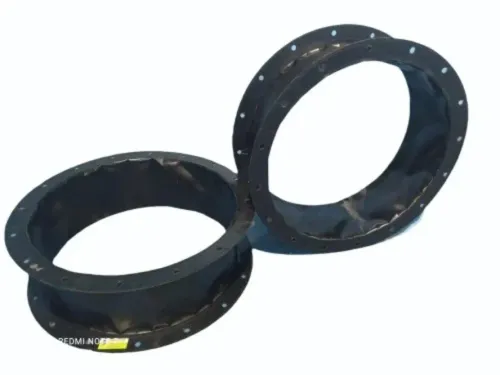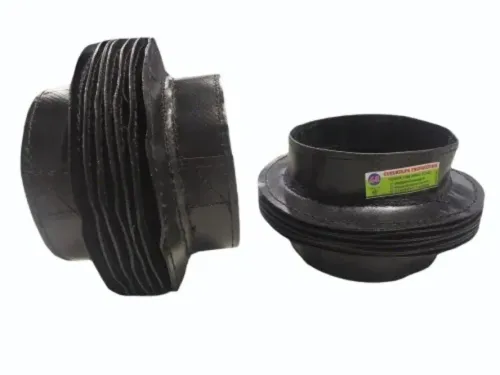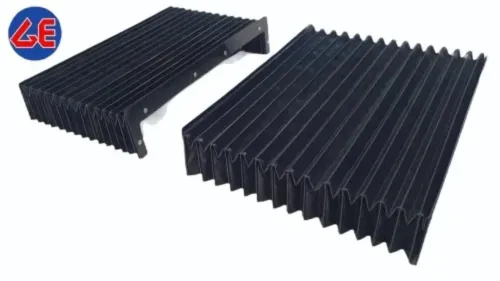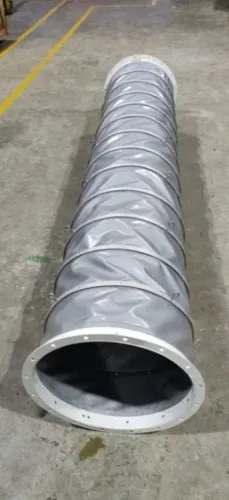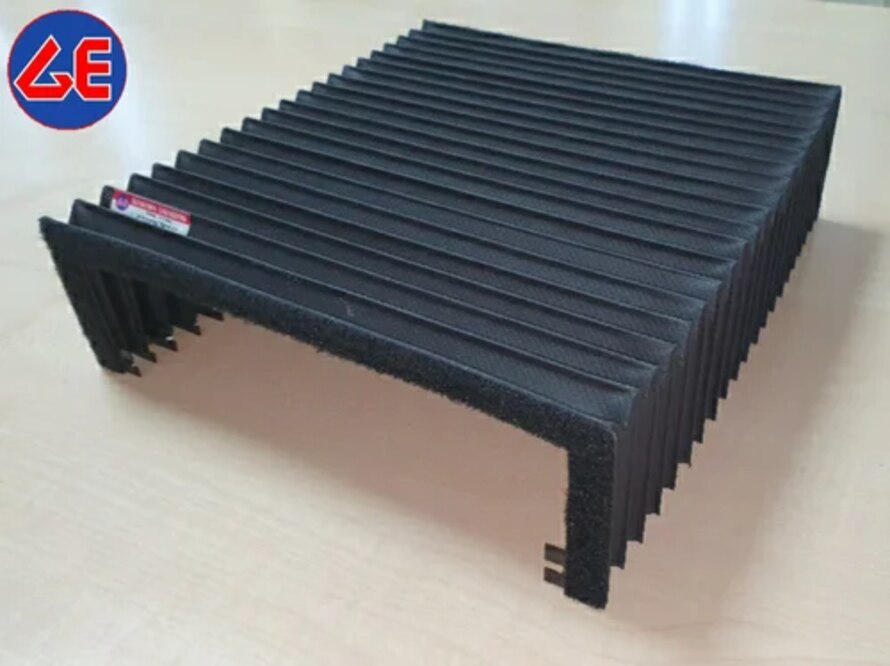
The names usually describe the same pleated machine-protection design, so the label alone will not tell you which cover will survive your axis, coolant, chips, or available space. By comparing fold geometry, construction, support, exposure, and measured machine clearances, you can choose the right design and write a specification that fits the real motion envelope.
Key takeaways
- Treat concertina and accordion as interchangeable supplier terms unless geometry is specified.
- Compare compressed length, extended length, fold height, and lateral clearance.
- Choose fabric, coating, reinforcement, and seals from the actual machine hazard.
- Give suppliers travel, mounting dimensions, speed, and interference limits for custom bellows.
Concertina and Accordion Usually Mean the Same Pleated Cover
Usually, concertina bellow covers and accordion bellow covers are different names for the same pleated, expanding-and-contracting machine cover. Suppliers do not use either term under a universal dimensional or performance standard, so the name alone cannot confirm travel, sealing, or durability.
In an accordion bellow cover comparison, check these specifications instead:
| Feature | Compare | Why it matters |
|---|---|---|
| Construction | Sewn, glued, heat-sealed, coated, molded, or internally framed | Seams and needle holes can leak flood coolant; sealed or molded construction suits liquid exclusion better |
| Movement | Extended length, compressed length, travel, fold pitch, speed, acceleration | A cover can reach the stated travel yet bind, stretch, or sag when its packing length is wrong |
| Installation | Width, height, mounting method, orientation, clearance, permitted sag | Tight spaces and unsupported runs expose poor fit during reversals |
| Protection | Chip impact, abrasion, coolant, oil, heat, cleaning chemicals | Fabric selection must match the hazard, not the supplier’s label |
| Service life | Cycle rate, moving mass, stiffness, wipers, reinforced corners | Extra reinforcement can improve durability while increasing friction, packing length, and cost |
A pleated fabric cover is lighter and more adaptable than a telescopic steel way cover, but large sharp chips can puncture it. Add slats, armour strips, an impact shield, or a separate steel cover when direct impact is expected. Compare the construction drawing and operating limits, not “concertina” against “accordion.”
Compare Fold Geometry, Packing Space, and Movement
Fold geometry determines how far the cover packs, how freely it moves, and how much installation space it needs. The collapsed length is controlled by fold pitch, fold count, and the minimum permitted fold radius; extended length is the collapsed package plus travel.
Compress folds too tightly and they rub, crease, or trap coolant and chips.
| Design choice | Effect on movement and protection | Choose it when |
|---|---|---|
| Tight pitch and many folds | Shorter movement per fold, compact packing, lower stiffness, and more rubbing points | Installation length is restricted and the axis has moderate speed and load |
| Wider pitch and fewer folds | Longer collapsed package, greater fold stiffness, lower rubbing risk, and better shape retention | The cover needs rigidity, frequent cycling, or a long unsupported span |
| Thick material, frames, wipers, or reinforced corners | Higher resistance to coolant, swarf, impact, and edge wear, but greater mass, friction, and compressed length | Protection and service life outweigh the smallest package |
In an accordion bellow cover comparison, maximum travel alone hides the real constraint. Check the available installation length at full compression, the open length at full extension, moving mass, acceleration, cycle rate, and permitted sag before choosing.
Concertina machine bellows suit irregular openings and offsets, but direct impact from large sharp chips can shorten service life. Add an impact shield, slats, or armour strips where needed; simply selecting heavier fabric can make the cover bind or overload its support. A compact design is not automatically the longest-lasting one.
Match Construction and Protection to the Hazard
Choose the construction from the hazard, not from whether the supplier calls the product a concertina or accordion cover. A useful accordion bellow cover comparison starts with seam integrity, material compatibility, abrasion resistance, and temperature.
| Construction | Best match | Main limitation |
|---|---|---|
| Stitched | Dry dust, light chips, and swarf deflection | Needle holes and fabric edges can leak coolant, water, and oil |
| Glued | Enclosed dust and low-pressure splash protection | Adhesive joints can soften, peel, or crack under heat, solvents, and repeated folding |
| Heat-sealed | Flood coolant, water spray, and sealed fluid exclusion | Thermoplastic seams and fabric can deform under excessive heat or hot spatter |
| Sewn-and-coated | Oil mist, coolant, abrasive dust, and moderate chip exposure | The coating must resist the specific oil or chemical; stitching remains a potential leak path |
| Bonded, molded, or vulcanized | Chemical splash, oil, coolant, and demanding repeated flexing | Material selection controls resistance, and replacement or repair can be less straightforward |
A sewn concertina machine bellows suits chip deflection when leakage is not the failure you are preventing. Specify a welded, coated, molded, or sealed design when fluid must stay out; otherwise coolant can travel through needle holes and porous edges.
Large sharp swarf and hot spatter can cut or burn fabric. Add sacrificial wear strips, internal liners, slats, or a separate impact shield instead of assuming thicker fabric solves the problem. For cleaning chemicals, provide the exact chemical name and concentration, because compatibility varies between polyurethane, PVC, rubber, and adhesive systems.
Design the Support for CNC Axes and Moving Components
An unsupported horizontal bellows will sag between folds, drag on the bed, and increase drive load before the fabric reaches its travel limit. Design the support around the moving envelope, not the nominal opening.
- Use guide frames or support strips when the bellows spans a long horizontal guideway, linear rail, or slide.
- Add slide rails or rollers when contact with the machine bed would create friction, abrasion, or chip buildup.
- Attach the bellows to the moving member when that arrangement keeps the folds aligned and prevents a loose span from sweeping across the axis.
- Support vertical runs so the folded stack does not pull on its mounting ends or buckle against a cylinder, ballscrew, spindle, or guide column.
Keep every fold clear of clamps, lubrication lines, fittings, chip conveyors, guards, and adjacent covers throughout the full programmed stroke. A fold that contacts a stationary guard can pinch, tear, or bind even when the stated travel is correct.
Acceleration can also pull a poorly secured mounting frame away from the machine and expose a gap.
A concertina machine bellows protects a screw assembly or guideway; it is not an energy chain. Route cables and hoses in a dedicated carrier that controls bend radius, separation, torsion, and dynamic minimum radius. Provide separate cut-outs or flexible seals for sensors and lubrication lines rather than letting them deform the pleats.
Check the collapsed stack, fold radius, support spacing, and maximum speed together. Excessive compression causes rubbing and trapped coolant, while insufficient support limits practical travel and speed. Custom folds help with offsets and non-rectangular openings, but nonstandard hardware increases replacement lead time.
Specify and Measure Custom Concertina Bellows Correctly
Specify the cover in both positions, not by overall size alone. A set of concertina bellow covers with the correct width can still bind if its compressed length, fold pitch, or mounting gap is wrong.
- Measure open length, compressed length, and required travel; state whether the travel is centred or moves from one fixed end.
- Record the protected opening’s width and height at several points, including any taper, offset, radius, or changing cross-section.
- Give the fold pitch, fold count, and maximum permitted packed height so the cover does not bottom out.
- Draw every cut-out for lubrication points, sensors, clamps, cables, hoses, screws, and drive components.
- Specify mounting-end dimensions, flange thickness, hole centres, bolt pattern, clamp type, and whether the frame is fixed or moving.
- State orientation, travel direction, cycle rate, maximum speed, acceleration, operating temperature, coolant or oil exposure, and permitted sag.
Measure clearance around the moving cover throughout its stroke. Leave room for fold expansion, cable movement, guide rollers, and access to fasteners; a static measurement often misses a collision at full compression. State the smallest clearance, not an estimated average.
Send photographs with a ruler, a marked-up drawing, and the failed cover’s dimensions to GURUKRUPA BELLOWS PVT LTD, then request a dimensional drawing before manufacture. Confirm the replacement’s mounting face, sealed gaps, and end-of-travel position on the drawing.
When direct chip impact exists, record the need for shields or slats rather than assuming thicker fabric solves it.
Related products
 | Accordion Bellow Cover Ours is a trustworthy name in the business that brings forth Accordion Bellow Cover that is used for delivering controlled pressurized air to a... View product → |
 | Soft Material Bellow Product Details: Brand GURUKRUPA Specifications:- Function of accordion machine shield: water-proof,oil-proof, anti-corrosion, fire-proof... View product → |
Frequently asked questions
Are concertina and accordion bellow covers different products?
Usually, no. Suppliers commonly use both names for pleated covers that expand and contract. Confirm the geometry, materials, travel, sealing, and mounting details rather than relying on the name.
What dimensions matter when comparing concertina machine bellows?
Compare the compressed length, extended length, fold height, outside dimensions, guideway clearance, mounting dimensions, and allowable movement.
How do you match a bellow cover to a machine hazard?
Specify construction for the hazard: fabric and coating for dust, coolant, heat, chips, sparks, corrosion, or fire exposure. Add scrapers, seals, reinforcement, or shields when the application requires them.
What information does a supplier need for custom concertina bellows?
Provide travel, compressed and extended lengths, fold geometry, mounting details, operating speed, acceleration, temperature, contaminants, clearance limits, and the movement path.